Family Tyrannidae
Ochraceous Pewee
Contopus ochraceus
In Spanish: Pibí Ocráceo (Tontillo)
- Resident
- Regional endemic
A rare, crested pewee that watches from the tops of highland oaks.
The Ochraceous Pewee is a fairly large, crested flycatcher of Costa Rica's high oak forest. It is endemic to southern Central America, in the highlands of Costa Rica and the far west of Panama, where it is very rare. Here it is a resident, uncommon to rare and localized.
On a trip we build, visitors usually meet it on the highland route over Cerro de la Muerte to the Savegre Valley and San Gerardo de Dota, often on the same days as quetzal watching. Guides treat it as a hard target, so it rewards patience and a good look up into the oak tops.
Below: how to know it, how to tell it from the Tufted Flycatcher, and the places in Costa Rica where it has been found.
How to find it
Scan the tops of tall highland oaks, on exposed branches and stumps with a wide view, where it perches and flies out after insects. Watch for the tail shiver on its return. Listen for the thin, high whistled song while checking forest edges, streamsides and tree-fall gaps. One tour company says it knows only a handful of sites to try, and one roadside site on the way to Savegre is marked as kilometer 71. Tours also include the waterfalls road at Savegre, looking for Dark and Ochraceous Pewees, Yellowish Flycatcher and Black-faced Solitaire. One group found it by chance walking up the hill at a quetzal-watching spot near Cerro de la Muerte, and another saw it near La Esperanza in the Talamanca mountains while waiting for a Resplendent Quetzal, led there by a local guide.
How to recognise it
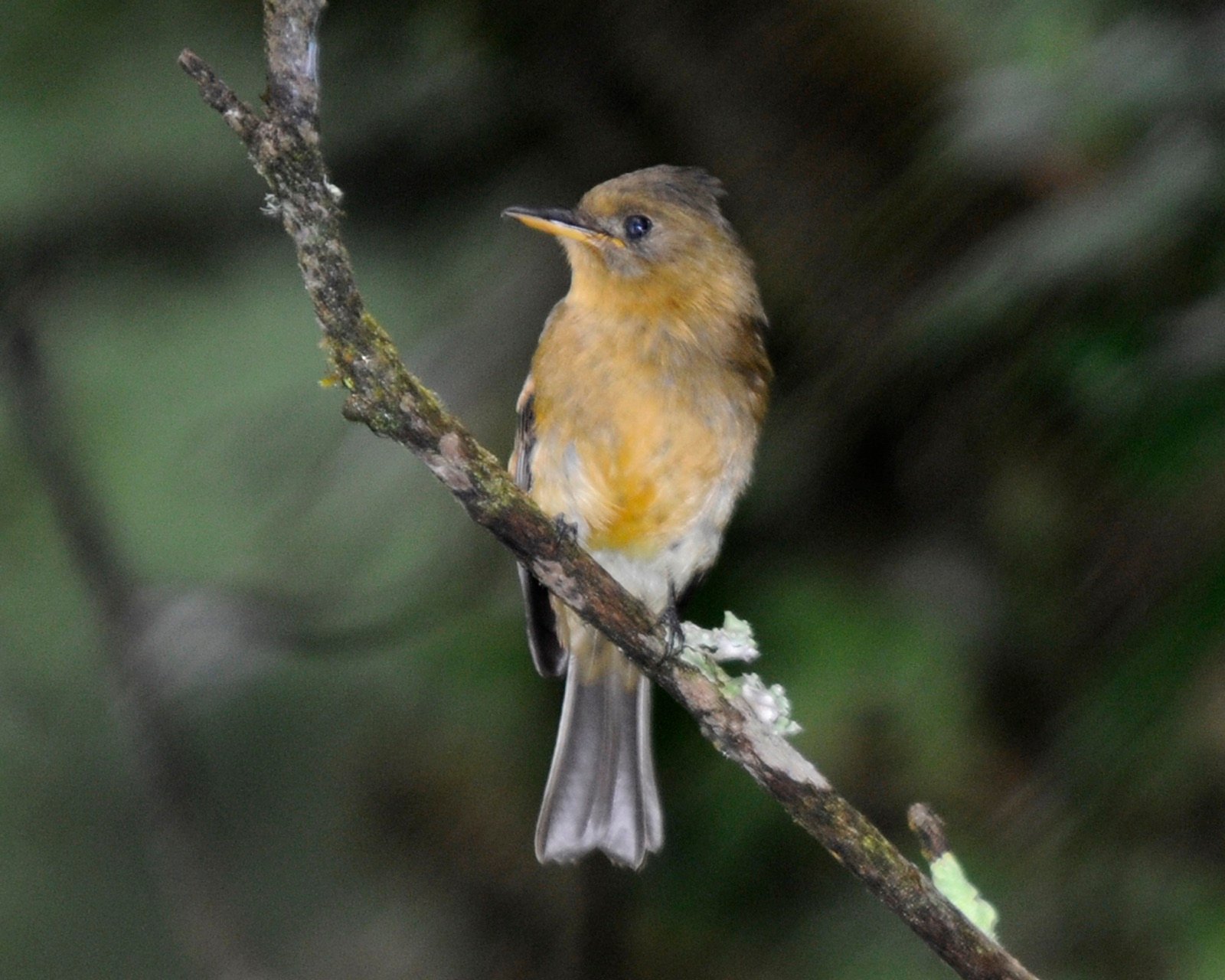
This is a fairly large, crested pewee, about 16.5 to 18 cm long and about 23 g. The brownish crest, the ochre wash on the breast and the ochre wing bars together set it apart from other pewees and tyrant flycatchers.
Look for these marks:
- Olive upperparts with a darker brown crown and a visible crest
- Blackish wings with two pale bars
- A wide bill, black above and orange-yellow below
- A buffy yellow belly
- Black legs and a slightly notched tail
Worn plumage looks paler and duller, but some ochre tint on the breast always remains. Young birds look like adults but have brighter ochre wing bars.
Behaviour and diet
In Costa Rica it is described as a solitary bird. It perches upright high in a tree or on an edge tree and sallies out on long flights from exposed stumps and branches with a clear view. It usually returns to the same perch and shivers its tail on landing.
It sometimes joins mixed-species feeding flocks as they pass through its territory. The nest is a mossy open cup set saddle-like on a slender limb high at the forest edge, and breeding is recorded in March.
Where it lives
In Costa Rica it is mainly found between about 2,200 and 3,000 m, in gaps in the canopy of montane oak forest, along streams and in clearings. Across its range it also uses mature second growth and favors forest edges and gaps left by fallen trees. The wider span for the whole species is 1,200 to 3,000 m.
It occupies two highland areas: the Irazú and Turrialba volcanoes in Cartago, and the Cordillera de Talamanca from Cartago and central San José eastward toward Panama.
When to see it
A Costa Rican source says it may move up and down the mountains during the year, while another calls it a year-round resident; neither gives months. One late April tour report describes seeing it soon after daybreak along Cerro de la Muerte, a single trip record rather than a seasonal pattern.
Similar birds
The Tufted Flycatcher is the look-alike to check. The Ochraceous Pewee is much larger and has an ochre breast, while the Tufted Flycatcher has a bigger crest and a tawny breast. Birders comparing photos from Savegre noted that a pewee shows a larger bill, a different underpart pattern and an all-dark head, face and nape. At San Gerardo de Dota, Dark Pewee and Tufted Flycatcher are both listed as common and likely to be seen near this pewee, which is listed there as uncommon.
Names and lore in Costa Rica
The Spanish name on the Costa Rican list is Pibí Ocráceo, with the nickname Tontillo. A Costa Rican natural history column also calls it Pewee ocre, and other spellings in use include Pibí Ocre and Pibí Ocraceo.
Status and conservation
It is a resident endemic (R-END on the AOCR list), uncommon to rare and localized in Costa Rica, and rated Least Concern by the IUCN.
Photography tips
It perches high on exposed stumps or branches of mountain oaks with a wide view, so look up into the oak tops. It often returns to the same perch, which helps with framing a shot once you have found it.
How we know this 21 sources, each read on the date shown
- Birds of the World (Cornell) read 2026-11-04
https://birdsoftheworld.org/bow/species/ochpew1/cur/introduction - Wikipedia read 2026-11-04
https://en.wikipedia.org/wiki/Ochraceous_pewee - Surcos Digital read 2026-11-04
https://surcosdigital.com/pajaros-endemicos-de-cr-pibi-ocraceo/ - Flickr (Costa Rican natural history text) read 2026-11-04
https://www.flickr.com/photos/jobando/19074482161 - Spanish Wikipedia read 2026-11-04
https://es.wikipedia.org/wiki/Contopus_ochraceus - Avesphoto read 2026-11-04
http://www.avesphoto.com/website/WD/species/PEWOCH-1.htm - Cloudbridge Nature Reserve species list read 2026-11-04
https://www.cloudbridge.org/wp-content/uploads/2020/04/Bird-Species-List-Costa-Rica-13-April-2020.pdf - Carolina Birds (Birds of the World: Tyrannidae) read 2026-11-04
https://carolinabirds.org/HTML/Flycatcher_Tyrannidae_07.htm - BirdForum read 2026-11-04
https://www.birdforum.net/threads/ochraceous-pewee-or-tufted-flycatcher-costa-rica-25-02.437114/ - Exotic Birding, San Gerardo de Dota checklist read 2026-11-04
http://www.exoticbirding.com/costarica/san-gerardo/checklist.html - Birdquest Best of Costa Rica 2023 report read 2026-11-04
https://www.birdquest-tours.com/wp-content/uploads/2023/08/costa-rica-best-of-2023.pdf?v=1788873114 - Birdquest Best of Costa Rica 2025 report read 2026-11-04
https://www.birdquest-tours.com/birding-tour-reports/costa-rica-best-2025/ - Birding Ecotours read 2026-11-04
https://www.birdingecotours.com/tour/birding-tour-costa-rica-escape/ - Eagle-Eye Tours read 2026-11-04
https://www.eagle-eye.com/blog/costa-rica-sampler-trip-report-mar-1-12-2026/ - Field Guides Birding Tours read 2026-11-04
https://fieldguides.com/triplists/cr118.html - Field Guides Birding Tours read 2026-11-04
https://fieldguides.com/triplists/cos17.html - Birding Never Sleeps blog read 2026-11-04
https://birdingneversleeps.blogspot.com/2022/10/costa-rica-2022-cerro-de-la-muerte-to.html - Wikipedia read 2026-11-04
https://en.wikipedia.org/wiki/Ochraceous_Pewee - xeno-canto read 2026-11-04
https://www.xeno-canto.org/set/1894 - Exotic Birding read 2026-11-04
http://www.exoticbirding.com/costarica/cerro-de-la-muerte/checklist.html - Wikipedia read 2026-11-04
https://en.wikipedia.org/wiki/Contopus_ochraceus