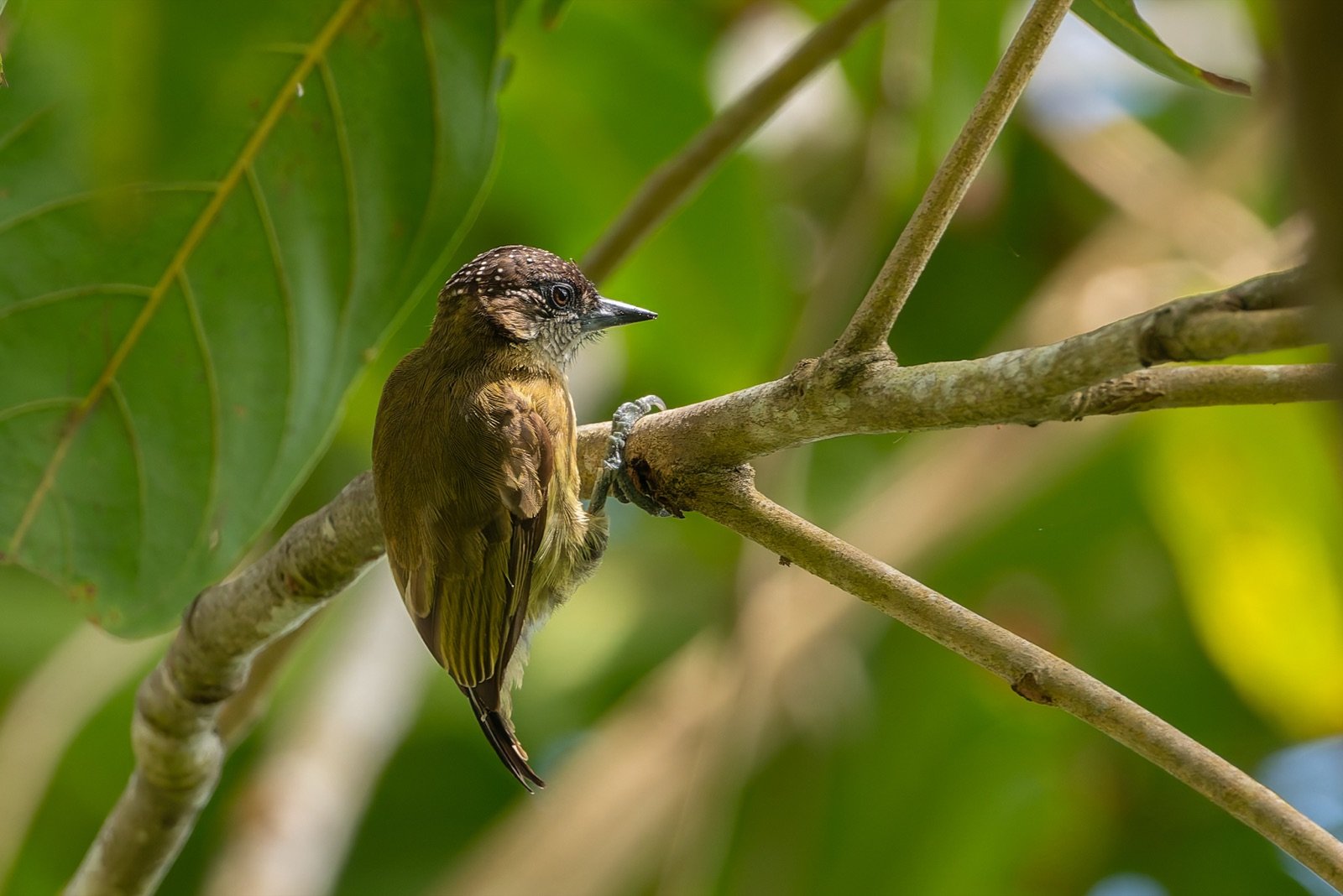
Family Picidae
Olivaceous Piculet
Picumnus olivaceus
In Spanish: Carpinterito Oliváceo (Telegrafista)
- Resident
Central America's smallest woodpecker, found by its quiet trill at edges and gardens
The Olivaceous Piculet is the smallest woodpecker in Central America, about 9 cm long and 11 g. In Costa Rica it is also called Telegrafista, because its tapping on trunks can sound like a telegraph.
Costa Rica has only one piculet, so the identification is simple once the bird is in view. The hard part is finding it, because it is small, unobtrusive and easily missed.
On a trip we build, guests meet it in gardens and edge habitat near Arenal, and in garden and edge habitat from Carara south. Learn the song first and the bird becomes far more findable.
How to find it
Search edge and garden habitat from the Carara area and the Valle del General south to Panama, and listen for the high-pitched song. One birder usually finds one or more pairs this way. At Carara, watch mixed flocks and learn the quiet trill, though one birder rates it rare there. Forest edge, gardens and viney second growth are good habitats, and examples include the Golfo Dulce area, Hacienda Baru and the Valle del General. Farmland and shaded gardens count too, so do not look only in deep forest.
How to recognise it
Think of a tiny woodpecker with a short tail. At about 9 cm and 11 g it is the smallest in Central America. Its tail feathers lack the stiff pointed tips that larger woodpeckers use as a prop.
The back is plain olive-brown. The throat is buff and the underparts are cream, lightly streaked with olive-brown. The tail is short and black, with a bold yellow centre stripe.
Male and female look alike apart from the head. Males have a black crown with short orange streaks, orange spots on the forehead and tiny white spots on the nape. Females have the whole crown finely flecked with white, with white spots on the forehead. A male with a small red spot may be a young male moulting into adult plumage.
Behaviour and diet
You may find it alone, in pairs or in family groups. It eats mainly ants and termites, gleaning and probing into wood, often in dense undergrowth, and it may join family or mixed-species groups. Pairs dig a small nest hole in a rotting fence post or a soft thin trunk. Breeding runs from January to May. At Carara, watch for it in mixed flocks.
Where it lives
It uses open groves, forest edges, tall scrub, farmland and shaded gardens. It climbs to about 1400 m on the slopes of the Talamanca range and the Dota region.
It is an uncommon to fairly common resident on the Burica Peninsula and in the General-Térraba region. It ranges north along the Pacific coast to the hills above Parrita, but is absent from the wettest Golfo Dulce area. On the Caribbean slope it is uncommon in the drier lowlands south of Lake Nicaragua, from west of Río Frío to around Santa Cecilia.
When to see it
It is a resident, so it is present all year. Nesting runs from January to May, and pairs at one Pérez Zeledón site were seen courting and singing from December to May.
Similar birds
Piculets are little woodpeckers that remind people of titmice or nuthatches. Costa Rica has only one piculet species, so no other piculet can be confused with it.
Names and lore in Costa Rica
Besides the AOCR name Carpinterito Oliváceo, the common Costa Rican name is Telegrafista, which comes from its telegraph-like tapping on trunks. A reserve checklist lists both names side by side.
Status and conservation
The AOCR list marks it as a resident (R), and the species is listed as Least Concern; one Costa Rica birder thinks it is more common than people realise and is spreading.
Photography tips
At a Pérez Zeledón farm, one birder says it can be seen daily and often well, while elsewhere in Costa Rica records are usually few, distant or brief. One photo was taken with a 600 mm lens at ISO 2200 and 1/500 sec, which shows how small and distant the bird can be.
How we know this 16 sources, each read on the date shown
- Aves de Costa Rica read 2026-11-04
https://www.avesdecostarica.com/Picumnus-olivaceus.html - Birds Colombia read 2026-11-04
https://birdscolombia.com/2018/09/25/carpinterito-olivaceo-olivaceous-piculet-picumnus-olivaceus/ - Birding Craft read 2026-11-04
https://birdingcraft.com/wordpress/tag/birding/page/21/ - Birding Craft read 2026-11-04
https://birdingcraft.com/wordpress/2020/08/18/whats-an-olivaceous-piculet/ - AvesTikas read 2026-11-04
https://avestikas.com/2024/02/14/picumnus-olivaceus/ - Birding Craft read 2026-11-04
https://birdingcraft.com/wordpress/2012/04/24/what-woodpeckers-are-you-going-to-see-when-birding-costa-rica/ - Foto Diarist read 2026-11-04
https://fotodiarist.com/page/5/ - Eagle-Eye Tours read 2026-11-04
https://www.eagle-eye.com/blog/costa-rica-long-2023-trip-report/ - Birding Craft read 2026-11-04
https://birdingcraft.com/wordpress/tag/woodpeckers/ - El Bibliote read 2026-11-04
https://elbibliote.com/resources/animales/ficha.php?id=3308 - Wikipedia read 2026-11-04
https://en.wikipedia.org/wiki/Olivaceous_Piculet - Holistic Birding read 2026-11-04
https://holisticbirding.wordpress.com/olivaceous-piculet-picumnus-olivaceus/ - Cloudbridge Nature Reserve bird list read 2026-11-04
https://www.cloudbridge.org/wp-content/uploads/2020/04/Bird-Species-List-Costa-Rica-13-April-2020.pdf - Observation.org read 2026-11-04
https://observation.org/species/70575/observations/ - Pinterest read 2026-11-04
https://es.pinterest.com/pin/16466354873681782/ - Macaulay Library read 2026-11-04
https://macaulaylibrary.org/asset/610930921