Family Passerellidae
Olive Sparrow
Arremonops rufivirgatus
In Spanish: Pinzón Aceitunado (Timbón)
- Resident
A low, shy sparrow of Pacific dry forest, found by ear first.
The Olive Sparrow (Pinzón Aceitunado, locally Timbón) is the only sparrow living inside dry forest in Costa Rica, which makes it a good bird to learn. It is a resident here and is considered common.
It stays low in thick cover, so it is hard to see, but its song of speeding-up chip notes often gives it away. On a trip we build, the dry forest of the northwest, such as Lomas de Barbudal National Park in Guanacaste, is a place to look for it.
Costa Rica is also the southern end of the whole range of the species, so a bird here is a southernmost Olive Sparrow.
How to find it
Listen first, because the speeding chip song will usually tell you the bird is there long before you see it. Then scan low, brushy edges for it. Look in forest strips along rivers and in dry or gallery forest. Watch the ground and dense tangles for a small bird pushing leaves aside with its bill. Singing males sometimes perch higher in the understory, so check above eye level too.
How to recognise it
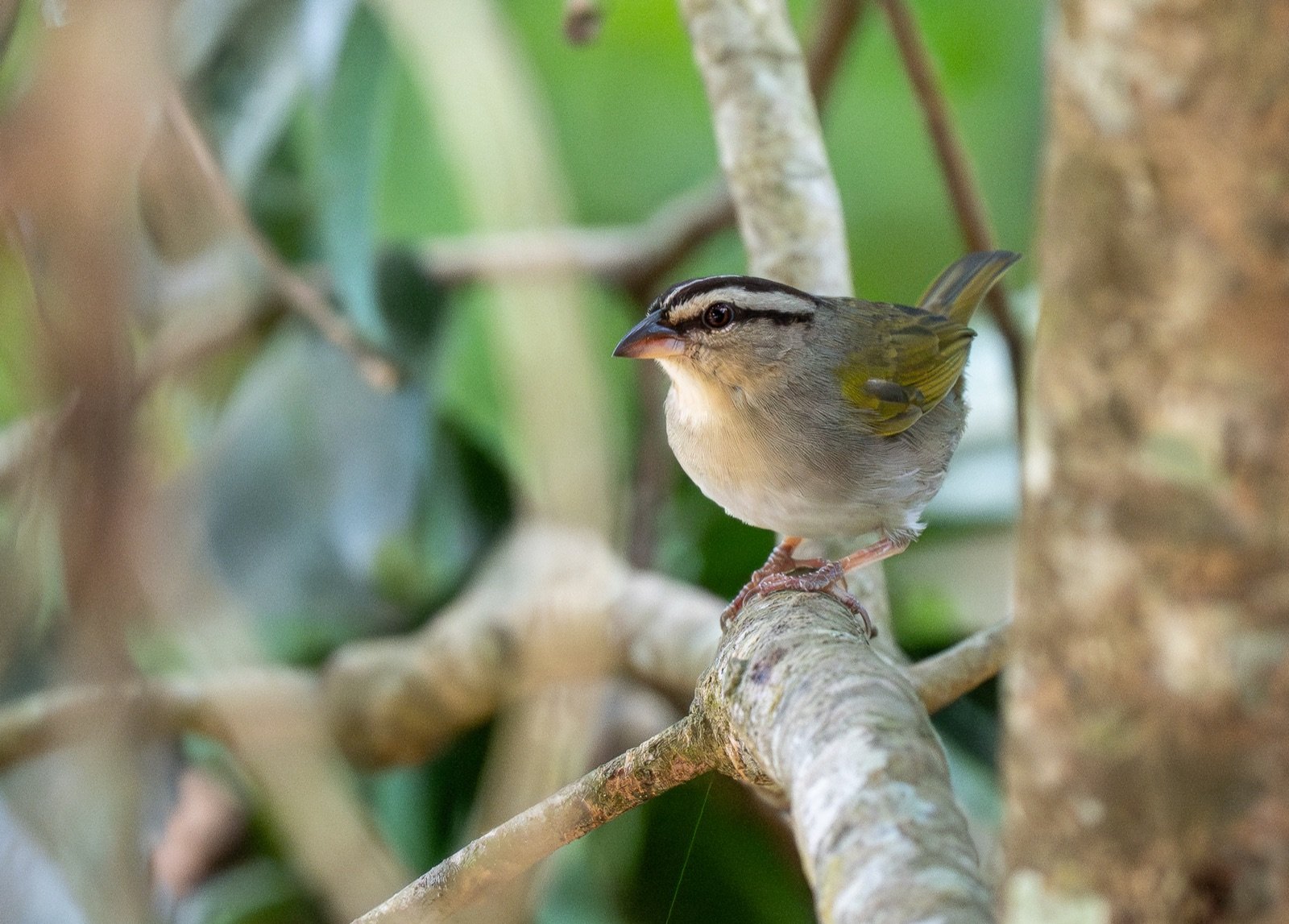
This is a small sparrow with a plain olive back and tail.
Look for these marks:
- two dull brown stripes on the crown
- a brown streak through the eye
- a paler belly with a few white feathers
- a cone-shaped bill
Costa Rican adults have a grayish buff head with broad blackish brown stripes, and the olive back has a gray tint. Males and females look alike. Young birds are duller than adults, browner above with faint streaks, and they show dark streaking on the breast and flanks. The striped head combined with a plain, uniform back is enough to identify it in Costa Rica.
What it sounds like
Recording: marcelodelagarza, CC0 1.0, source, read 4 Nov 2026.
Behaviour and diet
The Olive Sparrow forages alone or in pairs, eating seeds and insects. It hops on the ground or through dense tangles, pushing leaves aside with its bill to find insects, small spiders and seeds in the leaf litter. It only rarely scratches.
It stays low in thick cover, which is why it is hard to spot. Males, however, sing from the upper part of the understory and sometimes from the lower canopy, so a singing bird is not always hidden at ground level.
Where it lives
In Costa Rica it lives at the edges and in the understory of forest, and in nearby secondary forest. It is most often found along forested river courses, in dry forest and in gallery forest.
It is a common resident of Pacific lowlands and foothills, from northern Guanacaste south to the Tárcoles River and through the Central Valley, at least to Grecia and Santa Ana. It occurs from sea level to about 800 to 900 m.
When to see it
In Costa Rica the breeding season runs from April to July. The nest is a domed ball of rootlets and grass with a side entrance, and the clutch is 2 or 3 white eggs laid in those months.
Similar birds
In Costa Rica it is the only sparrow living inside dry forest, and its striped head with a plain, uniform back sets it apart. Beyond Costa Rica it can be mistaken for the Green-tailed Towhee, but the Olive Sparrow is smaller and lacks that bird's rusty cap.
Names and lore in Costa Rica
The AOCR list gives the Spanish name Pinzón Aceitunado, with the local nickname Timbón in brackets.
Status and conservation
The official AOCR list (2025-2026, updated June 2026) gives it as a resident (R), and the IUCN rates it Least Concern, with a stable population, and it is considered common in Costa Rica.
Photography tips
Listen for the song first, then scan low, brushy edges for the bird. It likes to stay close to the ground in thick cover, so patience helps. A singing male may offer a clearer view from the upper understory.
How we know this 11 sources, each read on the date shown
- Wikipedia (Spanish) read 2026-11-04
https://es.wikipedia.org/wiki/Arremonops_rufivirgatus - South Dakota Birds read 2026-11-04
https://www.sdakotabirds.com/species/olive_sparrow_info.htm - Wikipedia read 2026-11-04
https://en.wikipedia.org/wiki/Olive_sparrow - EarthLife.net read 2026-11-04
https://earthlife.net/olive-sparrows/ - Avibase read 2026-11-04
https://avibase.bsc-eoc.org/species.jsp?avibaseid=E33DE9A1 - AOCR Lista Oficial read 2026-11-04
https://listaoficialavesdecostarica.wordpress.com/lista-oficial/lista-oficial-online/ - Flickr, Jorge Obando (Historia Natural notes) read 2026-11-04
https://www.flickr.com/photos/jobando/19292723300 - Birds of Costa Rica (birdsofcolombia.org) read 2026-11-04
https://www.birdsofcolombia.org/costarica/Arremonops.html - Natural Atlas read 2026-11-04
https://naturalatlas.com/birds/olive-sparrows-3044770c - Aves Costa Rica (AOCR list names) read 2026-11-04
https://www.avesibericas.es/costaricaaves9.htm - EcoRegistros read 2026-11-04
https://ecoregistros.org/sheet/Arremonops-rufivirgatus