Family Falconidae
Peregrine Falcon
Falco peregrinus
In Spanish: Halcón Peregrino
- Migrant
A northern falcon that streams down the Caribbean coast each autumn
The Peregrine Falcon (Halcón Peregrino) is a visitor from the north, not a resident. The southern Caribbean coast is where it shows best, and the Kekoldi reserve near Puerto Viejo is described as the place with the biggest passage of migrating Peregrines anywhere, with estimates of up to 2000 birds in one season.
The wider Caribbean region of Talamanca, Cahuita and Puerto Viejo is reported to hold the world's largest autumn concentration of migrating Peregrines, with over 3000 birds a season. Away from that coast, birds spread thin across the country, so a sighting feels earned.
On a trip we build, the Caribbean coast in migration season is the place to plan around, though a sighting is never guaranteed.
How to find it
Start on the Caribbean coast during migration, where Peregrines are especially easy to see. Kekoldi has an observation tower, where raptor watchers can see Peregrines among other migrants such as Swainson's Hawk and Osprey.
Away from the coast, scan coastlines, wetlands, river mouths, islands and other open areas, where they hunt birds in flight. Look too for cliffs and tall structures used as hunting perches.
They can turn up almost anywhere in the country, but wintering birds stay well spread out, so patience helps. Sightings are never guaranteed.
How to recognise it
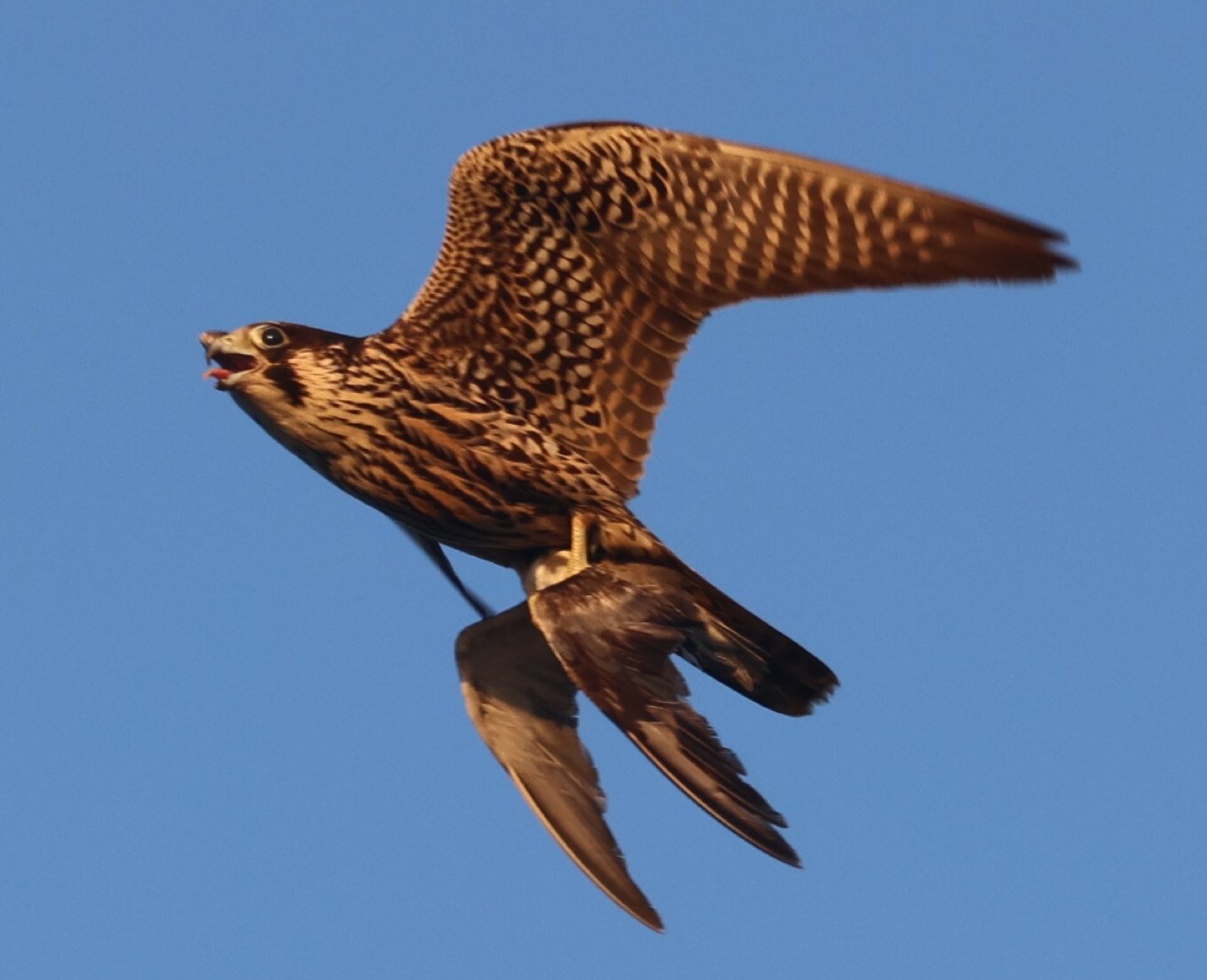
Look for a dark slate-grey body with a black helmet-like mark on the head. The shape is pointed-winged, short-tailed and torpedo-like.
In flight, a Peregrine looks much smaller than a Red-headed Vulture (Zopilote cabecirrojo) or a Swainson's Hawk. Underparts are pale. The tail carries black and white bands.
Juveniles have streaked chests. Most birds seen in Costa Rica are immatures, so streaky chests are what you will often meet.
One Costa Rica guide says the Peregrine is only a little bigger than the Bat Falcon.
What it sounds like
Recording: Wich’yanan (Jay) Limparungpatthanakij, CC BY 4.0, source, read 4 Nov 2026.
Behaviour and diet
In Costa Rica Peregrines are solitary. They migrate alone or in small scattered groups, and wintering birds usually stay well spread out.
Across its range, the falcon chases prey through the air or makes a powerful dive and strikes it with its feet. It then catches the prey in mid-air or picks it up from the ground. It strikes other birds from above.
They favor open areas with cliffs or tall structures, which they use as hunting perches.
Where it lives
In winter, Peregrines in Costa Rica favor open wetlands or steep islands with plenty of waterbirds. Wintering birds mostly occur around the Gulf of Nicoya and the lower Tempisque River basin, and Isla del Coco National Park also hosts them.
Two birds have wintered regularly at Palo Verde National Park in recent years. One adult male wintered on a tall building in downtown San José for at least five years.
During migration they follow the Caribbean coast, and they occasionally appear in the Central Valley and the Pacific lowlands.
When to see it
Migrating Peregrines are present from mid-September or October until March or early May. They were still passing over the Caribbean coast in early November, and some birds only pass through while others stay for part of the northern winter.
Similar birds
The Orange-breasted Falcon is a similar-sized cliff-nesting falcon, but it has no Costa Rican records since at least 1990, so a large falcon is almost certainly a Peregrine. Merlin and Eurasian Hobby can resemble a Peregrine in plumage but are much smaller, and the Merlin is hard to find here. The female Aplomado Falcon is nearly as large as a male Peregrine, but slimmer and lighter, more like a long-tailed kestrel.
Names and lore in Costa Rica
In Costa Rica it is called Halcón Peregrino. The English name Peregrine means wanderer, and one guide notes the bird is possible almost anywhere in the country.
Status and conservation
The AOCR list marks the Peregrine Falcon as M, a migrant, and the Costa Rican guide to rescued wildlife lists it as Least Concern with an increasing population.
Photography tips
The Kekoldi observation tower gives a wide view of passing raptors, which is a good place to watch for a fast falcon. Elsewhere, open coasts, river mouths and wetlands where Peregrines hunt birds in flight are the best bets. A fast streak overhead is often the first sign of one.
How we know this 17 sources, each read on the date shown
- Natur506 (WordPress) read 2026-11-04
https://natur506.wordpress.com/2013/10/24/costa-rica-el-mejor-lugar-en-el-mundo-para-la-migracion-del-halcon-peregrino-falco-peregrinus/ - Flickr (Costa Rica natural history account) read 2026-11-04
https://www.flickr.com/photos/jobando/31191034342 - Mistico Park read 2026-11-04
https://misticopark.com/blog/costa-rica-travel-tips/migratory-birds-costa-rica/ - Birdingcraft read 2026-11-04
https://birdingcraft.com/wordpress/2013/02/11/cool-falcons-in-costa-rica/ - Holbrook Travel read 2026-11-04
https://www.holbrooktravel.com/where-we-travel/central-and-south-america/costa-rica/costa-rica-hawk-watch-and-birding - Tico Times read 2026-11-04
https://ticotimes.net/2020/10/21/costa-ricas-million-raptor-watch-site - Hotel Rivel blog read 2026-11-04
https://hotelrivel.online/the-mighty-peregrine-falcon-a-costa-rican-sojourner/ - Birdingcraft read 2026-11-04
https://birdingcraft.com/wordpress/tag/costa-rica-raptors/ - Costa Rican Tourism Board (ICT) raptor infogram read 2026-11-04
https://www.ict.go.cr/en/documents/infogramas-1/espa%C3%B1ol/2232-aves-rapaces/file.html - Cornell Birds of the World read 2026-11-04
https://birdsoftheworld.org/bow/species/perfal/cur/identification?lang=es - Hotel Rivel read 2026-11-04
https://hotelrivel.online/es/el-majestuoso-halcon-peregrino-un-visitante-en-costa-rica/ - Birds of Colombia (Birds of Costa Rica page) read 2026-11-04
https://www.birdsofcolombia.org/costarica/Falco.html - Northeast Wildlife read 2026-11-04
https://northeastwildlife.org/types-of-raptors-in-costa-rica/ - Guía de fauna decomisada Costa Rica read 2026-11-04
https://faunadecomisada.go.cr/guia-de-especies/aves/falconidae/falco-peregrinus - Aves de Peru read 2026-11-04
https://avesdeperu.org/halcon-peregrino-distribucion-habitat-migracion/ - Birds for Beer (Turrialba) read 2026-11-04
https://birdsforbeer.com/2019/03/10/falcons-and-caracaras-in-turrialba/ - iNaturalist guide (Valderejo) read 2026-11-04
https://www.inaturalist.org/guide_taxa/386015