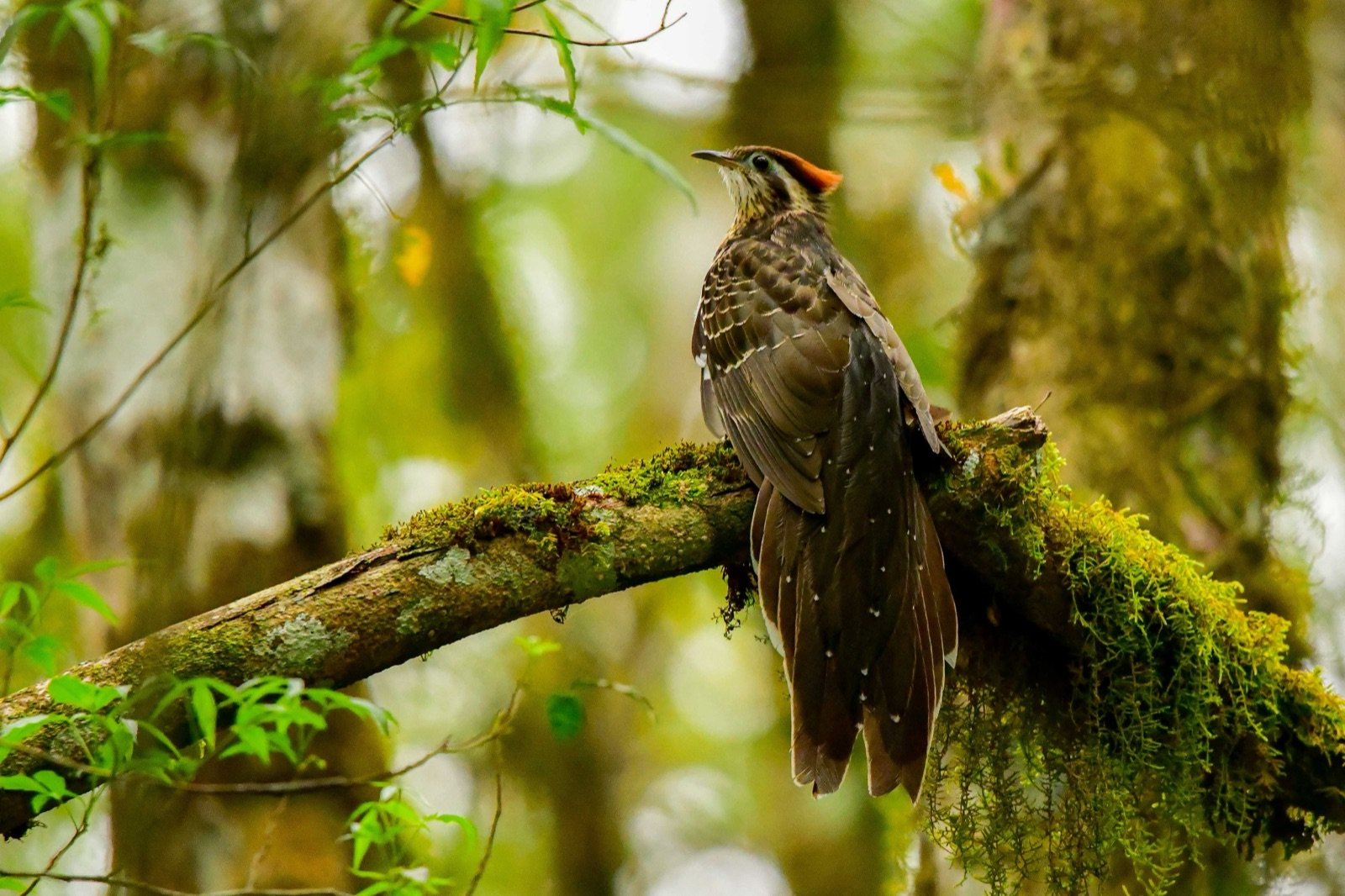
 Pheasant Cuckoo
Family Cuculidae
Pheasant Cuckoo
Dromococcyx phasianellus
In Spanish: Cuclillo Faisán
- Resident
A secretive, long-tailed ground cuckoo, very rare here and found by its call.
The Pheasant Cuckoo (Cuclillo Faisán, Dromococcyx phasianellus) is a resident of Costa Rica, yet one of the hardest birds in the country to meet. A checklist used for birding trips marks it as very rare, and it is the only cuckoo on that list with a site code instead of an abundance rating, which shows how few places it is known from.
It is a secretive brood parasite that stays low or on the ground. For a beginning birder it is best treated as a rare bonus on a trip we build, never a bird to expect on a standard itinerary, with the Striped Cuckoo as the easier relative to learn first.
Go with a modest hope and a good ear: this is a bird you are far more likely to hear than to see.
How to find it
Start with your ears. The bird is territorial, secretive and hard to see, but usually vocal, and it stays low or on the ground, so listening for its call is the best way to locate it. It should call if it is present, so its rarity in Costa Rica looks real rather than just shyness. Known sites are very few, so concentrate on the places where it has been recorded. Learn the Striped Cuckoo song as well before you trust an ID by ear.
How to recognise it
This is a long-tailed cuckoo, about 37 cm long. Look for:
- a small crested head
- a long broad tail, with rump feathers as long as the tail
- dark brown upperparts with pale feather edges and a bronzy green gloss
- a buffy face and chest with dark streaks
- a white belly and a white stripe behind the eye
- a grayish tail with white tips that stand out against black
- a yellowish eye with a yellow-green bare eye ring
Young birds are sooty brown above, with buff spots on the crown and scaly wing coverts.
What it sounds like
Recording: Thibaud Aronson, CC BY-SA 4.0, source, read 4 Nov 2026.
Behaviour and diet
The Pheasant Cuckoo is a brood parasite. It lays one whitish egg with reddish spots in another bird's nest, apparently most often a flycatcher's. Elsewhere in its range, brood parasitism was first suspected in 1913, when a strange egg turned up in a White-headed Marsh Tyrant nest in South America, and a female with a matching egg confirmed it in 1914.
Across its range it forages on or near the ground. It rattles its plumage and claps its bill, bobs its body and tail, then lunges forward and pecks in the leaf litter. One guide suggests the vibrations stir up hidden prey. Its flight is short and undulating, with the tail spread open.
Where it lives
In Costa Rica it is a widespread resident, but apparently very rare in the Pacific lowlands, where it reaches 800 m in places.
Across its whole range it lives in the understory of lowland evergreen, riverside and dry deciduous forest, from sea level to 1600 m. It also uses forest edge, second growth, scrub, low-elevation cloud forest and lake margins with good grass cover.
Similar birds
Costa Rica has two ground-dwelling parasitic cuckoos. The Striped Cuckoo is the easy one along forest edges, while the Pheasant Cuckoo is the hard-to-find relative. The longer song of the common Striped Cuckoo can sound like that of the much rarer Pheasant Cuckoo, so any claim by ear needs care.
Names and lore in Costa Rica
In Costa Rica the bird is called Cuclillo Faisán, a name also used in Mexico and Nicaragua. Elsewhere it is cuco faisán, cuclillo pavón or cuco pavón, and Argentina and Paraguay say yasiyateré grande. The genus name Dromococcyx means 'running cuckoo', and phasianellus is a diminutive of the Latin word for pheasant, which explains the common name.
Status and conservation
The official Costa Rican bird list gives it resident status, though a trip checklist marks it as very rare.
How we know this 10 sources, each read on the date shown
- Aves de Costa Rica (avesdecostarica.com) read 2026-11-04
http://www.avesdecostarica.com/Dromococcyx-phasianellus.html - Asociación Ornitológica de Costa Rica read 2026-11-04
https://avesdecostarica.weebly.com/cuculidae.html - Lista Oficial de las Aves de Costa Rica (AOCR) read 2026-11-04
https://listaoficialavesdecostarica.wordpress.com/lista-oficial/lista-oficial-online/ - Birds Colombia read 2026-11-04
https://birdscolombia.com/2020/07/23/cuco-faisan-pheasant-cuckoo-dromococcyx-phasianellus/ - Howler Magazine read 2026-11-04
https://howlermag.com/cuckoo-birds-in-costa-rica/ - Birding Craft read 2026-11-04
https://birdingcraft.com/wordpress/2010/07/12/striped-cuckoos-are-common-costa-rica-but-wheres-the-pheasant/ - Wikipedia read 2026-11-04
https://en.wikipedia.org/wiki/Dromococcyx_phasianellus - Infogalactic (Wikipedia mirror) read 2026-11-04
https://infogalactic.com/info/Pheasant_cuckoo - Exotic Birding Costa Rica checklist read 2026-11-04
http://www.exoticbirding.com/costarica/checklist.html - Guía de Aves de Misiones read 2026-11-04
https://guiadeavesdemisiones.com/yasiyatere-grande-dromococcyx-phasianellus/