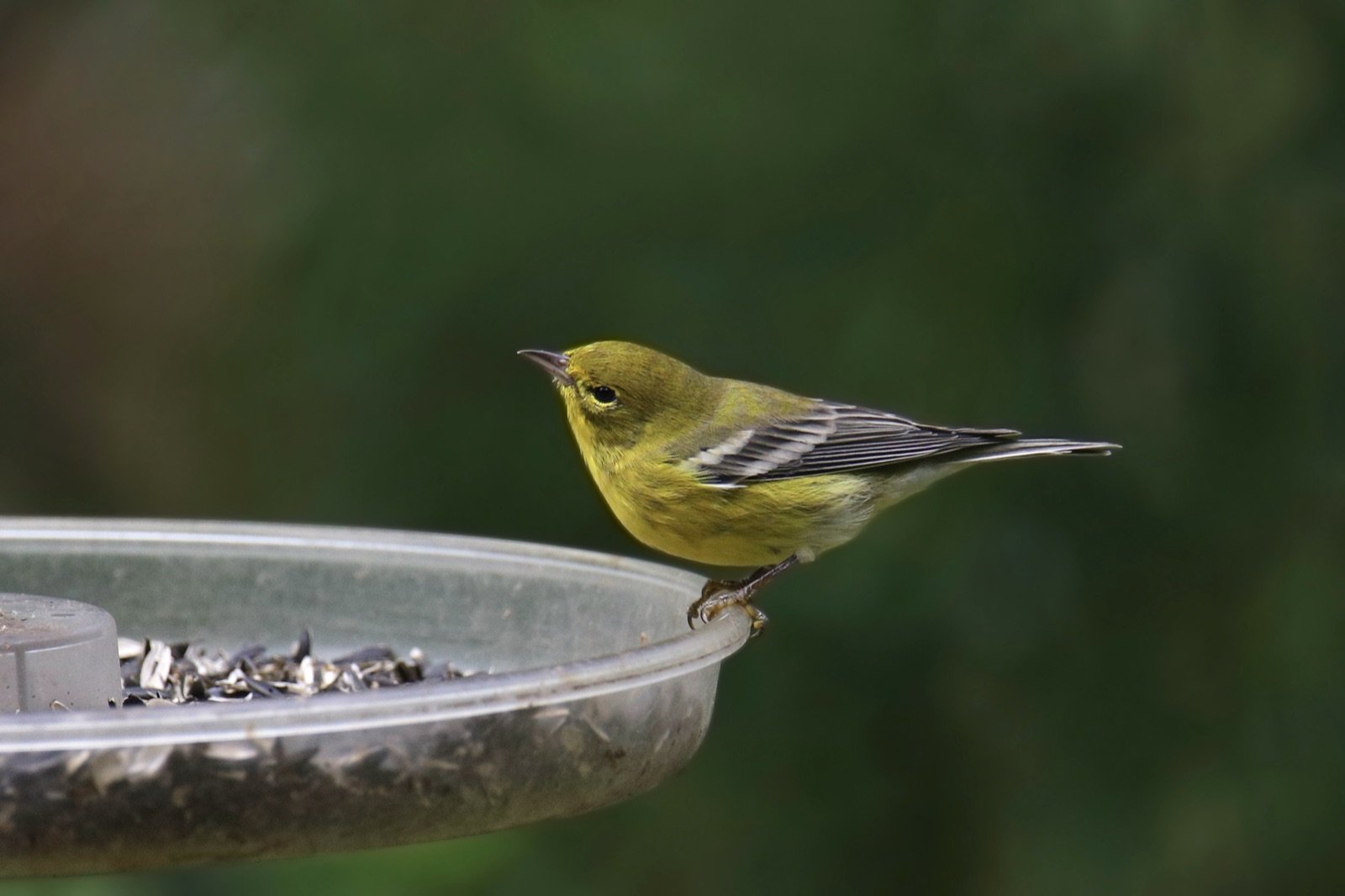
 Pine Warbler
Family Parulidae
Pine Warbler
Setophaga pinus
In Spanish: Reinita de Pinos
- M-SC
A rare vagrant: a few autumn records from 1974 in the upper Central Valley.
The Pine Warbler (Reinita de Pinos) is a bird to know about rather than to plan a trip around. The official Costa Rican list marks it as a migrant with the extra code SC, which means it reaches the country only as a rare visitor.
The Costa Rican record is a handful of sightings of at least two birds in 1974, in the upper Central Valley. Breeding and wintering ranges lie almost entirely in the United States and Canada, and Costa Rica holds some of the southernmost records of the species, so any sighting here would be a real surprise.
We include it so that a beginning birder knows what a yellowish warbler with dull wing bars could be, and why this one is a matter of luck and sharp eyes.
How to find it
Finding one means being ready for a surprise rather than following a plan. The old records point to the upper Central Valley, at roughly 1200 to 1500 m, in partly open areas and old secondary growth. Check yellowish warblers for a slow, deliberate way of moving and for dull grey or brownish wing bars. Listen for a steady trill that recalls a sparrow or junco. A vagrant could turn up in a mixed flock of other warblers, as one did in Colombia, so scan the whole flock. Because the species eats seeds, a feeder is one place it may show up.
How to recognise it
This is a fairly large, slow-moving warbler about 13 cm long.
The adult shows a yellowish throat and breast, olive streaking on the sides, and two wing bars that are often dull grey or brownish rather than bright white. The belly and undertail are white, and the tail extends past the undertail coverts. The bill is black and looks fairly heavy for a warbler.
Females are duller than males, with browner or greyer upperparts and paler yellow on the breast. Immatures are buffy-brown below and can show little or no yellow, so they look much plainer than the bright adult.
Slow movement and those dull wing bars are the traits the Costa Rican account suggests for separating it from other yellowish warblers.
What it sounds like
Behaviour and diet
Across its range the Pine Warbler is mostly an insect eater, yet it is the only wood-warbler that regularly eats a lot of seeds, often pine seeds. It tends to stay high in pines, where tufts of needles can hide it.
It forages in pine foliage at branch tips, moving from tip to tip, and sometimes hangs sideways or upside down to reach prey. It also searches trunk bark at the bases of branches, probes pine cones and checks the ground. These habits are general to the species, not described from Costa Rica.
Where it lives
In Costa Rica the species has been noted in partly open areas and old secondary growth. The known records come from the upper Central Valley, near San Pedro de Poás at about 1500 m and at the Ciudad Universitaria at about 1200 m.
Across its range it is closely tied to pine forest and is rarely found away from pines. Migrants are very rarely recorded in Central America.
When to see it
The 1974 sightings fell between 22 August and 10 September, and the species is called an accidental autumn visitor. Elsewhere, vagrant records are mostly in winter, which differs from these late-summer Costa Rican dates.
Similar birds
Pine Warbler can be mistaken for Yellow-throated Vireo. The warbler has a smaller, thinner bill, usually shows streaks on the breast or sides, and moves through foliage faster than the vireo. Against other yellowish warblers, look for the dull wing bars and the slow movement.
Names and lore in Costa Rica
Costa Ricans call it Reinita de Pinos. Other Spanish-speaking regions use different names: Bijirita del Pinar in Cuba, Cogüita del Pinar in the Dominican Republic and Chipe Pinero in Mexico.
Status and conservation
The official Costa Rican list marks it as a migrant (M) with the code SC, a rare visitor, while the IUCN rates the species Least Concern.
How we know this 12 sources, each read on the date shown
- Lista Oficial de las Aves de Costa Rica (AOCR) read 2026-11-04
https://listaoficialavesdecostarica.wordpress.com/lista-oficial/lista-oficial-online/ - Aves de Costa Rica read 2026-11-04
https://avesdecostarica.com/Setophaga-pinus.html - All About Birds (Cornell Lab) read 2026-11-04
https://www.allaboutbirds.org/guide/Pine_Warbler/overview - Birds of the World (Cornell Lab) read 2026-11-04
https://birdsoftheworld.org/bow/species/pinwar/cur/introduction - All About Birds, Cornell Lab of Ornithology read 2026-11-04
https://www.allaboutbirds.org/guide/Yellow-throated_Vireo/species-compare/ - Wikipedia (es) read 2026-11-04
https://es.wikipedia.org/wiki/Setophaga_pinus - Huitzil (SciELO Mexico) read 2026-11-04
https://www.scielo.org.mx/scielo.php?script=sci_arttext&pid=S1870-74592024000100207 - Wikipedia read 2026-11-04
https://en.wikipedia.org/wiki/Setophaga_pinus - Featherbase (IUCN 2025 data) read 2026-11-05
https://www.featherbase.info/en/species/setophaga/pinus - BC Conservation Data Centre read 2026-11-05
https://a100.gov.bc.ca/pub/eswp/speciesSummary.do;jsessionid=qfQ6T1RLldwrfMFvk0Wp3XpFMzTxWCbThSQPDpJfN2WMmbY4FGFn!234374013?id=23190 - Animalia (IUCN summary) read 2026-11-05
https://animalia.bio/pine-warbler?letter=p - Revista Mexicana de Biodiversidad (SciELO) read 2026-11-05
https://www.scielo.org.mx/scielo.php?script=sci_arttext_plus&pid=S1870-74592024000100207&lng=es&tlng=en&nrm=iso