Family Charadriidae
Piping Plover
Charadrius melodus
In Spanish: Chorlitejo Silbador
- A
Accidental here, with one Pacific coast record in 2009
The Piping Plover is a small beach shorebird named for its plaintive, bell-like whistles. Costa Rica's official bird list gives it status A, which means accidental: a very rare vagrant, not a resident and not an endemic.
Only one Costa Rican record was known as of 2020. It was a Pacific coast bird in November 2009, the first known for the country, and Jim Zook reported it in 2010 as a new species for Costa Rica.
That makes it a bird to know about, not a bird to plan a trip around. It is still a rewarding one for a beginner to learn, because it shows the habits of a classic beach plover.
How to find it
Realistically, finding one here would be a stroke of luck. The only known record came from the Pacific coast, so open sandy beaches and the water's edge on that side are the places to scan. Listen first for the bell-like whistle, which often comes before the bird. Then look for a small bird that runs in short bursts and stops, and check the wrack line where it feeds. Any suspected bird should be documented carefully, since the species is so rare in the country.
How to recognise it
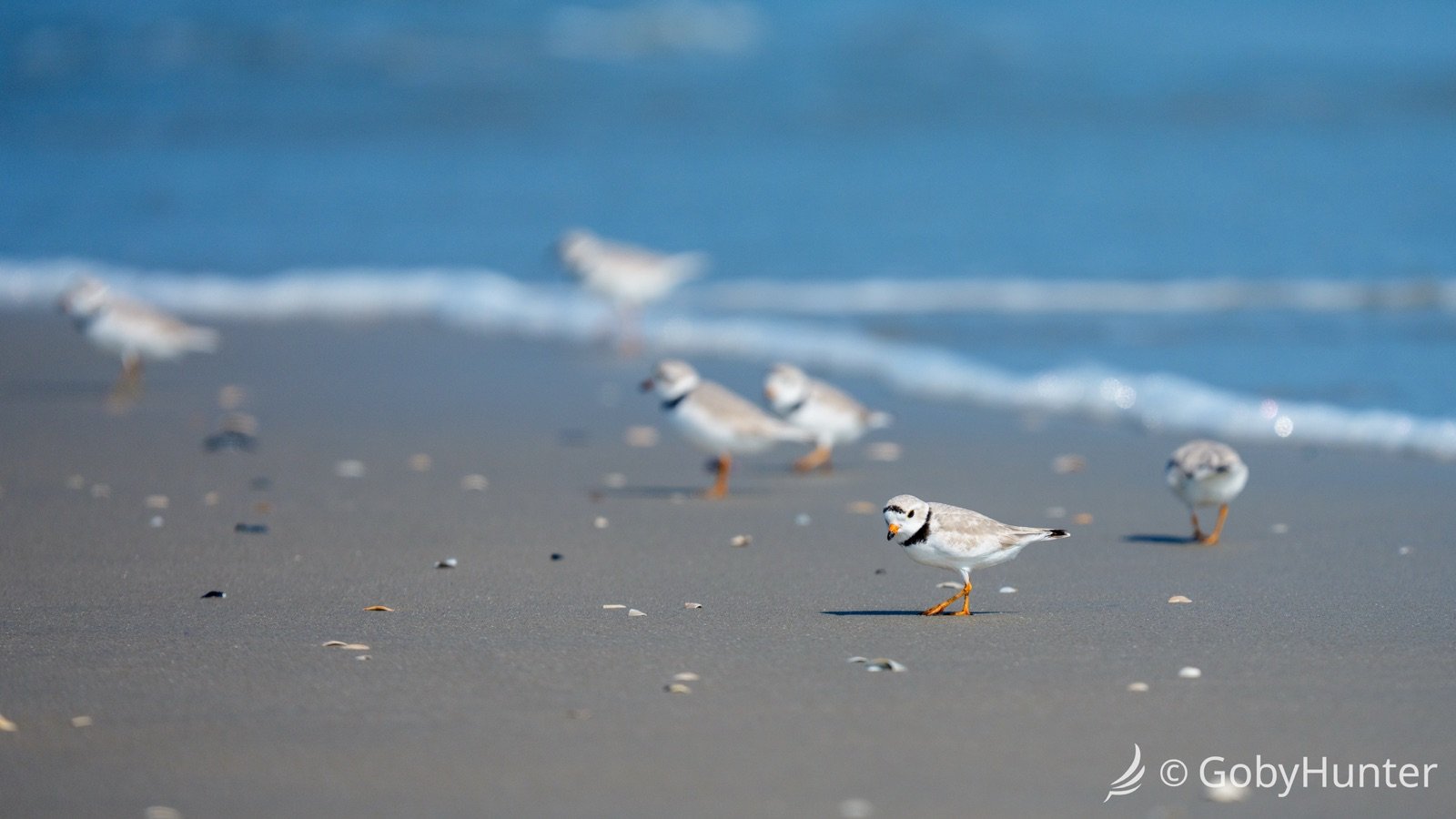
The Piping Plover is small, about 17 to 18 cm long. Look for these marks:
Sandy brown-gray upperparts and white underparts.
White eyebrows, a black tip on the tail and a short stubby bill.
Breeding birds add a black bar across the forehead and a black neck band.
In winter plumage the black bands fade or vanish, the legs turn a paler yellow-orange and the bill becomes all black. A bird in Costa Rica would most likely show this plain winter dress, so the shape, the pale legs and the way it moves along the sand matter as much as any band.
What it sounds like
Behaviour and diet
The Piping Plover moves across beaches in short, quick runs and then stops. It feeds mostly by sight, on insects, marine worms and crustaceans, around the wrack line and the water's edge.
Watching for that run-and-pause rhythm along the tide line is one of the best ways to pick a small plover out from the shoreline.
Where it lives
Across its range this plover lives on wide, open beaches, alkali flats and sandflats. In winter most birds use coastal beaches, sandflats and mudflats from the Carolinas to the Yucatan.
In Costa Rica the single known record came from the Pacific coast, in a region where the species is rare and irregular as far north as Mexico.
When to see it
The one Costa Rican record dates from November 2009.
Names and lore in Costa Rica
The official Spanish name is Chorlitejo Silbador. Elsewhere in Spanish the bird is also called chorlo chiflador, chorlito silbador and chorlito melódico, as well as frailecillo silbador, playerito, playero melódico and chorlitejo picocorto. These are general Spanish names for the species, not Costa Rican nicknames.
Status and conservation
The official Costa Rican list, in its June 2026 update, gives the Piping Plover status A, accidental, while the Semipalmated Plover beside it is marked M, migratory.
How we know this 8 sources, each read on the date shown
- Lista Oficial de las Aves de Costa Rica (AOCR) read 2026-11-04
https://listaoficialavesdecostarica.wordpress.com/lista-oficial/lista-oficial-online/ - Birds of the World (Cornell Lab) read 2026-11-04
https://birdsoftheworld.org/bow/species/pipplo/cur/introduction - Birds Colombia (Wikipedia text) read 2026-11-04
https://birdscolombia.com/2023/09/10/chorlitejo-silvador-piping-plover-charadrius-melodus/ - Bulletin of the British Ornithologists' Club read 2026-11-04
https://bioone.org/journals/bulletin-of-the-british-ornithologists-club/volume-140/issue-2/bboc.v140i2.2020.a7/First-records-of-Piping-Plover-Charadrius-melodus-for-Venezuela-with/10.25226/bboc.v140i2.2020.a7.full - En 15 días read 2026-11-04
https://en15dias.com/animales/chorlo-chiflador-el-ave-playera-pequena/ - Wikipedia (español) read 2026-11-04
https://es.wikipedia.org/wiki/Charadrius_melodus - NatureWorks (New Hampshire PBS) read 2026-11-05
https://natureworks.nhpbs.org/animals/piping-plover/ - PMC, Piping Plover monitoring in The Bahamas read 2026-11-05
https://www.ncbi.nlm.nih.gov/pmc/articles/PMC9850249/