Family Parulidae
Prairie Warbler
Setophaga discolor
In Spanish: Reinita Galana
- Migrant
A tail-bobbing yellow warbler that reaches Costa Rica only when lost.
The Prairie Warbler (Reinita Galana) is a small yellow warbler with a bold, black-striped face. It breeds in North America and does not breed in Costa Rica, where it is a vagrant, which means very few birds reach the country.
That makes it a bird to know rather than to plan a day around. The official Costa Rica list carries it as a migrant (M), yet a Costa Rica birder writes that it arrives only when lost.
For a beginning birder it is still a fine species to study. Its constant tail bobbing and its face pattern teach you how to look closely at every yellow warbler.
How to find it
Treat any sighting as a happy accident rather than a goal. Fall migration is when lost warblers are most likely to appear, so October is a good time to look closely at every yellow warbler. Scan low shrubs and scrubby edges for a bird that bobs its tail constantly. When you find one, check for the black eyeline and the dark crescent under the eye. If you can, listen for the sharp chek call or the rising buzzy song.
How to recognise it
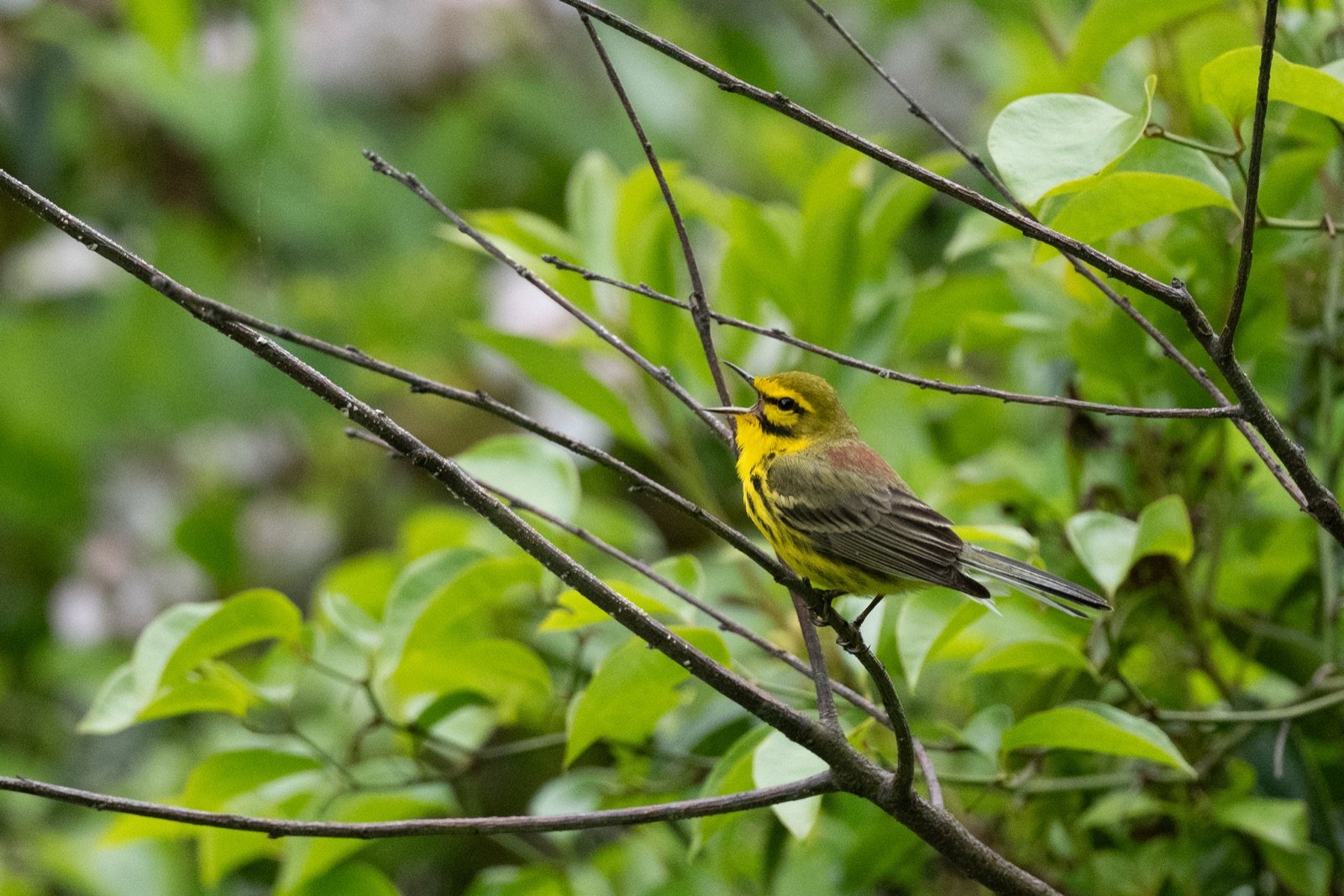
Adults have a yellow face crossed by two dark stripes. One runs through the eye. The other is a curved streak below the eye. Males show these stripes in black, and females show them in brown.
Adult males are bright yellow below with black streaks on the flanks. They add a black eyeline, a black crescent under the eye and a chestnut patch on the back.
Females and immatures are paler yellow than males, with blurry streaks on the sides. The darker crescent under the eye gives them a broken eye-ring look. In flight the tail shows clear white outer edges. These descriptions cover the species in general, not only birds in Costa Rica.
What it sounds like
Behaviour and diet
It bobs its tail constantly while foraging low in shrubs. Few yellowish warblers bob their tail while perched, so on a yellow warbler the habit is a useful clue, though you should check the face pattern too.
It eats mostly insects, especially caterpillars, and also spiders. Wintering birds in Puerto Rico were mostly solitary and silent, and often avoided other warblers, while a few defended territories against their own species. These habits are described for the species in general, not for birds in Costa Rica.
Where it lives
Across its range it prefers scrubby, young second-growth habitat such as old fields and young pine. It is not a true prairie bird despite its name.
It normally winters in the Bahamas, the Caribbean islands and southern Florida, so Costa Rica is not a normal wintering area. It is described as an occasional visitor on the Pacific side from western Mexico to El Salvador, and also in Costa Rica and Panama.
When to see it
A Costa Rica birder writes that October is high time for fall migration there, and names the Prairie among the warblers that rarely reach the country.
Similar birds
The Palm Warbler (Reinita Coronicastaña in Costa Rica) also wags its tail when perched, but it is browner with a chestnut cap, and it is a rare visitor too. Only three Setophaga warblers wag the tail nonstop: Kirtland's, Prairie and Palm, so a tail-wagging yellow warbler in Costa Rica is most likely one of these. The Prairie Warbler's bold face pattern and side streaks set it apart, and the dark crescent below the eye helps separate it from other yellow warblers.
Names and lore in Costa Rica
Costa Rica uses the name Reinita Galana, as do Puerto Rico, Panama and Colombia. Mexico uses chipe de pradera, chipe pradeño or chipe sabanero, Cuba uses mariposa galana, and the Dominican Republic uses cigüita de los prados.
Status and conservation
The official Costa Rica list, updated June 2026, marks it as a migrant (M), and the country is labelled a vagrant one for it, so very few birds arrive.
How we know this 15 sources, each read on the date shown
- Wikipedia (Spanish) read 2026-11-04
https://es.wikipedia.org/wiki/Setophaga_discolor - Featherbase read 2026-11-04
https://www.featherbase.info/es/species/setophaga/discolor - Cornell Birds of the World read 2026-11-04
https://birdsoftheworld.org/bow/species/prawar/cur/multimedia?media=photos - National Wildlife Foundation species page read 2026-11-04
https://nwlfd.org/species/prairie-warbler - BWD Magazine read 2026-11-04
https://bwdmagazine.com/species/prairie-warbler/ - All About Birds, Cornell Lab of Ornithology read 2026-11-04
https://www.allaboutbirds.org/guide/Prairie_Warbler/sounds - Michigan Natural Features Inventory read 2026-11-04
https://mnfi.anr.msu.edu/species/description/11178/Setophaga-discolor - Birding Craft read 2026-11-04
https://birdingcraft.com/wordpress/2010/08/30/migrants-are-on-their-way-back-to-costa-rica/ - 10,000 Birds read 2026-11-04
https://www.10000birds.com/looking-for-lost-warblers-at-parque-rio-loro-costa-rica.htm - Birding Craft read 2026-11-04
https://birdingcraft.com/wordpress/2014/09/04/what-does-the-fall-bring-for-birding-in-costa-rica/ - Birds of the World read 2026-11-04
https://birdsoftheworld.org/bow/species/prawar/cur/introduction - Wikipedia (es) read 2026-11-04
https://es.wikipedia.org/wiki/Setophaga_palmarum - NatureServe Explorer read 2026-11-05
https://explorer.natureserve.org/Taxon/ELEMENT_GLOBAL.2.103980/Setophaga_discolor - Lista Oficial de las Aves de Costa Rica (AOCR) read 2026-11-05
https://listaoficialavesdecostarica.wordpress.com/lista-oficial/lista-oficial-online/ - Animalia.bio read 2026-11-05
https://animalia.bio/es/palm-warbler?custom_list=12842