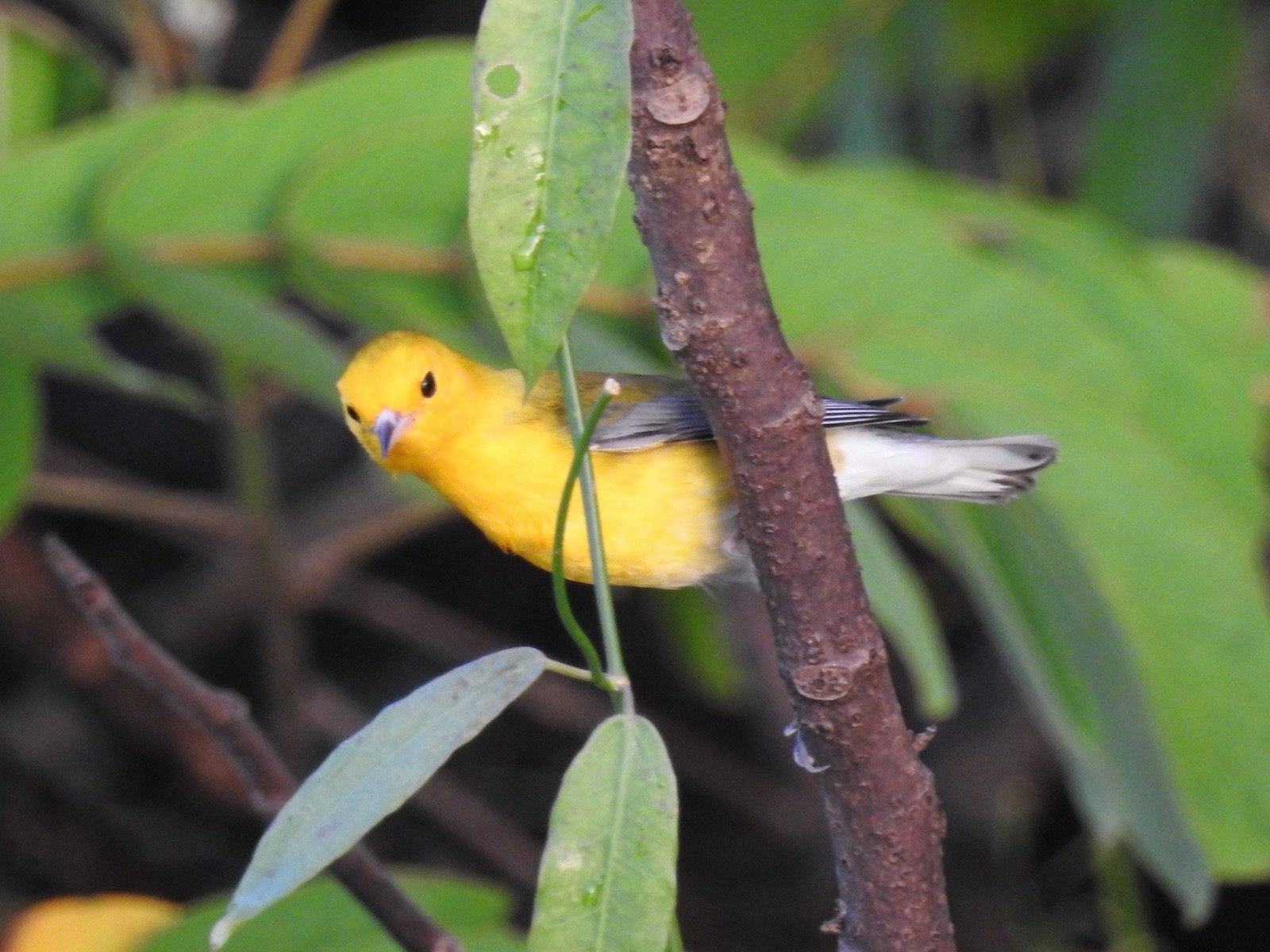
Family Parulidae
Prothonotary Warbler
Protonotaria citrea
In Spanish: Reinita Cabecidorada
- Migrant
Golden-headed winter warbler of mangroves and swamps, here from mid-August.
The Prothonotary Warbler (Reinita Cabecidorada) spends the northern winter in Costa Rica. The Spanish name means golden-headed warbler, and the bright golden head and breast are exactly what you notice first.
In Costa Rica it looks for swampy habitat, especially mangroves. One Costa Rica writer saw groups of up to 18 together while walking suitable wet habitat in the right season, so a good morning in the mangroves can be a lively one.
It is listed as a migrant (M) on the AOCR list, which is why timing matters when you plan a trip.
How to find it
Look in mangroves and swamps during the northern winter. A boat tour of mangroves and wetland forest is a good way to see it, as birds flash yellow when they cross the river in front of you. Spishing often brings wintering warblers into view in mangroves and wet thickets. Listen for the dry chip, since winter birds sing little. On one northern trip the best looks came from a roadside perch where a bird sat in the open singing. On a trip we build, mangrove channels and wetland boat rides are the natural places to give it a real chance.
How to recognise it
Look first at the head and breast, which are bright golden yellow. Then check the rest of the bird:
Back: olive green.
Wings and tail: blue-gray.
Undertail: white, with white tail spots.
Bill: large for a warbler.
Males have a brighter orange-yellow head. Females and young birds have a duller yellow head washed with green, so a paler bird in the mangroves is not necessarily a different species. These plumage details describe the species across its whole range, so expect some variation between individual birds.
What it sounds like
Behaviour and diet
In winter it flits through undergrowth or low canopy, picking insects and spiders from leaves and twigs. It may also eat seeds and plant material at that season. On the wintering grounds it is not territorial, and it may roost communally in the non-breeding season. In Costa Rica it forages alone, in pairs or in larger groups, usually within about 6 m of the ground. One group saw 18 golden warblers flitting around together in wetland habitat.
Where it lives
In Costa Rica it looks for swampy habitat, especially mangroves. Across its winter range it uses mainly coastal mangrove forest, and also lowland woods and wet forests. In the northern winter it is found on the Pacific slope of Nicaragua, Costa Rica and Panama. In Costa Rica it is a lowland bird, with an altitude limit given as about 1300 m and rare higher records, including an older one from Monteverde cloud forest. It also appears on the bird list of Cloudbridge Nature Reserve.
When to see it
It arrives in Costa Rica from around mid-August, and one field guide gives late August through October for arrivals. It stays for the northern winter.
Similar birds
On the wintering grounds it may be confused with Yellow Warbler, which is common in the lowlands. A rufous-headed Mangrove form of Yellow Warbler also lives in Pacific mangroves and shares the habitat. Check for a golden head, a bigger bill, blue-gray wings with no wing bars and a white undertail.
Names and lore in Costa Rica
Reinita Cabecidorada is the name used in Colombia, Nicaragua and Costa Rica, where reinita means warbler and cabecidorada means golden-headed. Reinita Protonotaria is used elsewhere, and Nicaraguans also call it Manguito Dorado. The English name refers to papal clerks in the Roman Catholic Church, who once wore yellow robes like the bird's bright plumage.
Status and conservation
It is a migrant (M) on the AOCR list, present in Costa Rica during the northern winter.
Photography tips
A boat tour of mangroves and wetland forest gives frequent views, and one visiting birder named it the best warbler of the trip. Watch for birds flashing yellow as they cross the river in front of you. Spishing can bring wintering warblers into view in mangroves and wet thickets.
How we know this 21 sources, each read on the date shown
- Birds of the World (Cornell Lab) read 2026-11-04
https://birdsoftheworld.org/bow/species/prowar/cur/movement - The Tico Times read 2026-11-04
https://ticotimes.net/2024/09/06/costa-rica-birdwatching-the-prothonotary-warbler - Wikipedia (Spanish) read 2026-11-04
https://es.wikipedia.org/wiki/Protonotaria_citrea - Cloudbridge Nature Reserve bird list read 2026-11-04
https://www.cloudbridge.org/wp-content/uploads/2020/04/Bird-Species-List-Costa-Rica-13-April-2020.pdf - Audubon Field Guide read 2026-11-04
https://www.audubon.org/field-guide/bird/prothonotary-warbler - Cornell Lab Land Trust read 2026-11-04
https://www.birds.cornell.edu/landtrust/prothonotary-warbler-prow/ - Wikipedia read 2026-11-04
https://en.wikipedia.org/wiki/Prothonotary_warbler - iNaturalist guide (NPS summary) read 2026-11-04
https://www.inaturalist.org/guide_taxa/364370 - COSEWIC status report (Canada.ca) read 2026-11-04
https://www.canada.ca/en/environment-climate-change/services/species-risk-public-registry/cosewic-assessments-status-reports/prothonotary-warbler/chapter-2.html - Sialis.org read 2026-11-04
https://www.sialis.org/prow/ - Ecology and Evolution (PMC) read 2026-11-04
https://www.ncbi.nlm.nih.gov/pmc/articles/PMC6802017/ - World Bird Traveler read 2026-11-04
https://worldbirdtraveler.com/central-america/costa-rica/ - Nicky by Nature read 2026-11-04
https://www.nickybynature.com/crocsincostarica/ - Field Guides read 2026-11-04
https://fieldguides.com/triplists/cr220.html - Exotic Birding read 2026-11-04
https://www.exoticbirding.com/costarica/paloverde/checklist.html - EcoRegistros read 2026-11-04
https://www.ecoregistros.org/ficha/Protonotaria-citrea - Birdwatch.info tour page read 2026-11-04
https://www.birdwatch.info/costa-rica/san-jose/costa-rica-birding - 10,000 Birds read 2026-11-04
https://www.10000birds.com/the-wintering-wood-warblers-of-costa-rica.htm - Catálogo de la Biodiversidad de Colombia read 2026-11-04
https://catalogo.biodiversidad.co/file/56c665c7f0106c67230e73bf/summary - Birds Outside My Window read 2026-11-04
https://www.birdsoutsidemywindow.org/category/travel/costa-rica/ - Birdingcraft read 2026-11-04
https://birdingcraft.com/wordpress/category/mangroves/feed/