 Riverside Wren
Family Troglodytidae
Riverside Wren
Cantorchilus semibadius
In Spanish: Soterré Pechibarreteado
- Resident
- Regional endemic
A loud, duetting wren of southern Pacific streams, from Carara to the Osa.
The Riverside Wren (Soterré Pechibarreteado) lives on the southern Pacific slope of Costa Rica, where it is common. Its range reaches north to about Carara National Park, and it occurs only in Costa Rica and Panama.
On a trip we build to Drake Bay and the Osa, it is one of the birds we point guests toward, alongside the Scarlet Macaw, Fiery-billed Aracari and Ornate Hawk-Eagle.
Expect to hear it before you see it. Pairs sing and duet from dense growth beside forest creeks, and a patient wait near the water is how a sighting begins.
Where to see it
How to find it
Watch for it along forested creeks and streams from Carara southward, since it likes riparian zones. Listen first, because the loud song usually gives it away before the bird shows. Then scan low, near the ground, and check swampy openings inside forest. Around Manuel Antonio the underbrush is described as full of Riverside Wrens, which love it there. It is also on the bird list of Cloudbridge Nature Reserve. Stand quietly and follow singing birds rather than hurrying through.
How to recognise it
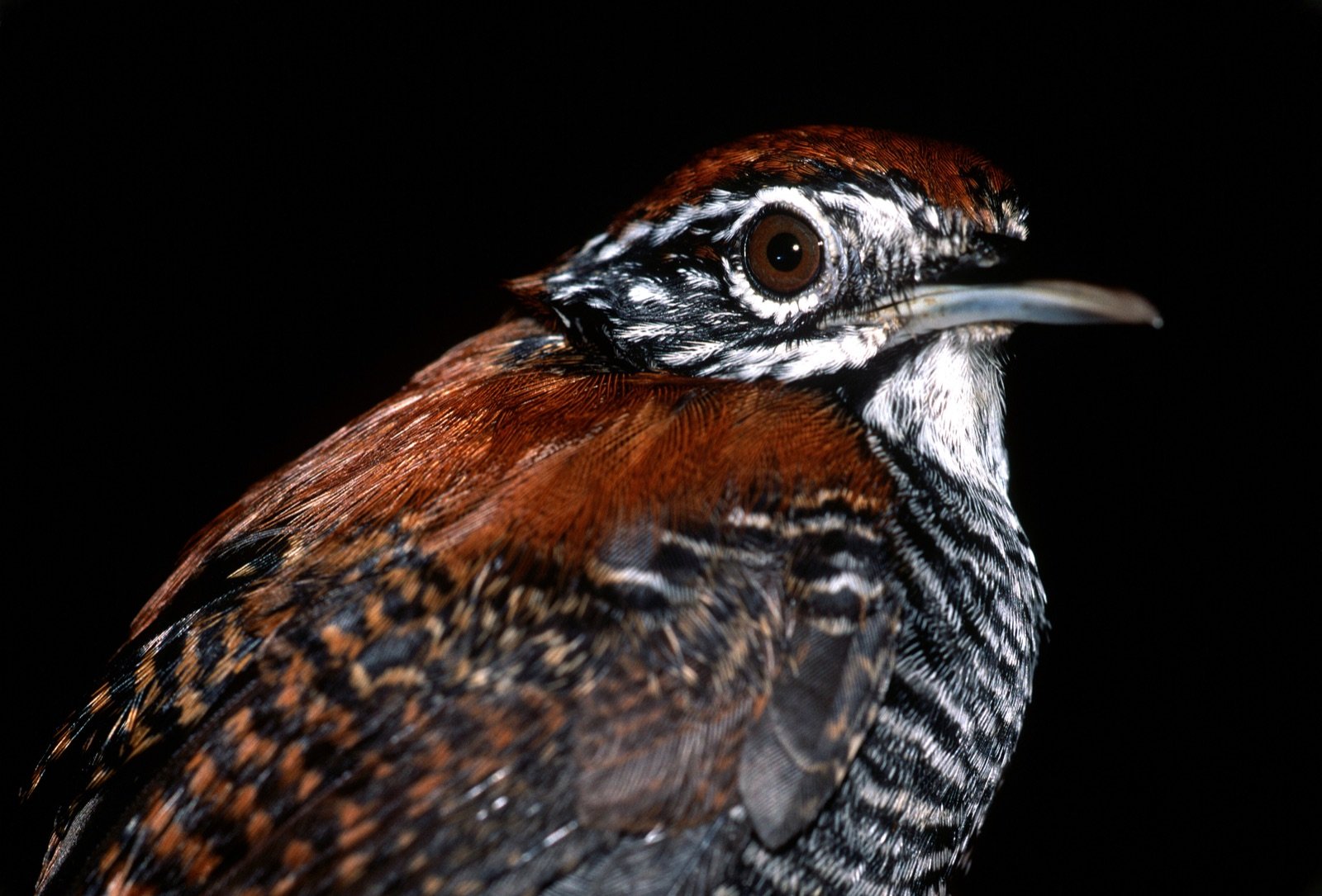
This is a small wren, about 13 to 14 cm long. Look for these marks:
Bright orange-brown crown and chestnut back.
Blackish tail with pale bars.
Black-over-white eyebrow stripe, with a face streaked black and white.
Pale gray underparts with fine black bars, turning buffier toward the rear.
In Costa Rica the description adds a white eye-ring, a reddish-brown eye, a black upper bill, a pale gray lower bill and dark gray legs. Juveniles look similar but are duller above.
What it sounds like
Behaviour and diet
Riverside Wrens go in pairs or family groups of three or four birds, and they are described as moving in small, noisy groups. They forage near the ground, and they sometimes join other species briefly at army ant swarms. The species is generally common but not always easy to see, because it tends to skulk in dense vegetation. The nest is a bulky globe on a horizontal branch, often hung over flowing water, about 1.5 to 2.2 m above it. The birds also build separate roosting nests.
Where it lives
In Costa Rica it lives on the southern Pacific slope, from the lowlands up to about 1,200 m. It likes dense growth along wider streams and open swampy spots inside forest, and it also enters forest-edge thickets, waterlogged banks and shaded gardens away from water. A Costa Rican natural history record places it in three conservation areas: Osa, Pacífico Central and Amistad Pacífico. It is a resident with no migration.
When to see it
It breeds from December to August in Costa Rica, and the clutch is two eggs. A Costa Rican bird guide says it prefers dense growth beside wider streams and open swamps, especially in the rainy season.
Similar birds
Bay Wren and Isthmian Wren are two similar Costa Rican wrens. Riverside Wren was once treated as the same species as Bay Wren, but the two differ in plumage, and there is no evidence of interbreeding where their ranges meet in Costa Rica and western Panama. Around Carara nine wren species share the habitats, including Rufous-breasted, Rufous-and-white and Black-bellied, and Riverside Wren is the one with loud, quick songs in rainforest.
Names and lore in Costa Rica
In Costa Rica the bird is called Soterrey Pechibarreteado. A Spanish-language source also lists the names cucarachero ribereño and ratona del río. Panama uses the spelling sotorrey pechibarreteado.
Status and conservation
The AOCR list marks it as an endemic resident (R-END), and the IUCN rates it Least Concern, though habitat change makes the population trend uncertain.
Photography tips
In protected areas, playback is technically illegal, so patient waiting and tracking singing birds is the legal approach. Stay still near dense growth beside the water and let the birds reveal themselves by song.
Trips that find it
- Dancing with Quetzals11 nightsSee the trip
Tell us when you are travelling and our team in Costa Rica builds the trip around the birds you want to see.
Plan my birding tripHow we know this 19 sources, each read on the date shown
- Aves de Costa Rica read 2026-11-04
https://avesdecostarica.com/Cantorchilus-semibadius.html - Flickr (Jorge Obando, natural history notes) read 2026-11-04
https://www.flickr.com/photos/jobando/31017565461 - Ficus Tours read 2026-11-04
https://www.ficustours.com/blog/cuales-son-los-tipos-de-aves-que-podemos-encontrar-en-la-peninsula-de-osa/ - Birds of Costa Rica (birdsofcolombia.org) read 2026-11-04
https://www.birdsofcolombia.org/costarica/Cantorchilus.html - Wikipedia read 2026-11-04
https://en.wikipedia.org/wiki/Riverside_wren - Cornell Birds of the World read 2026-11-04
https://birdsoftheworld.org/bow/species/rivwre1/cur/introduction - Wikipedia (Spanish) read 2026-11-04
https://es.wikipedia.org/wiki/Cantorchilus_semibadius - Birda read 2026-11-04
https://app.birda.org/species-guide/28656/Riverside_Wren - Wikipedia read 2026-11-04
https://en.wikipedia.org/wiki/List_of_birds_of_Costa_Rica - Animal Diversity Web (Naturesongs, D. Von Gausig) read 2026-11-04
https://animaldiversity.org/collections/contributors/naturesongs/riwr12/ - Zenodo (duetting wren study) read 2026-11-04
https://zenodo.org/records/4968974 - Birdingcraft read 2026-11-04
https://birdingcraft.com/wordpress/2014/08/14/big-cool-wrens-of-costa-rica/ - Animalia.bio (Wikipedia-based) read 2026-11-04
https://animalia.bio/riverside-wren - Cloudbridge Nature Reserve bird list read 2026-11-04
https://www.cloudbridge.org/wp-content/uploads/2020/04/Bird-Species-List-Costa-Rica-13-April-2020.pdf - CRS Tours read 2026-11-04
https://crstours.com/costa-rica-birdwatching-tours/ - Costa Rica Focus read 2026-11-04
https://www.costaricafocus.com/birding-carara-national-park-costa-rica-a-complete-guide/ - costarica.org read 2026-11-04
https://costarica.org/activities/birding/ - Aves y Ventanas Costa Rica read 2026-11-04
https://avesyventanascostarica.wordpress.com/algunas-aves-que-han-golpeado-contra-ventanas-en-costa-rica/ - Birdingcraft read 2026-11-04
https://birdingcraft.com/wordpress/2024/06/07/costa-rica-birding-a-whole-lot-of-wrens-going-on/