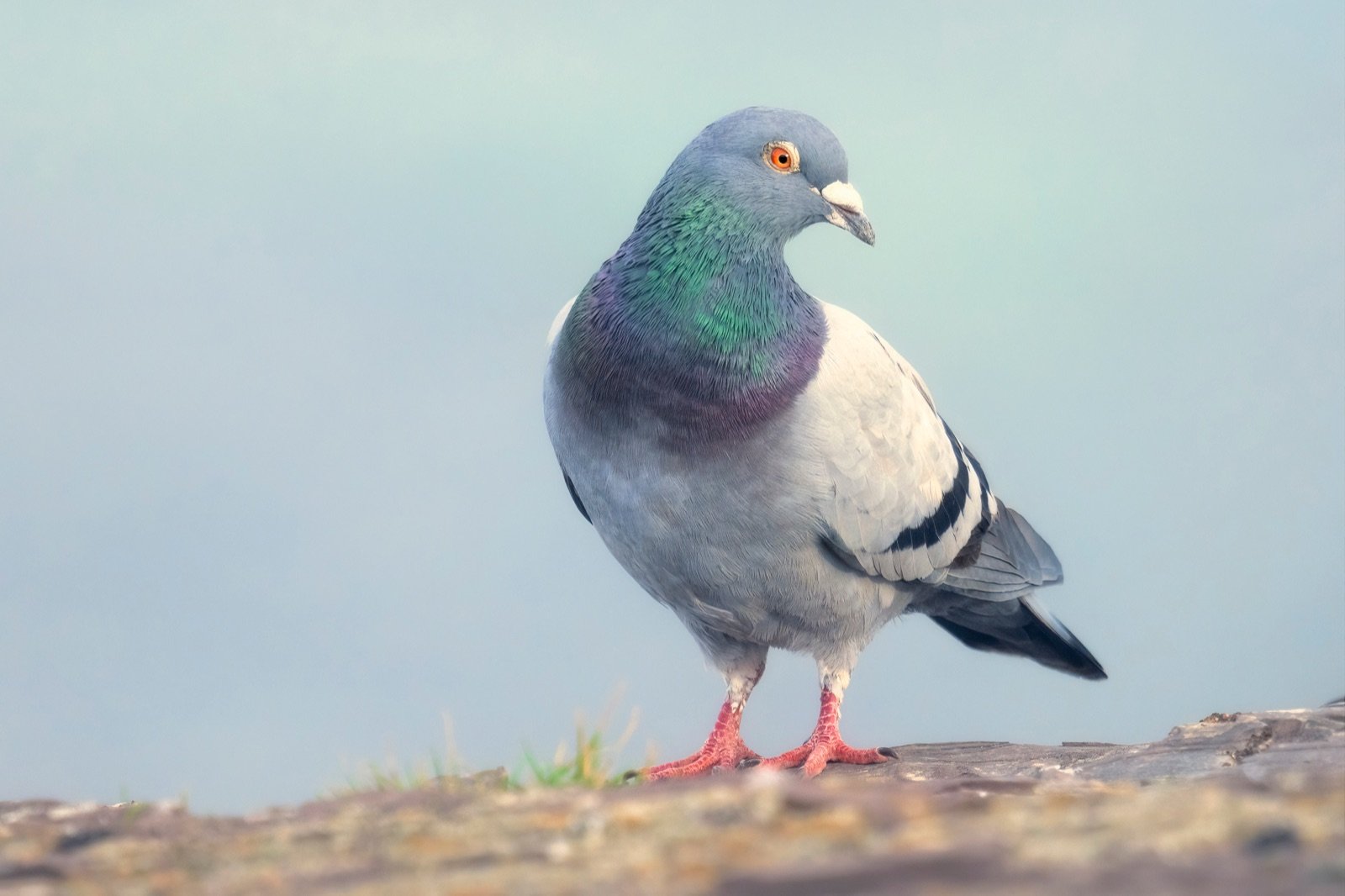
 Rock Pigeon
Family Columbidae
Rock Pigeon
Columba livia
In Spanish: Paloma Doméstica (Paloma de Castilla)
- Resident
An introduced town pigeon, easiest around San José plazas and Central Valley cities.
The Rock Pigeon is not a bird you travel to Costa Rica for, but it is one you will meet. The feral birds live mainly around cities and large towns, especially in the Central Valley, and in San José they gather around the Plaza de la Cultura and the Teatro Nacional.
It is not native here. It was brought in from Europe and is now a resident species, with birds ranging from fully domestic to fully feral.
For a beginning birder it makes a friendly first lesson. It is easy to watch closely, and it teaches you to notice plumage, flock behaviour and where a species chooses to nest.
How to find it
Head for a city or large town, especially in the Central Valley. In San José, pigeons gather around the Plaza de la Cultura and the Teatro Nacional. Scan open ground such as pavements and lawns, where flocks feed. Numbers in city parks follow human feeding, so look near vendors selling corn. Look up as well, because they nest on rooftops, terraces, ledges and church towers. A flock in the countryside is probably free-flying domestic birds rather than feral ones.
How to recognise it
A town pigeon about 30 cm long and 300 g. Its plumage varies so much that flocks are easy to spot from far away.
Wild-type adults look like this:
- dark grey, with a purple and green sheen on the neck
- two black wing bars
- a white rump and a black tail tip
- an orange eye and magenta feet
That wild-type look is often replaced, to varying degrees, by white, blackish or reddish brown patches. So do not expect every bird to match the textbook grey one. Look for the orange eye and the magenta feet, and enjoy how different neighbours in one flock can look.
What it sounds like
Behaviour and diet
Pigeons are gregarious and gather in flocks. Feral pigeons feed mainly on seeds, other plant matter and food scraps left by people, foraging on open ground such as pavements and lawns.
They are very tolerant of people and show little fear of humans, so you can watch them at close range. Many pigeons and doves feed almost only on the ground, walking with a nodding head.
In Costa Rican towns they build small bowl nests of sticks and grass stems. These sit on planters, beams, bridges and church bell towers.
Where it lives
Birds in Costa Rica range from fully domestic to fully feral. The feral ones live mostly in urban areas and nest on man-made structures, mainly around cities and large towns, especially in the Central Valley.
Flocks seen in rural districts are probably domestic birds allowed to fly free, not truly wild ones.
The species originally lived on coastal cliffs around the Mediterranean, Africa and Asia. City buildings give it similar nesting and resting places.
Names and lore in Costa Rica
Costa Ricans call this bird Paloma de Castilla or Paloma Doméstica, and a Costa Rican university study treats Paloma de Castilla as the usual everyday name. Some people see the pigeon as a pest, while others value it as part of the cultural and natural setting of parks and cities. In a 2008 interview study in Alajuela Central Park, about two thirds of 61 people said the pigeons matter in the park, and others disliked them for the damage they cause to buildings. Tradition is one reason people give for feeding park pigeons, alongside fun and empathy.
Status and conservation
The AOCR list marks it as a resident (R), though it is introduced rather than native here, and the species as a whole is listed as Least Concern by the IUCN.
Photography tips
Pigeons nest on rooftops, terraces, ledges and church towers, so look for them there as well as on the ground. Their tolerance of people lets you work at close range, and the mix of white, blackish and reddish brown birds in one flock makes for varied frames.
How we know this 15 sources, each read on the date shown
- Aves de Costa Rica read 2026-11-04
https://www.avesdecostarica.org/columbidae.html - Aves de Costa Rica read 2026-11-04
https://avesdecostarica.com/Columba-livia.html - Biodiversity Explorer read 2026-11-04
https://www.biodiversityexplorer.info/birds/columbidae/columba_livia.htm - Wikipedia read 2026-11-04
https://en.wikipedia.org/wiki/Rock_dove - Wikipedia read 2026-11-04
https://en.wikipedia.org/wiki/Feral_pigeon - Uniciencia (Universidad Nacional de Costa Rica) read 2026-11-04
https://www.redalyc.org/journal/4759/475950939004/html/ - iNaturalist Chile (Costa Rica Check List entry) read 2026-11-04
https://inaturalist.mma.gob.cl/taxa/3017-Columba-livia - PubMed Central (Chlamydia psittaci study, San José) read 2026-11-04
https://www.ncbi.nlm.nih.gov/pmc/articles/PMC4629625/ - Costa Rica Silvestre (Vecinos Silvestres series) read 2026-11-04
https://costaricasilvestre.go.cr/wp-content/uploads/2020/11/fichas-palomas.pdf - El Hornero (Efecto de la infraestructura y usuarios de parques urbanos) read 2026-11-05
https://elhornero.avesargentinas.org.ar/home/article/view/414 - SIIDCA-CSUCA thesis catalogue (Benavides Sánchez 2020) read 2026-11-05
https://catalogosiidca.csuca.org/Record/UNED.000083152/Description - Revista de Biología Tropical (Cabalceta and Barrientos) read 2026-11-05
https://www.redalyc.org/journal/5156/515663493014/html/ - SciELO Costa Rica (Revista de Biología Tropical) read 2026-11-05
https://www.scielo.sa.cr/scielo.php?script=sci_abstract&pid=S1659-42662019000300361&lng=en&nrm=iso&tlng=es - Universidad Nacional repository (Zeledonia study) read 2026-11-05
https://repositorio.una.ac.cr/items/5dd19ba1-addb-4912-828e-c2ee852d7dce - Avibase read 2026-11-05
https://avibase.bsc-eoc.org/checklist.jsp?region=CR