Family Troglodytidae
Rock Wren
Salpinctes obsoletus
In Spanish: Soterré Roquero
- Resident
A speckled wren of windswept boulder slopes in the northwest
The Rock Wren (Soterré Roquero) is a small wren, about 14 cm long, that lives on open, stony ground rather than in forest. In Costa Rica it is a locally common resident on the Pacific slope of the Cordillera de Guanacaste, and its range runs south to Volcán Miravalles.
This is the southernmost end of the species' range, and the Costa Rican birds are a small, isolated population, so the bird rewards a deliberate search. It sings or scolds from windswept, boulder-strewn grassy slopes, open stony hillsides and rocky canyons.
On a trip we build around Rincón de la Vieja, the grassy upper areas reached from the Catarata Escondida trail, in the northwest, are where guests can look for it.
How to find it
Start with the grassy area that the Catarata Escondida trail can lead up to in Rincón de la Vieja National Park, where Rock Wren, Rusty Sparrow and Botteri's Sparrow have been seen. The wind-blown oak savannas on the western flanks of Rincón de la Vieja are best visited early in the morning. A trip there also targets Rusty and Botteri's Sparrows, and a Rock Wren is only an outside chance. The windy oak savanna habitats about 30 minutes from a lodge nearby are another place where one might turn up. Expect to scan wide boulder fields, because pairs live far apart, and check the tops of boulders first.
How to recognise it
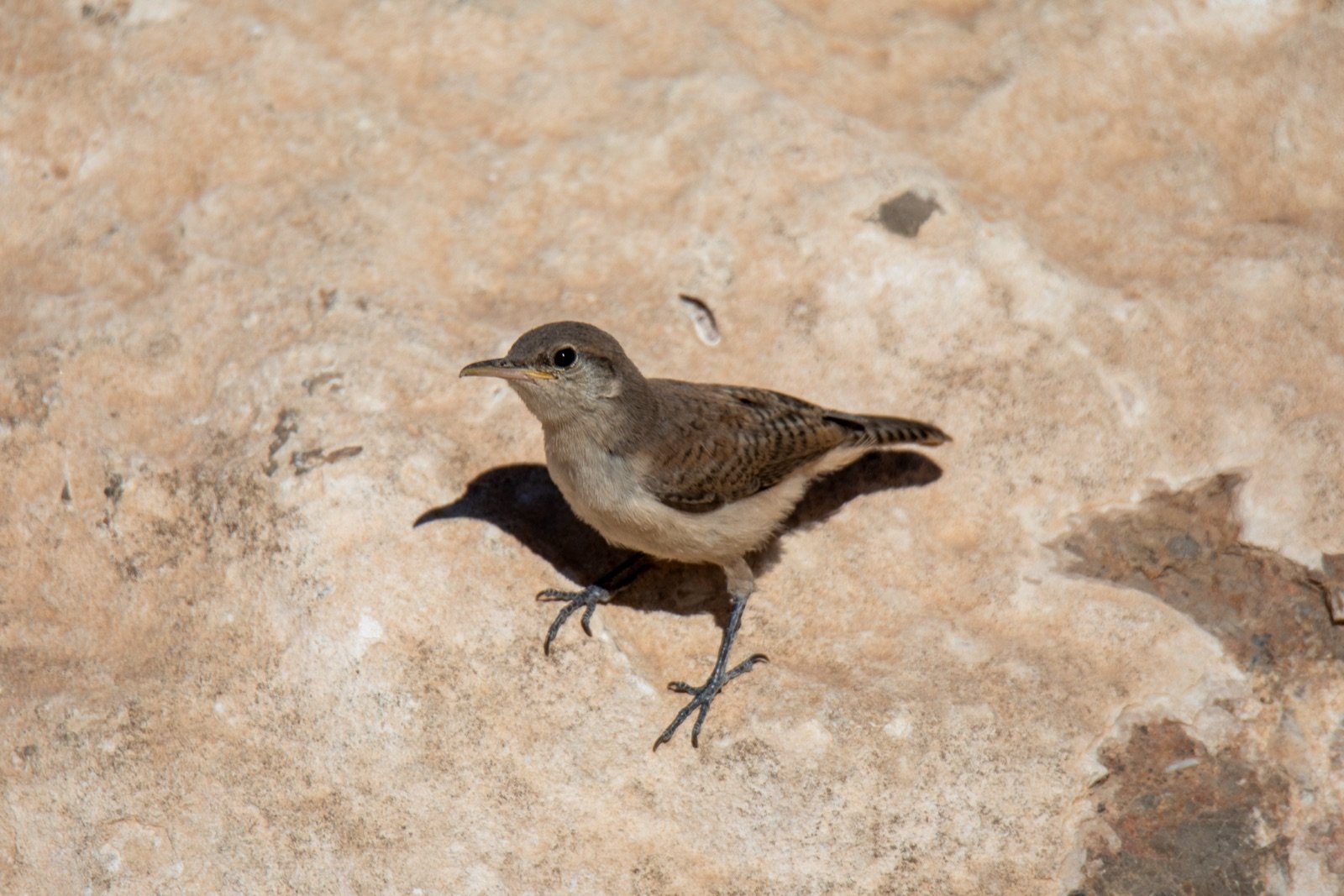
Look for a small wren, about 14 cm long, that is heavily speckled. It has a fairly long tail and a long, slightly downcurved bill.
Above, it is grayish brown, with paler eyebrows and a dark stripe behind the eye.
Below, it is dull white with a buff tint on the chest and flanks, and the underparts look spotted and finely barred.
The rump is buffy and barred. The tail is barred with black and has a black subterminal band with a buffy tip, a good detail to check if the bird turns away from you on a rock.
What it sounds like
Recording: Eric Johnson, CC BY 4.0, source, read 4 Nov 2026.
Behaviour and diet
A Rock Wren often bobs its body up and down while perched in rocky habitat, a habit noted across its range and a useful clue when you scan boulders.
In Costa Rica, pairs live fairly far apart from each other, so the birds are spread thinly across their slopes. The nest is a shallow cup of grass and plant fibres placed in a rock cavity or under a rock.
The species in general is often easy to see because it perches on top of rocks, and males commonly sing from rocky promontories.
Where it lives
In Costa Rica the Rock Wren is found between about 500 and 1600 m elevation.
It lives on windswept, boulder-strewn grassy slopes, open stony hillsides, rocky canyons and low-vegetation streams, where it sings or scolds.
Its range is the Pacific slope of the Cordillera de Guanacaste in the northwest, reaching south as far as Volcán Miravalles.
When to see it
One source says it breeds in May and June.
Similar birds
The Costa Rican description stresses the paler eyebrows, the dark line behind the eye, the spotted and finely barred underparts and the buffy, barred rump. Together with the black-barred tail and its buffy tip, these marks help you check a small brown bird on open, rocky ground. The Canyon Wren, with its bright white bib and rusty belly, is not a Costa Rican species, and the Rock Wren is paler and grayer with a buff breast.
Names and lore in Costa Rica
Costa Ricans call it Soterrey Roquero. Other Spanish names used elsewhere in its range include chivirín saltarroca, saltapared roquero and cucarachero roquero. In Honduras it is colchonero de piedras, and in Nicaragua charralero de las rocas.
Status and conservation
The AOCR official list marks it as a resident (R) in Costa Rica, and the species is not globally threatened.
Photography tips
The rocky slopes are open and windswept, so pairs live far apart. Expect to scan wide boulder fields rather than find several birds close together. Males commonly sing from rocky promontories, so scan boulder tops.
How we know this 15 sources, each read on the date shown
- Aves de Costa Rica read 2026-11-04
https://avesdecostarica.com/Salpinctes-obsoletus.html - Cornell Birds of the World read 2026-11-04
https://birdsoftheworld.org/bow/species/rocwre/cur/multimedia?media=photos - Birds of Southern California read 2026-11-04
https://ocbirds.com/gallery/rock-wren/index.html - Avibase read 2026-11-04
https://avibase.bsc-eoc.org/species.jsp?avibaseid=76DF73A9F213E90A&avibaseid=76DF73A9F213E90A - AOCR Lista Oficial read 2026-11-04
https://listaoficialavesdecostarica.wordpress.com/lista-oficial/lista-oficial-online/ - Birding Craft read 2026-11-04
https://birdingcraft.com/wordpress/2021/03/03/strategic-birding-in-costa-rica-at-rincon-de-la-vieja-rinconcito-lodge/ - Birding Craft read 2026-11-04
https://birdingcraft.com/wordpress/2015/11/25/birding-costa-rica-at-rincon-de-la-vieja-what-to-expect-in-2016/ - Wikipedia (es) read 2026-11-04
https://es.wikipedia.org/wiki/Salpinctes - Avibase read 2026-11-04
https://avibase.bsc-eoc.org/species.jsp?avibaseid=7D74040F00A5570E - Cornell Lab, All About Birds read 2026-11-05
https://www.allaboutbirds.org/guide/Rock_Wren/id - Oiseaux-Birds read 2026-11-05
https://www.oiseaux-birds.com/card-rock-wren.html - Eastside Audubon Society read 2026-11-05
https://www.eastsideaudubon.org/corvid-crier/2021/rock-wren - Audubon Field Guide read 2026-11-05
https://www.audubon.org/field-guide/bird/rock-wren - National Wildlife Foundation read 2026-11-05
https://nwlfd.org/species/rock-wren - DiBird read 2026-11-05
https://dibird.com/species/rock-wren/