Family Formicariidae
Rufous-breasted Antthrush
Formicarius rufipectus
In Spanish: Gallito Hormiguero Pechicastaño
- Resident
A chicken-walking forest floor bird, found first by its two-note whistle.
The Rufous-breasted Antthrush (Gallito Hormiguero Pechicastaño) is a chunky, short-tailed bird of the forest floor, and it walks like a chicken. In Costa Rica it lives on the Caribbean slope, recorded between about 800 and 1,800 m elevation.
Tapanti National Park, a middle elevation site about 30 minutes from Cartago, is where most birders in Costa Rica see their first one. The usual way in is by ear: a loud, ringing two-note whistle from steep, dark forest, then patient waiting.
On a trip we build, early morning and patience matter more than sharp eyes. It is fairly common here even though it is very local across its range.
How to find it
Start with your ears, because the two-note whistle is far easier to find than the bird. Early morning visits work better: one birder walked the Arboles Caidos trail at Tapanti in sunny weather in the least birdy part of the day, saw very little and did not even hear one. Arboles Caidos is a steep trail known as a place for this antthrush, and one group first heard it there, then waited patiently and watched it cross the forest floor. Braulio Carrillo National Park has similar forest where it calls, but the drive has few trails or stopping places, so visitors there mostly hear it from the road.
How to recognise it
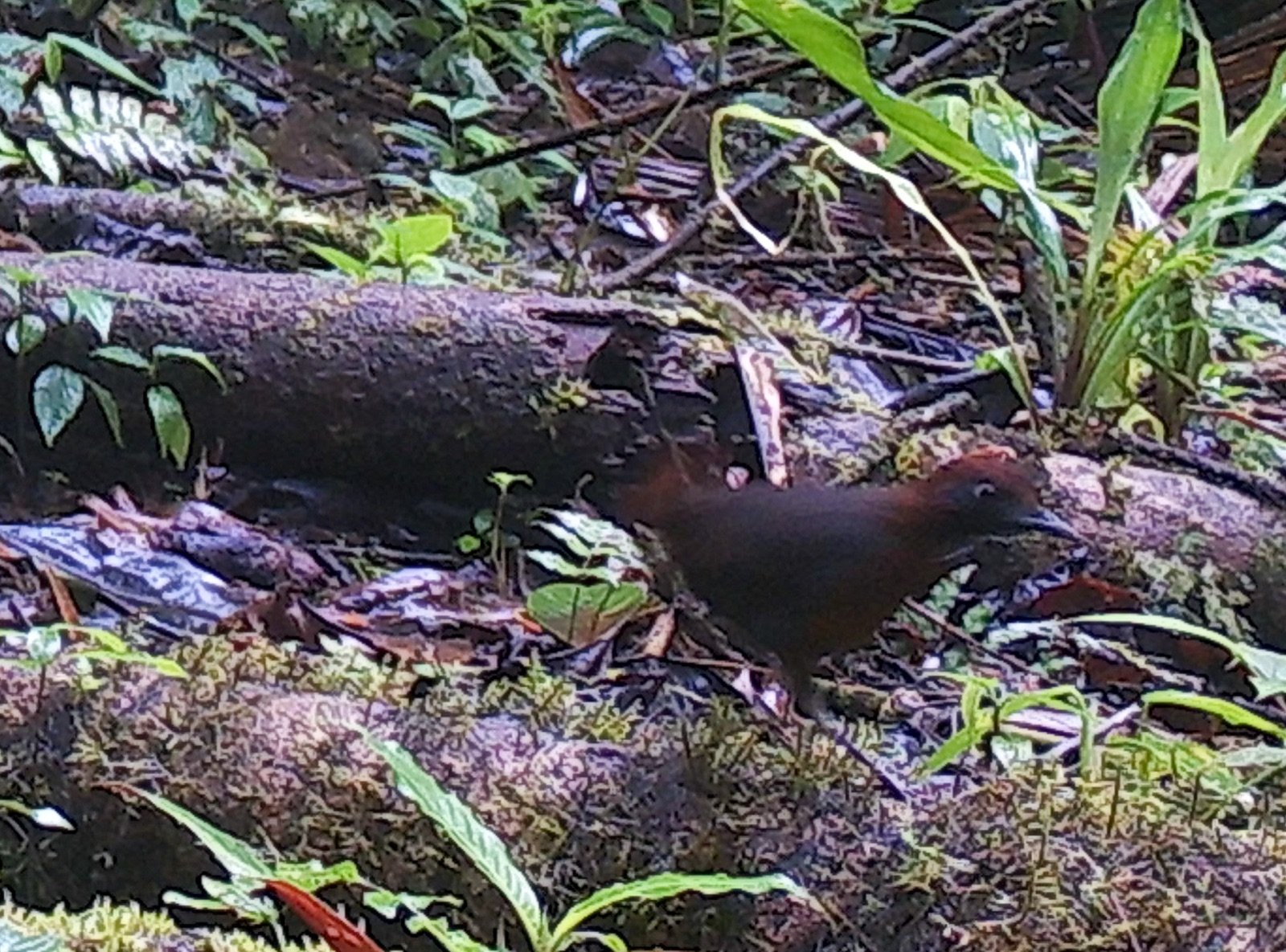
Look for a chunky, short-tailed bird walking on the forest floor like a chicken.
The underparts are entirely rufous, unlike other antthrushes in its genus, though that colour can be hard to see in dark forest. The face and throat are blackish. A bluish white ring of bare skin circles the eye. The crown and nape are dark chestnut.
In dim light the dark face, the pale eye ring and the strutting walk are the details to watch for.
What it sounds like
Recording: Niels Krabbe, CC BY-SA 4.0, source, read 5 Nov 2026.
Behaviour and diet
It is usually seen alone or in pairs in the forest, and it occasionally joins army ant swarms. It can strut across the forest floor in a chicken-like way.
Watching it can be a small comedy. On one Tapanti tour an antthrush in a roadside tree seemed to have just disturbed a stinging ant nest, because it paused every couple of steps to scratch its backside. Another group found one by ear, waited patiently, and watched it walk across the open forest floor.
Where it lives
In Costa Rica this antthrush lives on the Caribbean slope. Its range starts in southern Guanacaste Province and continues south into Panama. Here it is recorded between about 800 and 1,800 m elevation.
Across its range it lives in humid to wet primary forest and mature secondary forest. It prefers ravines, regrown landslide scars and steep slopes.
Similar birds
It usually occurs at higher elevations than Black-faced and Black-headed Antthrushes. Its two-note whistled song also differs strongly from theirs, so voice is the quickest way to tell them apart.
Names and lore in Costa Rica
The Costa Rican Spanish name is Gallito Hormiguero Pechicastaño.
Status and conservation
The official Costa Rican list gives it resident (R) status, one of three antthrushes on that list, and the IUCN rates it Least Concern.
Photography tips
At Tapanti one birder found an antthrush by ear and then waited patiently. It walked across the forest floor in the open, yet stayed hidden from the photographer, though everyone had great views. Listen first, wait where you hear it, and expect dark, steep forest.
How we know this 14 sources, each read on the date shown
- Wikipedia read 2026-11-04
https://en.wikipedia.org/wiki/Rufous-breasted_antthrush - Cornell Birds of the World read 2026-11-04
https://birdsoftheworld.org/bow/species/rubant1/cur/introduction - Birds Colombia read 2026-11-04
https://birdscolombia.com/2019/02/19/gallito-pechirrufo-rufous-breasted-antthrush-formicarius-rufipectus/ - Lista Oficial de las Aves de Costa Rica read 2026-11-04
https://listaoficialavesdecostarica.wordpress.com/lista-oficial/lista-oficial-online/ - Birds of Passage read 2026-11-04
https://birdsofpassage.wordpress.com/2014/06/24/tapanti-national-park-and-reserva-el-copal/ - Birdingcraft read 2026-11-04
https://birdingcraft.com/wordpress/2016/09/07/a-morning-at-tapanti-national-park/ - Birdingcraft read 2026-11-04
https://birdingcraft.com/wordpress/tag/tapanti-national-park/ - Costa Rica Focus read 2026-11-04
https://www.costaricafocus.com/hotspot/rancho-naturalista-trails/ - Field Guides trip list read 2026-11-04
https://fieldguides.com/triplists/cos20.html - Wikipedia (Spanish) read 2026-11-04
https://es.wikipedia.org/wiki/Formicarius_rufipectus - Birding Craft read 2026-11-04
https://birdingcraft.com/wordpress/tag/costa-rica/page/21/ - Quetzal by Car read 2026-11-04
https://www.quetzalbycar.com/locations/el-copal-and-tapanti-np - Exotic Birding Tapanti checklist read 2026-11-04
http://www.exoticbirding.com/costarica/tapanti-national-park/checklist.html - Birding Craft read 2026-11-04
https://birdingcraft.com/wordpress/2011/05/23/recent-birding-at-tapanti-national-park/