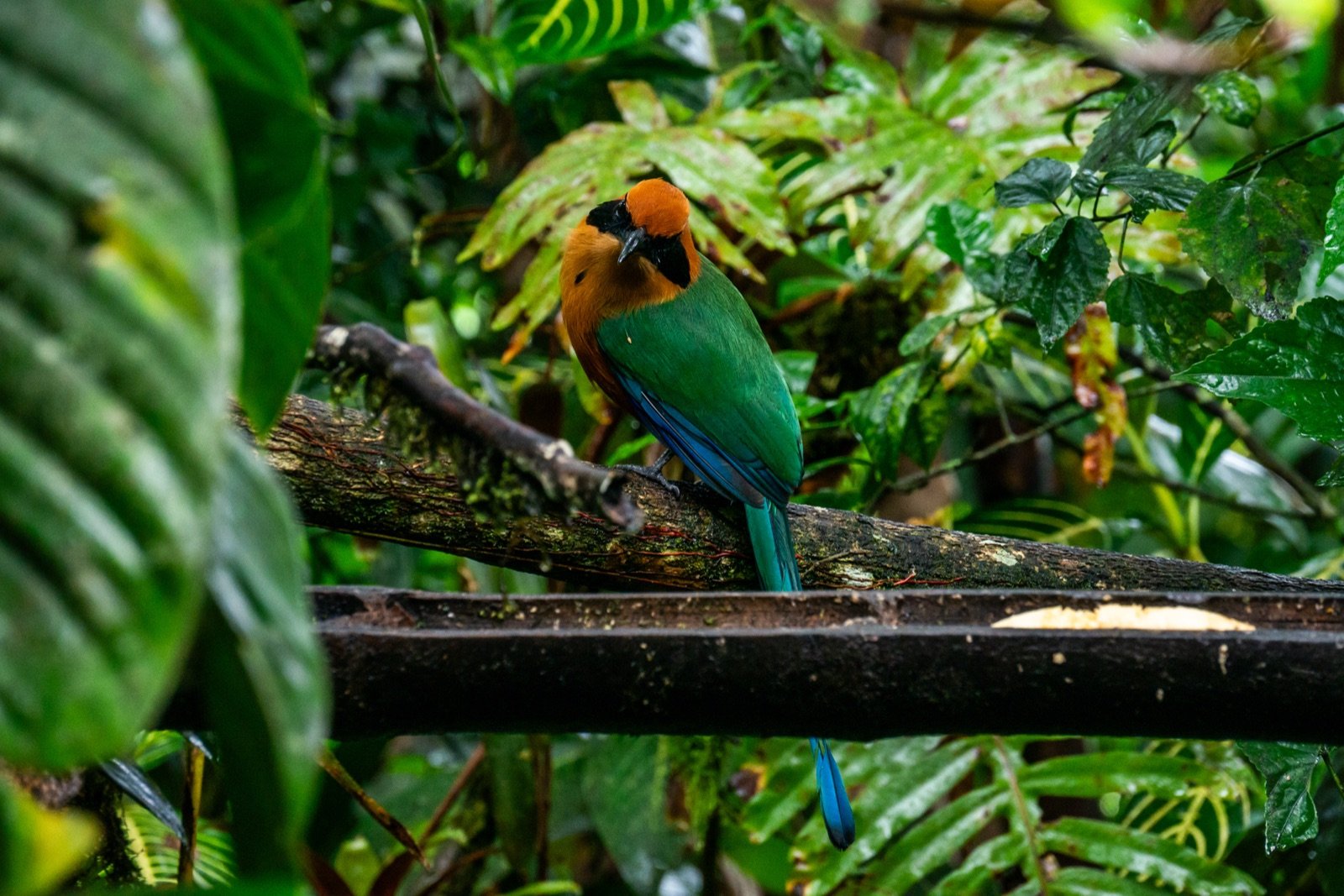
 Rufous Motmot
Family Momotidae
Rufous Motmot
Baryphthengus martii
In Spanish: Momoto Canelo Mayor (Pájaro Bobo)
- Resident
Large cinnamon motmot of Caribbean lowland forest
The Rufous Motmot is a large, sturdy bird of about 46 cm, with a cinnamon-rufous head and breast and a wide black face mask. It is a common resident of the Caribbean slope, in the lowlands and on the foothills.
On trips we build around Turrialba, it turns up at the morning feeders, alongside Gray-headed Chachalaca and Collared Aracari.
Where to see it
How to find it
Look in lowland and foothill rainforest on the Caribbean slope, especially around forested ravines, streams and embankments where it can nest. It often follows army ants to catch the insects they flush, so a swarm in lowland forest can lead you to it. Check both high perches and the lower forest levels.
How to recognise it
Look for a large, sturdy motmot about 46 cm long. The head and breast are cinnamon-rufous, with a wide black face mask and a small black spot on the breast. The back and wings are deep green and the tail is long, ending in small bare-shafted rackets. The lower belly is greenish-blue, the flight feathers and tail are dark blue, and the bill and legs are black. Young birds look like adults but are paler and duller, with no black breast spot and no tail rackets.
What it sounds like
Behaviour and diet
It is usually seen alone or in pairs. When hunting it sits quietly on a shaded horizontal branch for long stretches, then darts out suddenly after passing insects. When excited or disturbed it swings its tail side to side like a pendulum. It eats many kinds of fruit, plus insects, spiders, small fish, lizards and frogs. At Tirimbina Biological Reserve one was recorded preying on a green iguana, a first for the country.
Where it lives
It lives in humid lowland evergreen forest, both old and secondary growth, and prefers tall forest along rivers and streams. In Costa Rica it is found on the Caribbean slope, in the lowlands and on the foothills, up to about 900 m in one account, while another gives near sea level up to about 1,250 m. It perches and sings high in the canopy in partly open areas, but drops into the understory to forage.
When to see it
Breeding in Costa Rica runs from March to June.
Similar birds
The Broad-billed Motmot looks almost the same but is smaller, with a blue-green chin where the Rufous has a cinnamon chin, and a larger black chest patch. The Rufous also has a much narrower bill. At a distance, with nothing to judge size against, they can be hard to tell apart.
Names and lore in Costa Rica
Costa Ricans call it Bobo or Pájaro Bobo, alongside the AOCR name Momoto Canelo Mayor. The same nickname is used for the other motmots. One magazine says bobo imitates the call. In a Bribri legend, the lazy motmot hid in a hole when the god Sibú asked all creatures to help make the world, but left its tail sticking out, which explains the bare-tipped tail.
Status and conservation
The AOCR list marks it as a resident (R), and the IUCN lists it as Least Concern.
Photography tips
Motmots may show in more open places at dawn and dusk, but usually hide in dark ravines at other times, so plan to look right after dawn and near dusk. Expect low light in the shade of the forest.
Trips that find it
- Bird Photography in Costa Rica9 nightsSee the trip
- Best of Birding in Costa Rica's Caribbean9 nightsSee the trip
- Caribbean Lowlands Birding Tour11 nightsSee the trip
- Birding in Costa Rica's Eco-Zones11 nightsSee the trip
Tell us when you are travelling and our team in Costa Rica builds the trip around the birds you want to see.
Plan my birding tripHow we know this 24 sources, each read on the date shown
- Aves de Costa Rica read 2026-11-04
https://avesdecostarica.com/Baryphthengus-martii.html - Wikipedia (via iNaturalist) read 2026-11-04
https://www.inaturalist.org/taxa/2163-Baryphthengus-martii - Birds of the World (Cornell) read 2026-11-04
https://birdsoftheworld.org/bow/species/rufmot1/cur/behavior - EcoRegistros read 2026-11-04
https://www.ecoregistros.org/sheet/Baryphthengus-martii - Birda read 2026-11-04
https://app.birda.org/species-guide/10729/Rufous_Motmot - JungleDragon (Wikipedia text) read 2026-11-04
https://www.jungledragon.com/specie/10298/rufous_motmot.html - Revista Latinoamericana de Herpetología read 2026-11-04
https://herpetologia.fciencias.unam.mx/index.php/revista/article/view/1069 - Bird Watching Costa Rica read 2026-11-04
https://www.birdwatchingcostarica.com/familia/momotidae/ - Wikipedia read 2026-11-04
https://en.wikipedia.org/wiki/Broad-billed_motmot - Skutch, Life History of the Broad-billed Motmot (Coraciiformes TAG) read 2026-11-04
https://www.coraciiformestag.com/Research/Motmot/p0074-p0094_1_.pdf - Birds for Beer read 2026-11-04
https://birdsforbeer.com/2019/06/15/rufous-motmot-nesting-at-bonilla-arriba/ - Birding Craft read 2026-11-04
https://birdingcraft.com/wordpress/2014/06/13/where-to-see-motmots-when-birding-costa-rica/ - Ecos del Bosque read 2026-11-04
https://ecosdelbosque.com/fauna/baryphthengus-martii - Cornell Birds of the World read 2026-11-04
https://birdsoftheworld.org/bow/species/rufmot1/cur/introduction - Animalia read 2026-11-04
https://animalia.bio/rufous-motmot - Howler Magazine read 2026-11-04
https://howlermag.com/motmots-of-costa-rica/ - Wikipedia read 2026-11-04
https://en.wikipedia.org/wiki/Rufous_motmot - Flickr, Aves de Costa Rica text read 2026-11-04
https://www.flickr.com/photos/jobando/34806243893 - WINGS Birding Tours read 2026-11-04
https://wingsbirds.com/tours/costa-rica-july/ - Birding Craft read 2026-11-04
https://birdingcraft.com/wordpress/tag/rufous-motmot/ - Vacations Costa Rica read 2026-11-04
https://www.vacationscostarica.com/wildlife/motmots/ - Canopy Family read 2026-11-04
https://canopytower.com/rufous-motmot/ - Creagrus read 2026-11-04
https://creagrus.com/motmots.html - Evaneos read 2026-11-04
https://www.evaneos.com/costa-rica/holidays/discover/16545-1-13-incredible-birds-to-spot-in-costa-rica/