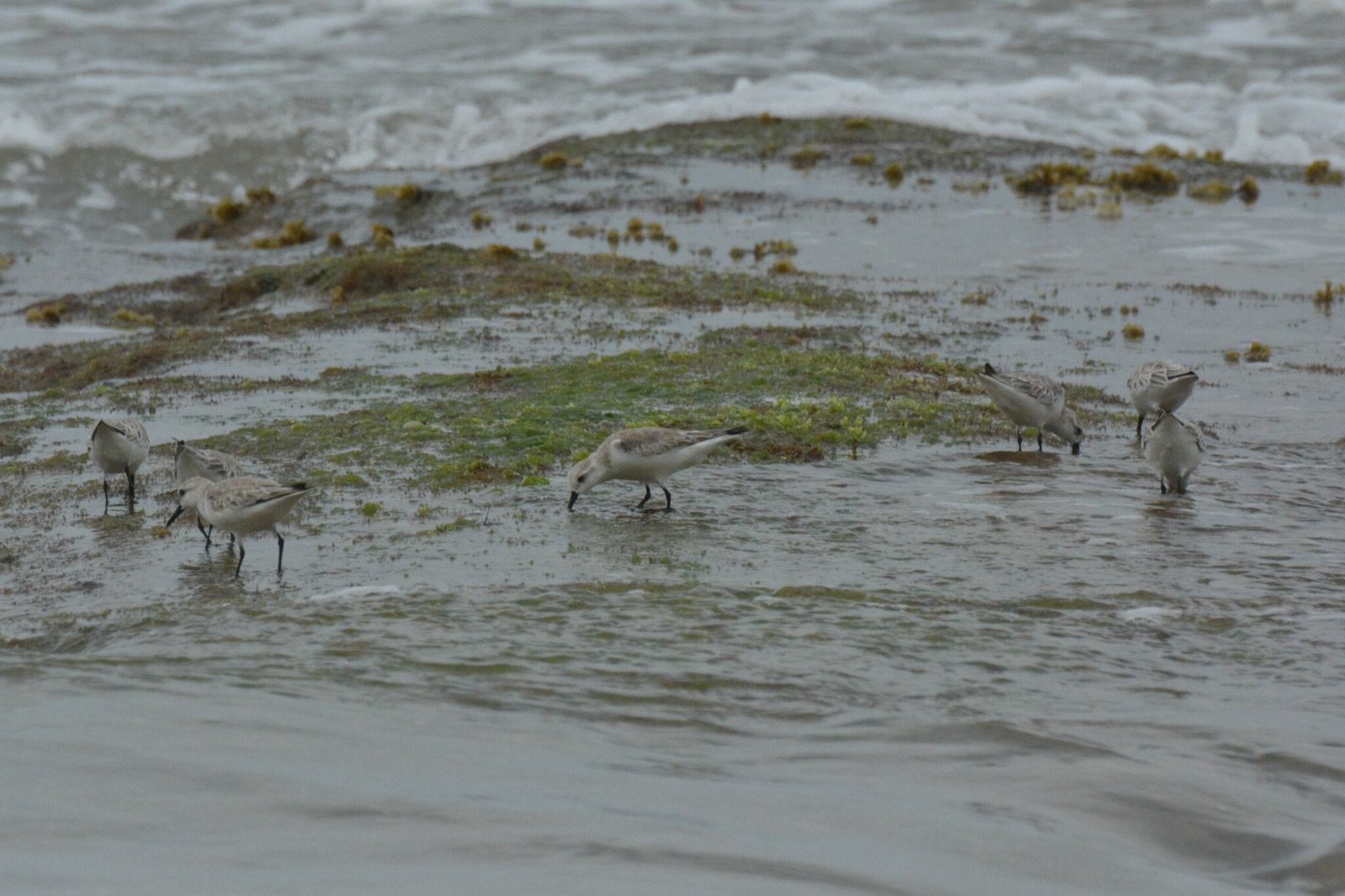
Family Scolopacidae
Sanderling
Calidris alba
In Spanish: Playero Arenero
- Migrant
A pale migrant sandpiper that races the waves on Costa Rican beaches.
The Sanderling (Playero Arenero) is a small, plump sandpiper about 18 to 20 cm long that lives at the edge of the surf. Small flocks dash back and forth as each wave pulls back, then run up the beach ahead of the next one.
In Costa Rica it is a visitor from the north, matching the AOCR status of migrant. It breeds on Arctic tundra and winters on coasts as far south as South America. A Costa Rican nature site reports flocks running along the shoreline at Puntarenas, on the Pacific coast.
On a trip we build, Pacific beaches such as Playa Tivives in Puntarenas province are where guests can meet it, which makes it a friendly first shorebird for a beginner.
How to find it
Look on sandy beaches and watch the edge of the surf, where the birds follow the waves in and out. The Pacific coast is described as more productive and easier for Sanderlings than the Caribbean. After feeding, birds retreat to rest and sleep on the upper beach or on the dikes of salt works, so check these spots when the shoreline looks empty. Mornings on the Pacific beaches are usually calm, which makes watching easier. One photographer reports the biggest flocks in April to May and September to October.
How to recognise it
Start with the colour, or rather the lack of it. In its pale winter plumage the Sanderling looks almost white, apart from a dark patch at the shoulder.
A Costa Rican field description stresses a pale head with a dark eye and that dark shoulder patch. Bill and legs are blackish, and winter adults are brownish gray above. A nonbreeding bird is pale gray and unstreaked on head and back.
It is small and plump, about 18 to 20 cm long. Unlike other small sandpipers it has no hind toe, though this is hard to see in the field. Later in the northern summer the face and throat turn brick red.
What it sounds like
Behaviour and diet
Watch the water's edge. Small flocks chase receding waves, probe the wet sand, then run back up the beach ahead of the next wave. They pick worms, mollusks and crustaceans from the sand.
Away from the breeding grounds the species is very social and often forms large flocks on beaches or coastal mudflats. Flocks sometimes take off together and land again to rest on the beach. A single bird sometimes defends its own feeding patch, a small detail to watch for among the flock.
Where it lives
The Sanderling is mostly a bird of sandy ocean beaches. It also uses sand and mud flats, lagoons and rocky shores between the tides, but less often.
In Costa Rica it is a bird of the coast, not the highlands. A Costa Rican natural history entry shows its range across the Amistad Caribe, Guanacaste, Osa, Pacífico Central, Tortuguero, Arenal Tempisque and Isla del Coco conservation areas.
When to see it
During migration, from mid-August to October and from mid-March to early May, it is common along both coasts. It is uncommon but widespread in the winter months, and summer presence is unconfirmed.
Similar birds
Nonbreeding Western Sandpipers are smaller, with a finely streaked head and back that a pale gray Sanderling lacks. Semipalmated Sandpipers are also smaller and show fine streaking on the breast. Least Sandpipers are smaller too and have yellow legs, while the Sanderling has black legs.
Names and lore in Costa Rica
Costa Rican sources list Playero Arenero as the Spanish name, and one source gives Correlimos Grande as another name used in Costa Rica. General Spanish names for the species, not specific to Costa Rica, include Playero Blanco, Playerito Blanco, Playerito Blanquito and Correlimos Tridáctilo.
Status and conservation
The AOCR lists the Sanderling as a migrant, a visitor from its Arctic breeding grounds.
Photography tips
At Playa Hermosa in Guanacaste the dark sand makes the pale birds stand out. The first two hours after sunrise gave the best light and the best encounters.
Do not push a feeding flock. Use a long lens from a comfortable distance and let the birds come to you as they follow the tide. If they scatter for no reason, you got too close.
How we know this 13 sources, each read on the date shown
- Contenido Tico read 2026-11-04
https://contenidotico.com/biodiversidad/aves/playero-arenero/ - Birds of the World (Cornell Lab) read 2026-11-04
https://birdsoftheworld.org/bow/species/sander/cur/introduction?lang=es - Wikipedia read 2026-11-04
https://en.wikipedia.org/wiki/Sanderling - Flickr (Costa Rican natural history text, Playa Tivives) read 2026-11-04
https://www.flickr.com/photos/jobando/36819454040 - Audubon Field Guide read 2026-11-04
https://www.audubon.org/field-guide/bird/sanderling - Birds in Backyards read 2026-11-04
https://www.birdsinbackyards.net/species/Calidris-alba - Cornell Lab, All About Birds read 2026-11-04
https://www.allaboutbirds.org/guide/Sanderling/species-compare/ - South Dakota Birds read 2026-11-04
https://www.sdakotabirds.com/species/sanderling_info.htm - Las Aves que Viven en Chile read 2026-11-04
http://avesvivenchile.blogspot.com/2007/11/playero-blanco.html - Naturalista Costa Rica read 2026-11-04
https://costarica.inaturalist.org/taxa/3849-Calidris-alba - Museo Nacional de Costa Rica read 2026-11-04
https://www.museocostarica.go.cr/nuestro-trabajo/investigaciones/historia-natural/gam/aves/ - Aves Ibéricas, Aves Costa Rica read 2026-11-04
https://www.avesibericas.es/costaricaaves2.htm - perfectcostarica.com read 2026-11-04
https://perfectcostarica.com/sanderling-costa-rica-photography-guide/