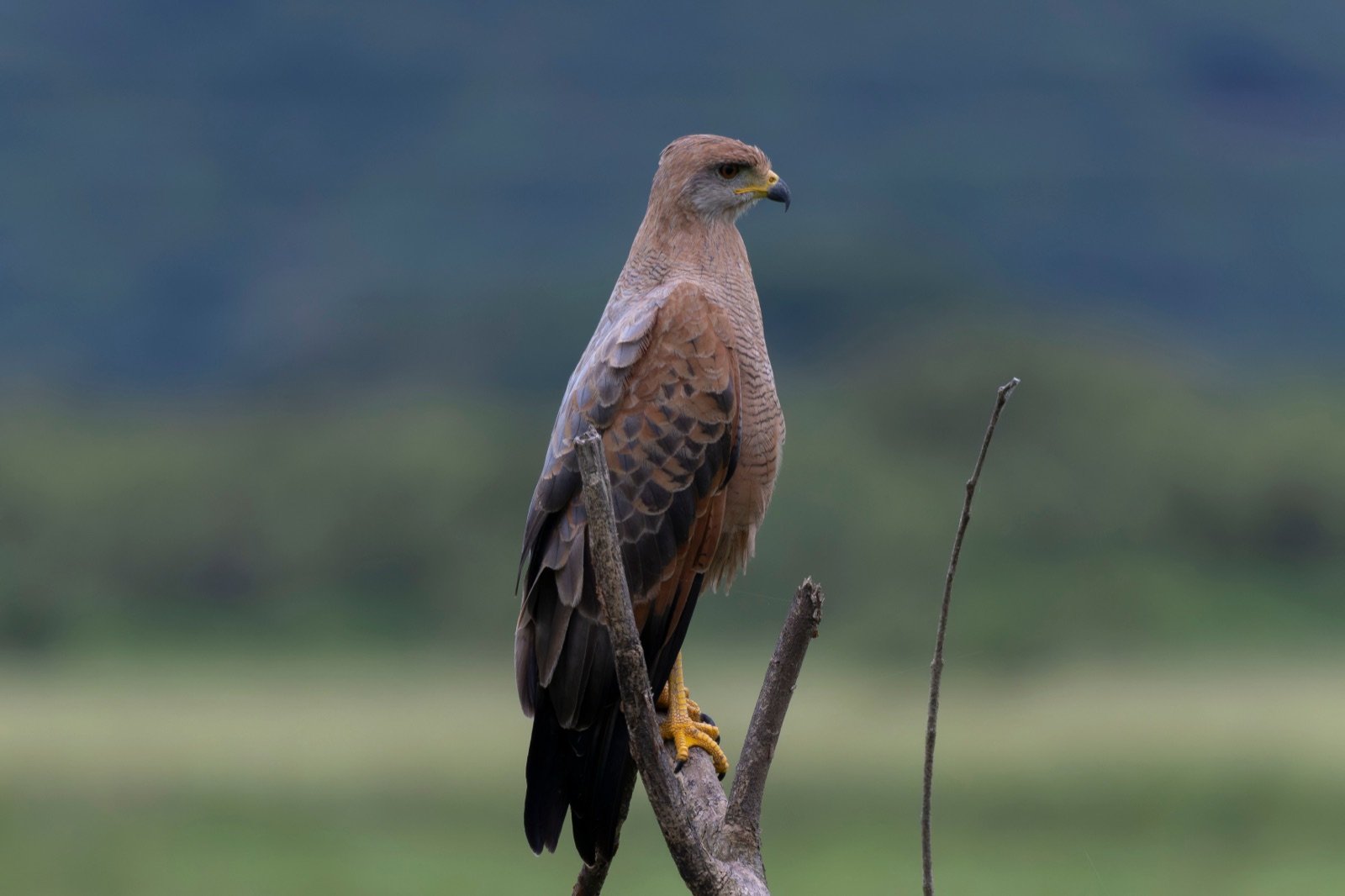
 Savanna Hawk
Family Accipitridae
Savanna Hawk
Buteogallus meridionalis
In Spanish: Gavilán Sabanero
- Resident
A tall rufous hawk newly settled in the far south Pacific farmland
The Savanna Hawk (Gavilán Sabanero) is a newcomer to Costa Rica. It was first documented here in 2008, and the country sits at the northernmost edge of its range, where the bird has spread only recently.
Look for a large rufous hawk standing very upright on a high open perch, a fence post or the ground. It likes open lowland country with scattered trees, which in Costa Rica means the far south Pacific, around rice fields and pastures near Ciudad Neily.
A 2015 paper reported the first nesting in the country and the status was changed to resident. This is a bird for patient scanning of open farmland rather than forest walking.
How to find it
Scan open lowland farmland, rice fields and pastures in the far south Pacific. Look for large rufous hawks on high open perches, on fence posts or on the ground. Check low tree branches too, since birds have been found watching for prey from them. It walks easily on grass, so scan fields and their edges as well. Records are often of distant birds, so a long lens or scope helps. Watch fire lines and working farm machinery, which can draw it in.
How to recognise it
Adults are rufous overall, with grey mottling above and fine black barring below. A Costa Rican source describes a bird about 58 cm long, with a cinnamon to pale rufous head and underparts and mostly rufous wings.
In flight the wings are long and broad, with black flight feathers. The tail is black with a white middle band and a white tip. The legs are yellow.
Perched, it holds a very upright posture and its legs look strikingly long. Young birds are darker and duller above, paler below with coarser barring, and have a whitish eyebrow stripe.
Behaviour and diet
The Savanna Hawk often hunts by swooping from an open high perch, but it will also hunt on foot and is often seen on the ground. In Costa Rica it tends to follow fire lines or farm machinery, feeding on prey that flees or is injured. Its diet there includes large insects, lizards and mice. Birders elsewhere have found it on a low tree branch watching for prey, and several birds may gather at grass fires. Through most of its range it is not a migrant and holds a territory all year.
Where it lives
In Costa Rica it prefers open areas with scattered trees in the lowlands and is often seen on the ground. One source places it in the Golfo Dulce area. Its stronghold here is the far south Pacific, including farmland, rice fields and pastures. The first reliable record came in 2008 at Playa Zancudo, near Golfito, and it has probably spread through the southern Pacific region since then. A possible sighting was also noted at Puerto Jiménez on the Osa Peninsula.
When to see it
Tour groups recorded it in January 2023 south of Ciudad Neily. It is not a migrant: through most of its range it holds a territory all year.
Similar birds
Young Savanna Hawks resemble other Buteogallus hawks but are more rufous, especially on the belly, under the tail and on the wings. Adults are larger than the Black-collared Hawk, with longer legs and a longer tail.
Names and lore in Costa Rica
Other Spanish names listed for the species include gavilán cangrejero colorado, aguilucho colorado, águila colorada and busardo sabanero. A database lists Ké̱o̱k as the Cabécar name for this hawk.
Status and conservation
The AOCR lists it as a resident (R); it was first documented in Costa Rica in 2008 and is listed globally as Least Concern.
Photography tips
Costa Rican records are often distant birds, such as one seen far off in 2018 watching over a field, so a long lens or scope helps. Scan fields and edges, since it walks easily on grass and may sit on a low branch.
How we know this 14 sources, each read on the date shown
- Birds Colombia (text from Wikipedia) read 2026-11-04
https://birdscolombia.com/2018/03/29/gavilan-sabanero-savanna-hawk-buteogallus-meridionalis/ - Aves de Costa Rica read 2026-11-04
https://avesdecostarica.com/Buteogallus-meridionalis.html - Wikipedia read 2026-11-04
https://en.wikipedia.org/wiki/Savanna_hawk - Flickr (natural history notes, Ceiba, Orotina) read 2026-11-04
https://www.flickr.com/photos/jobando/37092164775 - Bird Watching Costa Rica read 2026-11-04
https://www.birdwatchingcostarica.com/ave/savanna-hawk/ - Project Noah read 2026-11-04
https://projectnoah.org/spotting/565619 - The Peregrine Fund read 2026-11-04
https://peregrinefund.org/explore-raptors-species/hawks/savanna-hawk - ArgentiNat read 2026-11-04
https://www.argentinat.org/taxa/5235-Buteogallus-meridionalis - Fundación Rapaces de Costa Rica (Vimeo) read 2026-11-04
https://vimeo.com/134153105 - Field Guides tour report 2018 read 2026-11-04
https://fieldguides.com/triplists/cr118.html - Wikipedia en español (mirror) read 2026-11-04
https://es-academic.com/dic.nsf/eswiki/195253 - Field Guides tour report 2023 read 2026-11-04
https://fieldguides.com/triplists/cr123.html - Damisela read 2026-11-04
https://www.damisela.com/zoo/ave/otros/falcon/accipitridae/accipitrinae/buteogallus/meridionalis/index.htm - STRI Panama Biota read 2026-11-04
https://panamabiota.org/stri/taxa/index.php?taxauthid=1&taxon=2830&clid=8