Family Vireonidae
Scrub Greenlet
Hylophilus flavipes
In Spanish: Verdillo Matorralero
- Resident
A plucky southern Pacific greenlet of scrub, bamboo and forest edge.
The Scrub Greenlet (Verdillo Matorralero, Hylophilus flavipes) is a locally common resident on the Pacific side of Costa Rica. It ranges from Carara National Park south to Panama, and the National Museum names it as a bird typical of the southern part of the country.
It is not a bird of tall forest. It lives in low dense scrub, oil palm plantations, pasture trees and forest edge, so you can meet it along the rural roads and fields a southern trip passes through anyway.
In the Deep South, birders meet it in the lowlands near Esquinas, along the road through La Gamba and near the bridge south of Ciudad Neily.
How to find it
Head for the southern Pacific lowlands and listen first for the repeated we-cher phrase ending in a wee. Check scrubby fields, forest edges, bamboo stands and roadside trees rather than the inside of tall forest. Scan thickets for pairs or small groups. Look through mixed-species flocks, since it sometimes joins them. The road through La Gamba, near Esquinas, is a named place to look, and the same stretch holds other southern birds that are hard to find elsewhere in Costa Rica.
How to recognise it
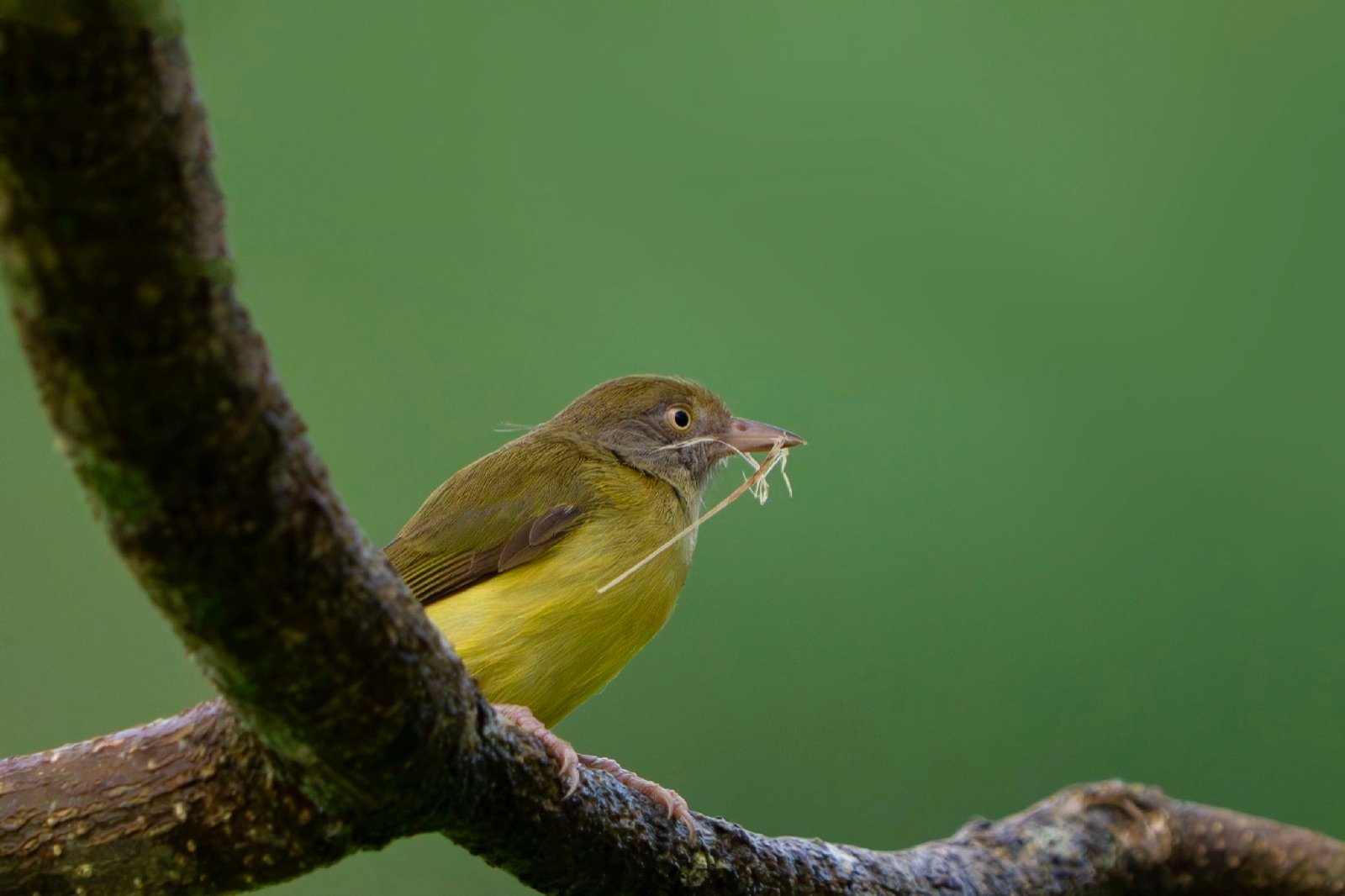
Adults are small, about 11 to 12 cm long. Look for these marks:
Olive-green upperparts.
An olive-brown head with a faint eyebrow and a yellowish eyering.
Yellow underparts.
A dark bill and pale legs.
The Costa Rican race, viridiflavus, has a yellowish olive crown and back. Its chin is dull white, its throat and upper breast are pale yellowish olive, and the rest of the underparts are pale yellow. The iris is yellowish white to gray.
Males and females look alike. Young birds look much the same as adults but have a dark bill and a dark eye. These descriptions cover the species in general.
What it sounds like
Recording: GERMAN LEONEL SARMIENTO CRUZ, CC BY 4.0, source, read 4 Nov 2026.
Behaviour and diet
It forages in trees and thickets in pairs or small groups and sometimes joins mixed-species flocks. It is said to hang upside down while foraging. It is thought to eat arthropods plus some berries and seeds. These notes describe the species in general rather than Costa Rica alone.
Nesting in Costa Rica runs from April to July. The nests are thin cups of fine fibres, hung in a branch fork 4 to 10 m up, with 2 to 3 white eggs.
Where it lives
In Costa Rica it lives from the lowlands up to about 900 m, on the Pacific side. Its habitats include low dense scrub, African oil palm plantations, trees in pastures and clearings, forest edges and tall second growth. It is most common in dense bamboo stands in abandoned banana plantations.
It ranges from Carara National Park south to Panama, and only rarely north as far as Caldera. The Costa Rican subspecies, viridiflavus, occurs in southwestern Costa Rica and Panama.
When to see it
Nesting in Costa Rica runs from April to July, when the birds are tied to their nest sites.
Similar birds
Costa Rica has two other greenlets, the Lesser Greenlet and the Tawny-crowned (Ochre-crowned) Greenlet. A tour report says the Tawny-crowned is easily overlooked and never sits still for long, so take your time with any greenlet in thick growth and check the song.
Names and lore in Costa Rica
The Spanish name used in Costa Rica and Panama is Verdillo Matorralero. Elsewhere it is also called verdillo paticlaro, verdillo de matorral, vireillo de los matorrales, verderón rastrojero (Colombia) or verderón patipálido (Venezuela).
Status and conservation
The AOCR list marks it as a resident (R); it is considered uncommon in Costa Rica, though locally common in the south, and the IUCN rates it Least Concern, meaning a stable population.
How we know this 20 sources, each read on the date shown
- Flickr (Spanish natural history text) read 2026-11-04
https://www.flickr.com/photos/jobando/38653331300 - Museo Nacional de Costa Rica read 2026-11-04
https://www.museocostarica.go.cr/wp-content/uploads/Publicaciones/biodiversidad/aves-f6.pdf - Birds Colombia (Spanish Wikipedia text) read 2026-11-04
https://birdscolombia.com/2020/08/28/verderon-rastrojero-scrub-greenlet-hylophilus-flavipes/ - iNaturalist (Wikipedia text) read 2026-11-04
https://www.inaturalist.org/taxa/17427-Hylophilus-flavipes - Bird Studies read 2026-11-04
https://birdstudies.net/post/823350001835048960/july-10-2026-scrub-greenlet-hylophilus - Wikipedia read 2026-11-04
https://en.wikipedia.org/wiki/Scrub_greenlet - Birda read 2026-11-04
https://app.birda.org/species-guide/21349/Scrub_Greenlet - Field Guides trip list, Deep South 2020 read 2026-11-04
https://fieldguides.com/triplists/cr120.html - Birdingcraft read 2026-11-04
https://birdingcraft.com/wordpress/category/costa-rica-bird-finding-guide/ - Field Guides trip list, Deep South 2023 read 2026-11-04
https://fieldguides.com/triplists/cr123PRINT.html - Field Guides trip list, Deep South 2024 read 2026-11-04
https://fieldguides.com/triplists/cr124PRINT.html - Wikipedia (es) read 2026-11-04
https://es.wikipedia.org/wiki/Hylophilus_flavipes - Cotinga Tours read 2026-11-04
https://www.cotingatours.com/southern-tour-sample - Holbrook Travel read 2026-11-04
https://www.holbrooktravel.com/where-we-travel/central-and-south-america/costa-rica/tropical-field-ornithology-san-vito-osa-peninsula-27 - BirdForum Opus read 2026-11-05
https://www.birdforum.net/opus/Scrub_Greenlet - Animalia.bio read 2026-11-05
https://animalia.bio/scrub-greenlet - Birdquest read 2026-11-05
https://www.birdquest-tours.com/birding-tours/costa-rica-ultimate/ - Holbrook Travel read 2026-11-05
https://www.holbrooktravel.com/where-we-travel/central-and-south-america/costa-rica/costa-rica-birding-rainforests-cloud-forests-carara-bedford-audubon - Exotic Birding read 2026-11-05
http://www.exoticbirding.com/costarica/osa-peninsula/special-birds.html - Costa Rica Focus read 2026-11-05
https://www.costaricafocus.com/birding-central-pacific-costa-rica-a-complete-guide/