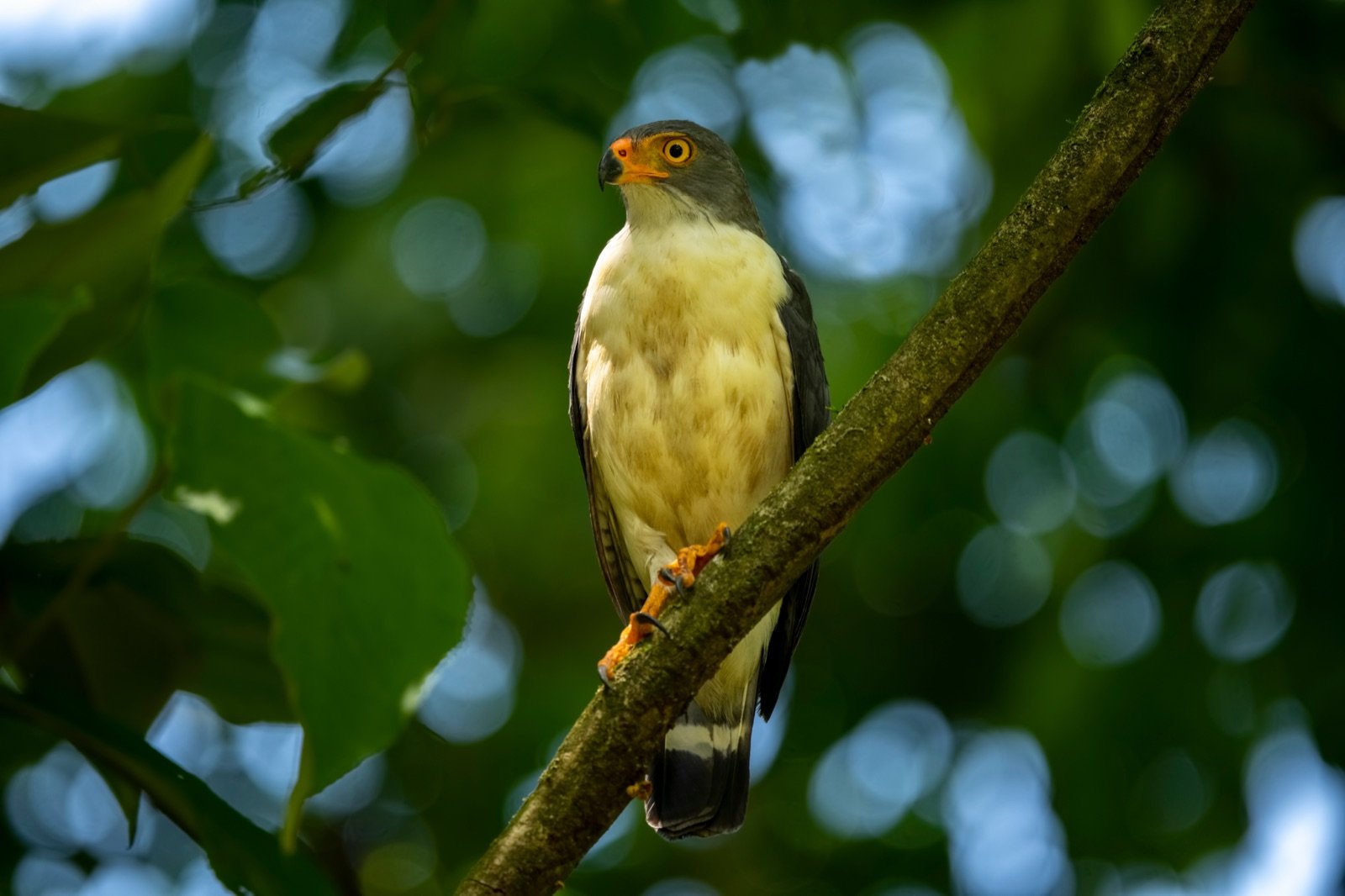
 Semiplumbeous Hawk
Family Accipitridae
Semiplumbeous Hawk
Leucopternis semiplumbeus
In Spanish: Gavilán Dorsiplomizo
- Resident
Small gray and white forest hawk of the Caribbean lowlands.
The Semiplumbeous Hawk (Gavilán Dorsiplomizo) is a small, two-toned raptor, dark gray above and white below, with bright yellow eyes and an orange cere. In Costa Rica it is a Caribbean slope bird, fairly uncommon in the lowlands and rarely found above 500 meters.
It sits at middle levels of mature wet forest and waits for prey to pass, so it rewards patient scanning of the trees rather than watching open sky.
On a trip we build around the Caribbean side, lower lowland forest trails and large areas of healthy forest give the better chances.
How to find it
Start in the Caribbean lowlands and keep to forest below about 500 meters. Scan the middle levels of mature forest and older second growth for a still gray and white hawk. In Braulio Carrillo National Park the hawk was not regular on the higher Las Palmas trail, while lower, more lowland-leaning trails such as Ceiba gave better chances. Learn the rising whistles, since birders have found one by call. At Tirimbina one sat on a branch about 3 m above the ground, so close views are sometimes possible.
How to recognise it
This is a two-toned hawk, small, about 30 to 33 cm long, roughly the size of a kestrel or merlin.
Look for these marks:
- dark gray upperparts
- a white throat and white underparts
- bright yellow eyes
- a black face mask
- a striking orange cere and orange legs
- short, broad wings, which help it steer between trees and branches inside the forest
- a short tail with two white bands across an otherwise dark background
The scientific name fits the look: Leucopternis means white hawk, and semiplumbeus means half-leaden.
What it sounds like
Recording: Niels Krabbe, CC BY-SA 4.0, source, read 5 Nov 2026.
Behaviour and diet
This is a sit-and-wait hunter. It watches from a perch and surprises small mammals, reptiles and birds from a low perch. Recorded prey across its range includes lizards, snakes, amphibians, mammals, birds and arthropods.
It often follows army ant swarms to catch antbirds and other small songbirds, which make up a large part of its diet.
In Costa Rica it nests and breeds, building a stick platform very high in the forest canopy.
Where it lives
In Costa Rica this is a Caribbean slope bird of the lowlands and foothills, rarely found above 500 meters. It usually sits at middle levels of mature wet forest and older second growth, and only occasionally comes out into open areas.
Across its whole range it is limited to humid forest in the tropical and subtropical lowlands and foothills, from Costa Rica south to the Choco region of northwestern South America. It can tolerate tall second growth and is locally common in some primary forest.
Similar birds
The short tail helps separate it from forest-falcons of similar size. The two white bands across an otherwise dark tail are another useful mark, along with the white underparts.
Names and lore in Costa Rica
The AOCR name used in Costa Rica is Gavilán Dorsiplomizo. Elsewhere it is also called gavilán pecho blanco, gavilán gris and gavilán dorsigris.
Status and conservation
The AOCR list treats it as a resident (R) in Costa Rica, and it is rated Least Concern globally.
Photography tips
Look for it perched low near forest trails or openings in mature forest. At Tirimbina one sat about 3 m above the ground, which suggests it will sometimes sit low enough for close views. Lower, lowland trails give the better chances.
How we know this 13 sources, each read on the date shown
- Costa Rica Birding Trips read 2026-11-04
https://www.costaricabirdingtrips.com/accipitridae/semiplumbeous-hawk-leucopternis-semiplumbeus - El Hornero (Aves Argentinas) read 2026-11-04
https://elhornero.avesargentinas.org.ar/home/article/view/443 - Birds of the World (Cornell) read 2026-11-04
https://birdsoftheworld.org/bow/species/semhaw/cur/introduction - Wikipedia read 2026-11-04
https://en.wikipedia.org/wiki/Semiplumbeous_hawk - The Explorers (Spanish Wikipedia text) read 2026-11-04
https://theexplorers.com/photo/gavilan-pecho-blanco-leucopternis-semiplumbeus/es - Birds for Beer (Turrialba) read 2026-11-04
https://birdsforbeer.com/2020/09/07/semiplumbeous-hawk-a-rare-appearance-in-our-area/ - Tica Birding Adventure read 2026-11-04
http://ticabirdingadventure.blogspot.com/2020/10/aves-caribenas-de-costa-rica-parte-1.html - Birdingcraft read 2026-11-04
https://birdingcraft.com/wordpress/2014/02/12/a-couple-of-cool-hawks-and-other-raptors-during-recent-birding-in-costa-rica/ - Birds Colombia (Wikipedia text) read 2026-11-04
https://birdscolombia.com/2019/07/01/gavilan-gris-semiplumbeous-hawk-leucopternis-semiplumbeus/ - Wikipedia (Spanish) read 2026-11-04
https://es.wikipedia.org/wiki/Leucopternis_semiplumbeus - El Hornero via ResearchGate read 2026-11-04
https://www.researchgate.net/publication/348575349_First_record_of_a_Semiplumbeous_Hawk_Leucopternis_semiplumbeus_preying_on_a_Red-throated_Ant-tanager_Habia_fuscicauda_in_Tirimbina_Biological_Reserve_Costa_Rica - Animalia.bio (Wikipedia photo caption) read 2026-11-04
https://animalia.bio/semiplumbeous-hawk - iNaturalist guide, Laguna del Lagarto read 2026-11-04
https://www.inaturalist.org/guide_taxa/459628