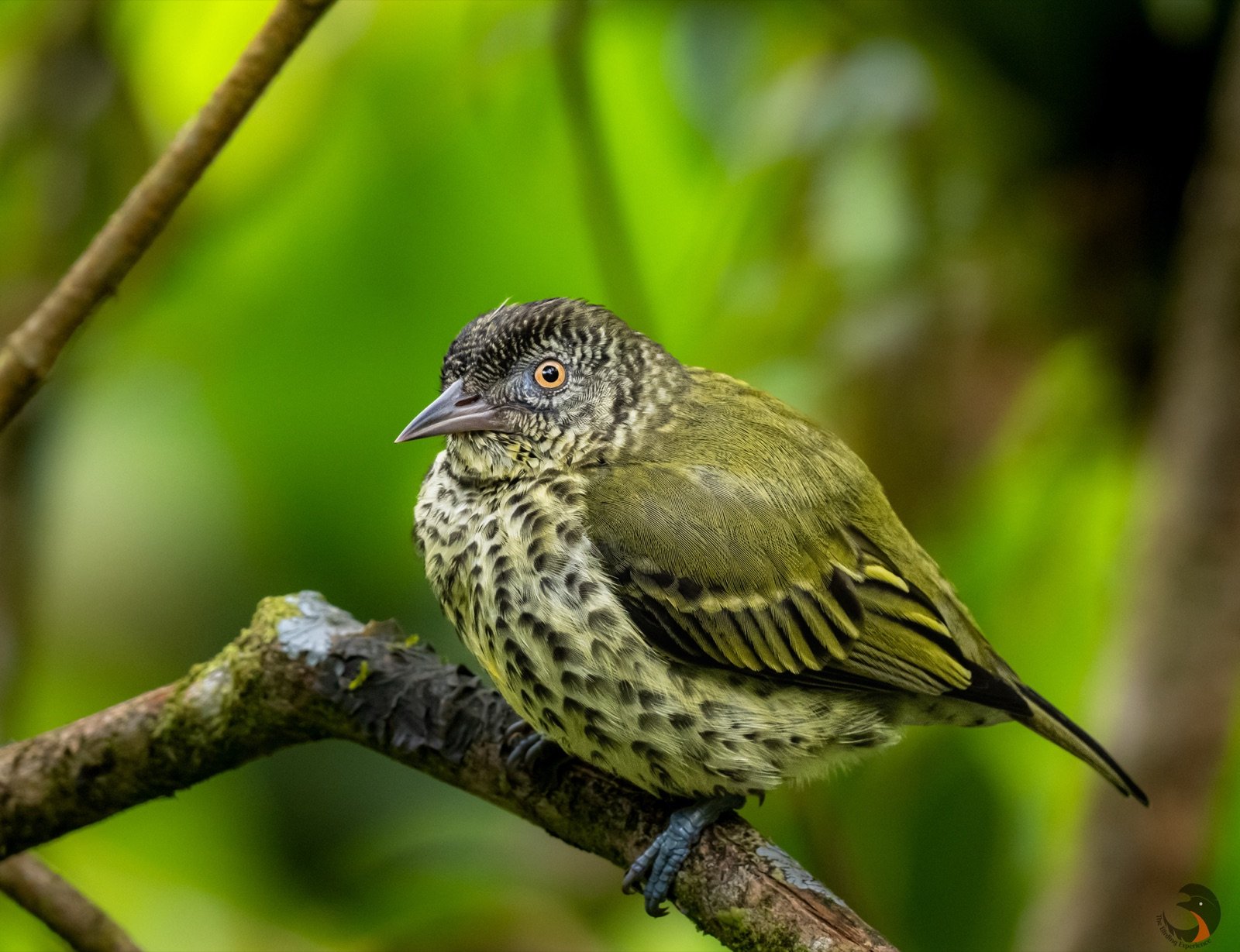
Family Oxyruncidae
Sharpbill
Oxyruncus cristatus
In Spanish: Picoagudo
- Resident
A scaly, red-eyed canopy bird that hides inside mixed flocks.
The Sharpbill, Picoagudo in Costa Rican Spanish, is an uncommon, local resident here. It lives high in the canopy of wet forest between about 700 and 1400 m, so this is a bird for looking up.
Costa Rican birders say it is a tough bird that they see rarely, almost always inside a large mixed flock. That makes it a real prize for a patient beginner who is happy to keep moving with the birds.
On a trip we build around Arenal, hanging bridges reach primary montane forest and bring the treetops within range, which is where this bird spends its time.
How to find it
Staying with a moving mixed flock is the way to find this bird. A birding guide advises keeping up with the flock, listening for the Sharpbill and staying with the birds as long as you can. That is how you eventually catch one.
Look high, into the treetops, rather than at eye level. Canopy access helps: the hanging bridges at Sky Adventure Park, near La Fortuna, reach primary montane forest and give canopy views, and a guided tour of the Arenal area looks for Sharpbill there.
Braulio Carrillo National Park, the Manuel Brenes road near San Ramón and the La Selva entrance road are also named as places to look.
How to recognise it
The Sharpbill is a stout bird about 15.5 cm long, with a small head, a pointed bill and short strong legs. The iris is brick red, a detail worth checking if you get a clear view.
The upperparts are olive green. The face and underparts are pale yellowish, brightest on the belly.
The underparts are spotted: the face and throat look scaly, and the breast and flanks carry black spots.
The adult male has a dark crown mixed with olive and a hidden scarlet crest that can be raised. Do not expect to see the red on a bird tucked into foliage.
What it sounds like
Behaviour and diet
The Sharpbill lives high in the canopy of wet forest, so look up into the treetops. It is often found in pairs or small groups and joins mixed-species flocks.
It eats mainly fruit and sometimes insects, and it has been seen hanging upside down to catch insect larvae.
Across its range, males may display for females in exploded leks, singing and displaying on small neighbouring territories.
Where it lives
In Costa Rica the Sharpbill is found between about 700 and 1400 m elevation. It occurs from the Guanacaste range (Volcán Miravalles) southward and along the Caribbean slope to Panama. It may once have occurred in the Dota region.
Across its range the species is local and patchy, mainly in foothill forest, and the Costa Rican records fit that pattern.
When to see it
At Hitoy Cerere, one birder found Sharpbills fairly common and calling often during March and April. A nest was found at Tapantí National Park on 3 June 2008, in the rainy season, at 1,280 m on the Caribbean slope.
Names and lore in Costa Rica
Costa Ricans call it Picoagudo. The genus name Oxyruncus comes from Greek words meaning sharp and bill.
Status and conservation
The AOCR list treats the Sharpbill as a resident (R), and in Costa Rica it is an uncommon, local bird, though across its range it is not thought to approach the thresholds for threatened status on the IUCN Red List.
Photography tips
At Quebrada Gonzalez the canopy is very tall and the foliage dense. One birder heard a Sharpbill sing three times without seeing it, and suspects it sings from a still, hidden perch high up. Patience and a view of the flock, rather than a single perch, give the best chance.
How we know this 22 sources, each read on the date shown
- Aves de Costa Rica read 2026-11-04
https://avesdecostarica.com/Oxyruncus-cristatus.html - AvesPhoto read 2026-11-04
http://avesphoto.com/website/WD/species/SHPBIL-1.htm - Bird Watching Costa Rica read 2026-11-04
https://www.birdwatchingcostarica.com/ave/sharpbill-2/ - Birds of the World read 2026-11-04
https://birdsoftheworld.org/bow/species/sharpb1/cur/introduction - Descourtilz (wordpress) read 2026-11-04
https://descourtilz.wordpress.com/2012/11/06/sharpbill/ - Birds of the World read 2026-11-04
https://birdsoftheworld.org/bow/species/oxyrun1/cur/introduction - Planet of Birds read 2026-11-04
https://planetofbirds.com/passeriformes-cotingidae-sharpbill-oxyruncus-cristatus/ - BirdForum (Birdingcraft post) read 2026-11-04
https://www.birdforum.net/threads/birdingcrafts-costa-rica-patch.131932/ - Birdingcraft read 2026-11-04
https://birdingcraft.com/wordpress/category/costa-rica-bird-finding-guide/ - ResearchGate (Sharpbill nesting ecology in Costa Rica) read 2026-11-04
https://www.researchgate.net/publication/236176139_Sharpbill_Oxyruncus_cristatus_frater_nesting_ecology_in_Costa_Rica - Birding Ecotours read 2026-11-04
https://www.birdingecotours.com/tour/costa-rica-escape-part-2/ - Costa Rica Focus read 2026-11-04
https://www.costaricafocus.com/birding-san-jose-province-costa-rica-a-complete-guide/ - Birdingcraft read 2026-11-04
https://birdingcraft.com/wordpress/tag/birding-costa-rica/page/3/ - Birdingcraft read 2026-11-04
https://birdingcraft.com/wordpress/tag/middle-elevations/ - Adventure Inn read 2026-11-04
https://www.adventure-inn.com/tours/birdwatching-in-braulio-carrillo-national-park - Birdingcraft read 2026-11-04
https://birdingcraft.com/wordpress/2014/03/27/birding-costa-rica-march-2014/ - Birdingcraft read 2026-11-04
http://birdingcraft.com/wordpress/2011/05/02/good-mixed-flocks-during-recent-birding-at-quebrada-gonzalez/ - Birds of the World (Cornell) read 2026-11-04
https://neotropical.birds.cornell.edu/Species-Account/nb/species/sharpb1/overview - Encyclopedia.com read 2026-11-04
https://www.encyclopedia.com/environment/encyclopedias-almanacs-transcripts-and-maps/sharpbills-oxyruncidae - Field Guides trip list read 2026-11-04
https://fieldguides.com/triplists/cos16.html - Animalia.bio (Spanish Wikipedia text) read 2026-11-04
https://animalia.bio/es/sharpbill - BirdForum Opus read 2026-11-04
https://www.birdforum.net/opus/Sharpbill