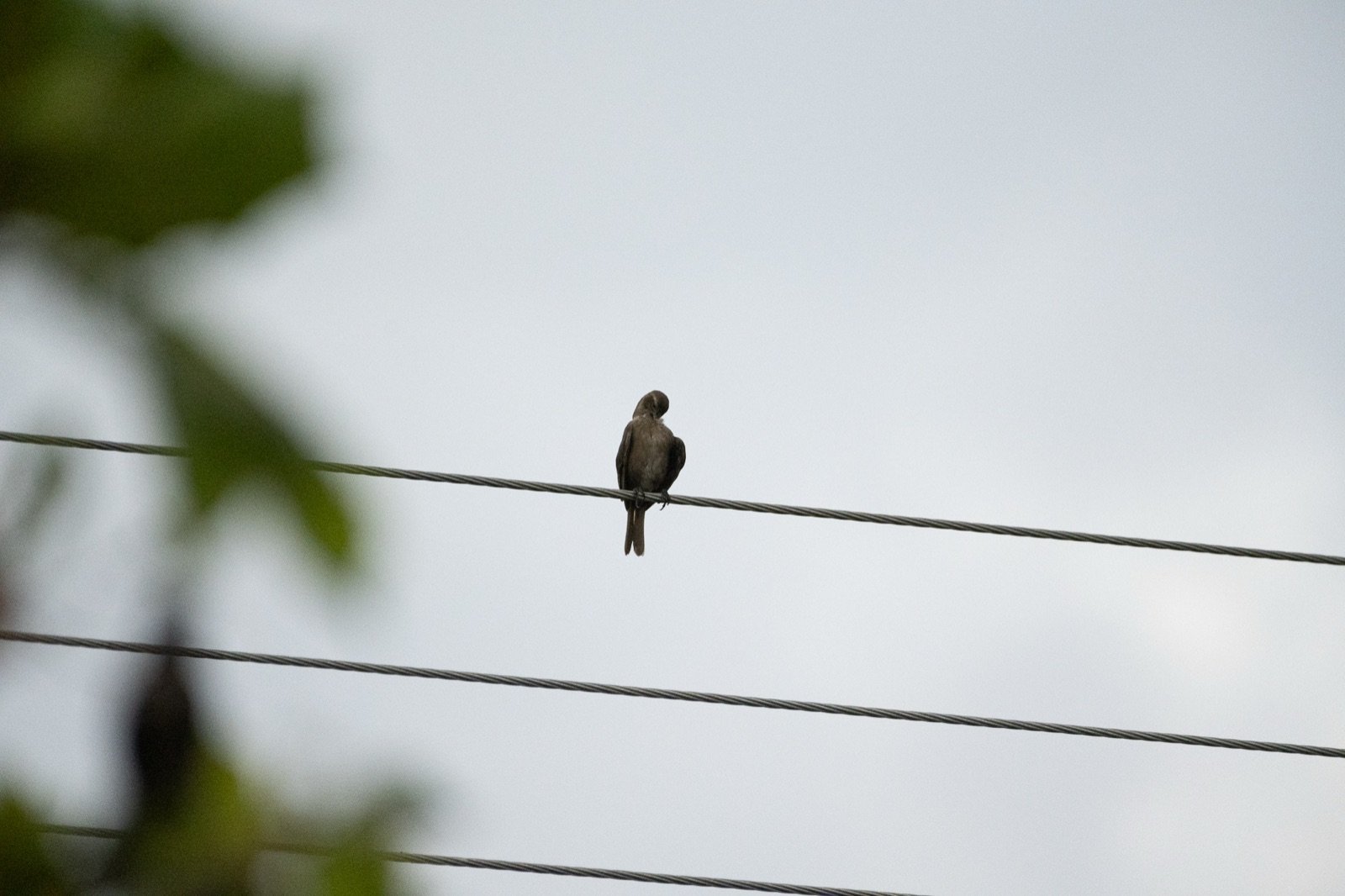
Family Icteridae
Shiny Cowbird
Molothrus bonariensis
In Spanish: Vaquero Mirlo
- Resident
A purple-black cowbird that reached Costa Rica from Panama in 2004.
The Shiny Cowbird, known here as Vaquero Mirlo, is a newcomer. It spread north from Panama, and the first Costa Rican record dates from April 2004.
The male is velvety, deep purple-black, and the species is a brood parasite: it lays eggs in other birds' nests and raises no young of its own. That habit makes it a bird worth understanding as well as ticking.
For a beginning birder it is a good lesson in open-country birding. Look in farmland and pasture, where birds often ride on the backs of cattle, horses and sheep while they feed. Tour reports place it in Costa Rica in January and early February.
How to find it
Look in open, disturbed places such as farmland and pasture. Scan the backs of cattle, horses and sheep, where birds often ride while they feed. Village garden patches are worth checking too: near Turrialba, a glossy purple male was seen courting two dull brown females in one. A Costa Rican list of birds observed places it among open-country icterids such as Great-tailed Grackle and Bronzed Cowbird, so look through those flocks carefully. Watch for the slender build and dark eye of the male.
How to recognise it
The male is velvety, deep purple-black. In Costa Rica, a purplish cowbird that looks slender and has dark eyes is likely a Shiny Cowbird.
The female is brownish and looks much like a female Brown-headed Cowbird. A Colombian description gives her as grey-brown above and much paler, even whitish, below, with a dark brown eyebrow stripe. It adds that the bird walks with its tail slightly raised.
Immatures are streaky, unlike the glossy purple adult male.
The Costa Rican subspecies, cabanisii, has paler females than the nominate form of South America, while the males look much the same as males of that form.
What it sounds like
Recording: margaritarestrepou, CC0 1.0, source, read 4 Nov 2026.
Behaviour and diet
As a brood parasite, it lays eggs in other birds' nests and raises no young of its own. In Costa Rica it may displace small native songbirds. Across its range it has been seen targeting at least 201 host species.
In courtship the male sings to a female on the ground, then takes off and circles her in a wide loop with fluttering wingbeats. Females are greyish and often travel with males.
Where it lives
Across its range it uses varied habitats, humid to dry, mostly open. Colombian sources describe flocks feeding on small insects in grass, pastures, crops and city parks.
In Costa Rica, birds from open areas of Panama colonised the country. Reports then came from the Pacific coast, which suggests the species is spreading toward the Pacific side. Costa Rican guides say it can turn up almost anywhere in open, cleared country. The National Museum lists it as an accidental visitor on Isla del Coco, the remote Pacific island.
When to see it
Tour reports place Shiny Cowbirds in Costa Rica in January and early February, on 2025 and 2026 trips. They give no wider season pattern.
Similar birds
Bronzed Cowbirds have red eyes, a thicker neck and a shorter tail, and are less uniformly purple. The Melodious Blackbird is bulkier with a stronger bill, while the cowbird has a smaller one. Female Shiny Cowbirds differ from female Brown-headed Cowbirds in having a longer, finer bill and a flatter head. The male Screaming Cowbird of South America looks like a male Shiny but is duller, and it does not occur in Costa Rica.
Names and lore in Costa Rica
Costa Rica uses Vaquero Mirlo. Panama uses Vaquero Brillante, Ecuador uses Vaquero Brilloso, and Colombia uses Chamón parásito or Chamón común. The Costa Rican paper on its first Pacific reports calls it Chamón Parásito and Pius Reluciente, and Tordo renegrido is used elsewhere.
Status and conservation
The AOCR list marks it as a resident (R), though it is a recent colonist that has stopped being rare, and it is still less common than the Bronzed Cowbird.
Photography tips
Cowbirds gather in fields near the evening drinking time, just before sunset. That gives a good chance to compare Shiny, Bronzed and Giant Cowbirds side by side.
How we know this 20 sources, each read on the date shown
- Sandoval et al., Primeros reportes de Molothrus bonariensis en el Pacífico de Costa Rica read 2026-11-04
https://www.researchgate.net/publication/259892883_Primeros_reportes_de_Molothrus_bonariensis_Icteridae_Aves_en_el_Pacifico_de_Costa_Rica - Birds for Beer (Paul Pickering) read 2026-11-04
https://birdsforbeer.com/2016/02/10/shiny-cowbird-arrives-in-san-antonio/ - Wikipedia read 2026-11-04
https://en.wikipedia.org/wiki/Shiny_cowbird - Museo Nacional de Costa Rica read 2026-11-04
https://www.museocostarica.go.cr/nuestro-trabajo/investigaciones/historia-natural/isla-del-coco/aves/ - All About Birds, Cornell Lab read 2026-11-04
https://www.allaboutbirds.org/guide/Shiny_Cowbird/overview - Catálogo de Biodiversidad de Colombia read 2026-11-04
https://catalogo.biodiversidad.co/file/56c7b9d7f0106c67230e740b/summary - All About Birds (Cornell Lab) read 2026-11-04
https://www.allaboutbirds.org/guide/Shiny_Cowbird/id - Audubon Field Guide read 2026-11-04
https://www.audubon.org/field-guide/bird/shiny-cowbird - BirdBuddy Wiki read 2026-11-04
https://app.mybirdbuddy.com/birds/shiny-cowbird/4cac0007-bd2d-4f3c-9775-2e692876214b - Birds of the World (Cornell Lab) read 2026-11-04
https://birdsoftheworld.org/bow/species/shicow/cur/sounds - Aves Ibéricas, Aves de Costa Rica read 2026-11-04
https://www.avesibericas.es/costaricaaves10.htm - Birding Craft read 2026-11-04
https://birdingcraft.com/wordpress/2010/06/15/four-common-black-birds-of-costa-rica/ - Wikipedia read 2026-11-04
https://en.wikipedia.org/wiki/Shiny_Cowbird - BirdForum read 2026-11-04
https://www.birdforum.net/threads/shiny-cowbird-or-melodius-blackbird-costa-rica.252523/ - Birding Craft read 2026-11-04
https://birdingcraft.com/wordpress/tag/great-tailed-grackle/ - Eagle-Eye Tours read 2026-11-05
https://www.eagle-eye.com/blog/costa-rica-birding-tour-trip-report-jan-22-feb-7-2025/ - Eagle-Eye Tours read 2026-11-05
https://www.eagle-eye.com/blog/costa-rica-birding-trip-report-jan-11-27-2026/ - Field Guides trip list read 2026-11-05
https://fieldguides.com/triplists/cos24.html - Wikipedia (es) read 2026-11-05
https://es.wikipedia.org/wiki/Molothrus_bonariensis - Birdfinding.info read 2026-11-05
https://birdfinding.info/shiny-cowbird/