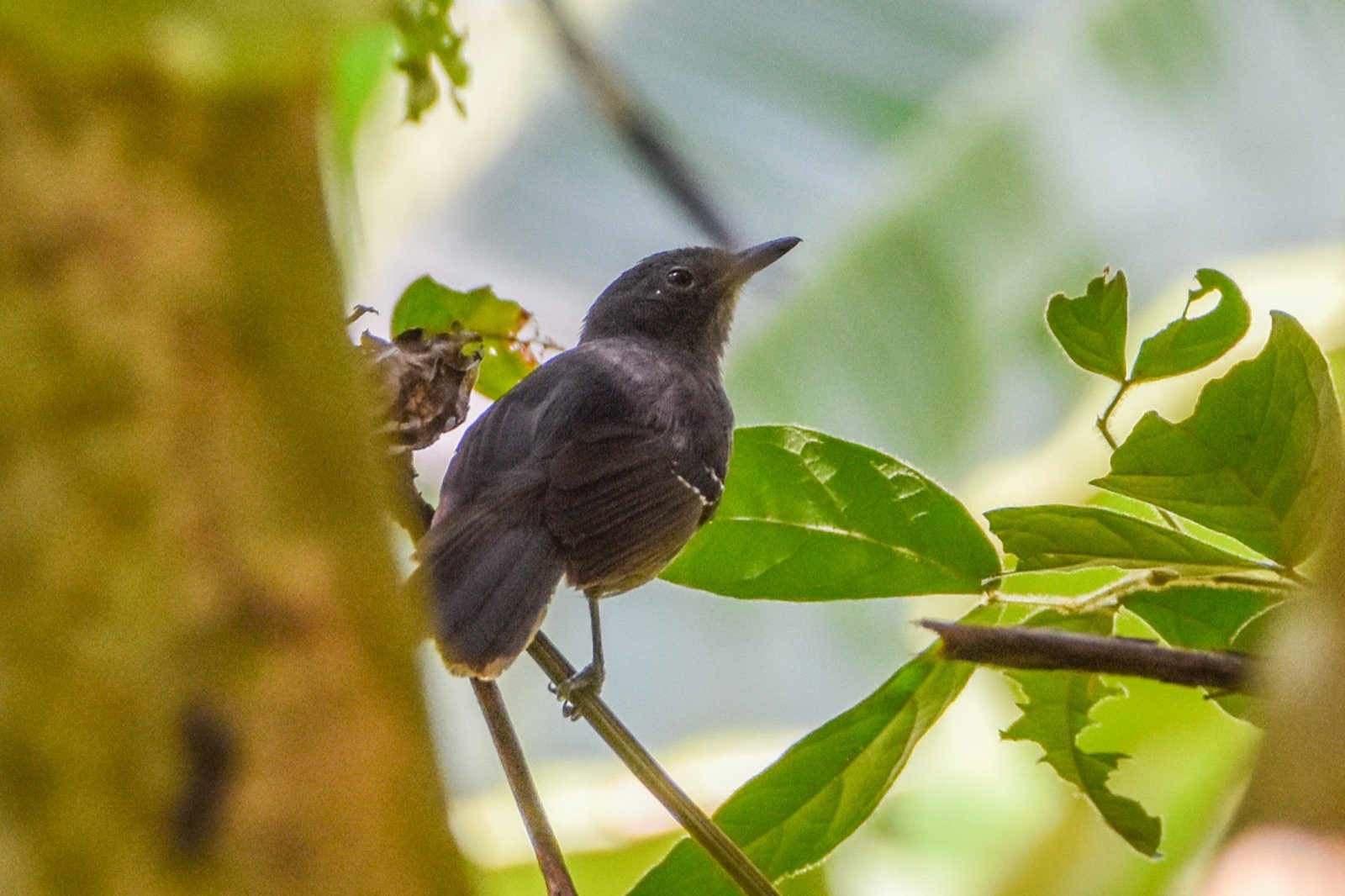
Family Thamnophilidae
Slaty Antwren
Myrmotherula schisticolor
In Spanish: Hormiguerito Pizarroso
- Resident
A tiny slate antwren that tags along with mixed flocks in foothill forest.
The Slaty Antwren (Hormiguerito Pizarroso) is a tiny bird, about 10 cm long and 9.5 g, and it is often found in pairs or family groups moving through the understory with other species. That habit tells you how to look for it: watch the flock, not the bird.
In Costa Rica it lives in wet foothill and cloud forest and in nearby tall second growth, and it reaches about 2,000 m. Birders have met it in mixed flocks around Monteverde, at Arenal, at Carara on the Pacific side and in the deep south near San Vito.
Costa Rica also has a special link to this bird: the species was first described in 1865 from a specimen collected at Turrialba, in Cartago province.
How to find it
Start by finding a mixed flock, because the antwren is usually part of one. Listen for the thin 'cheeur' call, then scan the low and mid levels of the understory. It usually forages in dense vegetation about 1 to 6 m up, but sometimes on the ground or as high as 12 m. A guided group heard one across a valley and then found a few in a mixed flock along the Tapantí park road. At Curi-Cancha Reserve near Monteverde, flocks can include Slaty Antwren alongside Plain Antvireo, Spotted Barbtail and Eye-ringed Flatbill. Check ant swarms where you meet them, as birds there can appear one after another.
How to recognise it
This is a very small antwren, about 10 cm long and weighing around 9.5 g. The English name refers to its slate color, and the scientific name means 'small ant hunter' of slate color.
The white on the wings is less extensive than on related antwrens, which helps separate the male from similar species.
It is so small that it is easy to overlook among bigger birds, so size, slate tone and the company it keeps are the most useful clues. Look for pairs or small family groups moving through the understory rather than a lone bird in the open.
What it sounds like
Recording: rawcomposition, CC0 1.0, source, read 4 Nov 2026.
Behaviour and diet
Look for it with mixed-species flocks rather than alone. It usually forages in pairs and often tags along with woodcreepers, ant-tanagers, ovenbirds and Basileuterus warblers.
It picks insects and spiders off leaves and gleans from dead leaf clusters and vine tangles. When prey is dislodged, it chases it to the ground.
Birders in the Monteverde area found it with an ant swarm, where a quiet, stealthy flock attended the swarm and the birds appeared one after another.
The nest is a deep cup of fine fungal threads bound with spider silk, hung from a branch fork, usually less than about 2 m above the ground.
Where it lives
It lives in the understory of wet foothill and cloud forest and in nearby tall second growth. In Costa Rica it reaches about 2,000 m, while across Central America it generally ranges from sea level to about 1,250 m. It tends to live higher than most other antwrens.
In Costa Rica and Panama it is found in semi-humid forest on the Pacific slope. Records come from Tapantí National Park in Cartago, the Monteverde area, Arenal, Carara and the deep south near San Vito.
When to see it
In Costa Rica it breeds between March and July.
Similar birds
The male is separated from similar antwrens by its wings, which show less white than related species. Because it is so small and moves with other birds, take a careful look at the wing before settling on the name.
Names and lore in Costa Rica
In Costa Rica the usual Spanish name is hormiguerito pizarroso, the same as in Colombia, Honduras and Peru. Mexico and Venezuela use hormiguerito or hormiguero apizarrado, and Nicaragua uses hormiguerito pechinegro. Hormiguero Plomizo is also listed for this species.
Status and conservation
The AOCR list marks it as a resident (R), and the IUCN rates it Least Concern, with a very large range and uncommon to fairly common numbers.
Photography tips
Scan the low and mid levels of the understory, where it forages in dense vegetation about 1 to 6 m up. A blogger on a Costa Rica trip found it hard to photograph, as few photos of the bird exist, so patience with a passing flock matters.
How we know this 18 sources, each read on the date shown
- Beauty of Birds read 2026-11-04
https://www.beautyofbirds.com/slatyantwrens.html - Wikipedia read 2026-11-04
https://en.wikipedia.org/wiki/Slaty_antwren - EcoRegistros read 2026-11-04
https://www.ecoregistros.org/sheet/Myrmotherula-schisticolor - Cloudbridge Nature Reserve bird list read 2026-11-04
https://www.cloudbridge.org/wp-content/uploads/2020/04/Bird-Species-List-Costa-Rica-13-April-2020.pdf - Avibase read 2026-11-04
https://avibase.bsc-eoc.org/species.jsp?lang=EN&avibaseid=CF8A33941B7EEE70 - Animalia.bio (from Wikipedia) read 2026-11-04
https://animalia.bio/slaty-antwren - Field Guides trip list, Rancho Naturalista 2021 read 2026-11-04
https://fieldguides.com/triplists/crh21b.html - WINGS Birding Tours, Costa Rica in July read 2026-11-04
https://wingsbirds.com/tours/costa-rica-july/ - Field Guides trip list, Costa Rica Birding the Edges 2017 read 2026-11-04
https://fieldguides.com/triplists/cr217.html - Field Guides trip list, Deep South 2023 read 2026-11-04
https://fieldguides.com/triplists/cr123.html - Birds of Passage blog read 2026-11-04
https://birdsofpassage.wordpress.com/2014/05/11/monteverde-costa-rica/ - Birding Craft read 2026-11-04
https://birdingcraft.com/wordpress/tag/red-legged-honeycreeper/ - Wikipedia read 2026-11-04
https://en.wikipedia.org/wiki/Myrmotherula_schisticolor - Wikipedia (es) read 2026-11-04
https://es.wikipedia.org/wiki/Myrmotherula_schisticolor - Wikispecies read 2026-11-04
https://species.wikimedia.org/wiki/Myrmotherula_schisticolor - Field Guides Costa Rica 2024 trip list read 2026-11-04
https://fieldguides.com/triplists/cos24.html - Exotic Birding Monteverde checklist read 2026-11-04
http://www.exoticbirding.com/costarica/monteverde/checklist.html - Birds Outside My Window read 2026-11-04
https://www.birdsoutsidemywindow.org/category/travel/costa-rica/