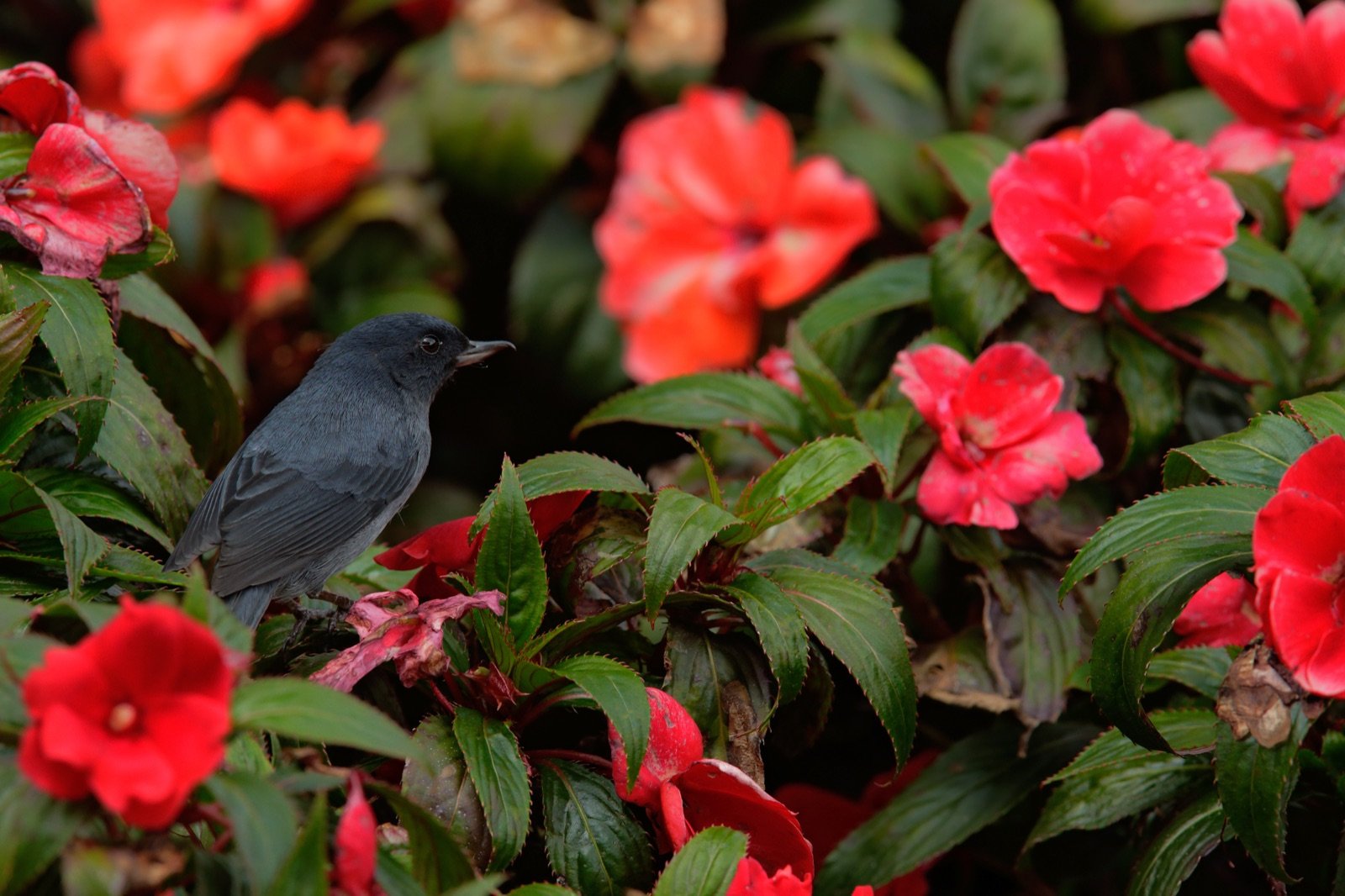
 Slaty Flowerpiercer
Family Thraupidae
Slaty Flowerpiercer
Diglossa plumbea
In Spanish: Pinchaflor Plomizo
- Resident
- Regional endemic
A hook-billed highland nectar thief, endemic to Costa Rica and western Panama.
The Slaty Flowerpiercer (Pinchaflor Plomizo, Diglossa plumbea) is a small bird that steals nectar. It pierces the base of a tubular flower and licks the nectar out with a brush-tipped tongue, never entering by the front door.
It is a common resident of the higher parts of Costa Rica, and it is endemic to the highlands of Costa Rica and western Panama. It turns up in flowering gardens and sunny forest edges as well as in the forest canopy, which makes it a friendly bird to learn on a mountain trip.
For a beginning birder it is also a lesson in looking closely: a dull bird among the blooms is easy to pass over, but the hooked bill gives it away once it is in view.
How to find it
Look at the sunlit edges of forest, in clearings and in flower gardens in the mountains, where it feeds on nectar. Check the centre of flowering plants, where it hides to reach flowers from behind. Males can give away their position to hummingbirds by calling, so listen for the thin 'tsip' as well as watching the blooms. Expect brief views, since hummingbirds chase it even when it hides in the foliage. Once you have a bird in view, check the hooked upper bill.
How to recognise it
This is a small bird, about 10 cm long and about 9 g, roughly warbler-sized. It has dark eyes and an upturned bill with a hooked tip on the upper half.
The adult male is slaty blue-gray, with a lead-gray throat and breast. The bill is black, with a paler base on the lower half.
Females and young birds are dull olive-brown. Young birds look like the adult female, usually with two buffy wing bars and faint streaks on the breast. Males get adult body plumage during their first year.
On a dull brown bird, check the bill first. The pronounced hook on the upper bill is the clue.
What it sounds like
Behaviour and diet
It is usually alone or in pairs. Besides nectar, it picks insects from foliage or catches them in flight, including flies, beetles, wasps and moth larvae.
Hummingbirds defend their flowers, so the flowerpiercer slips into dense foliage and approaches blooms stealthily from behind, hidden among the leaves.
Breeding runs from August to December, and sometimes into March. The nest is a bulky cup of moss and plant fibre, set 0.4 to 4 m up, and the clutch is two pale blue eggs.
Where it lives
It lives in the canopy and edges of mountain forest. It is most numerous in sunny clearings and in open areas with flowering shrubs, including gardens.
It is a common resident of the higher parts of the country. It starts at about 1200 m in the Guanacaste range, 1500 m in Tilarán, and 1900 m in the Central Volcanic and Talamanca ranges. It reaches páramo above the treeline.
Similar birds
Across most of its range it is the only flowerpiercer, and the pronounced hook on the upper bill identifies it easily. The female is brown with paler underparts, so check the bill on dull birds.
Names and lore in Costa Rica
In Costa Rica the bird is called Pinchaflor Plomizo, in Panama Pinchaflor Pizarroso, and another Spanish name is Diglosa Pizarra. The Latin name plumbea means lead-colored, and Diglossa means double tongue. The first description in 1861 gave Costa Rica as the type locality.
Status and conservation
The AOCR list marks it as a resident endemic (R-END); it is common, listed as Least Concern, with a stable population.
Photography tips
Look in the centre of flowering plants, where it hides to reach flowers from behind. Males can give away their position to hummingbirds by calling, which can help you locate one.
How we know this 14 sources, each read on the date shown
- The Firefly Forest read 2026-11-04
https://fireflyforest.net/firefly/2007/08/26/slaty-flowerpiercer/ - Flickr (Costa Rican natural history text) read 2026-11-04
https://www.flickr.com/photos/jobando/27028728941 - EcoRegistros read 2026-11-04
https://www.ecoregistros.org/ficha/Diglossa-plumbea - Beauty of Birds read 2026-11-04
https://beautyofbirds.com/slaty-flowerpiercers/ - Cloudbridge Nature Reserve read 2026-11-04
https://www.cloudbridge.org/wp-content/uploads/2020/04/Bird-Species-List-Costa-Rica-13-April-2020.pdf - Animalia.bio read 2026-11-04
https://animalia.bio/slaty-flowerpiercer - iNaturalist (from Wikipedia) read 2026-11-04
https://www.inaturalist.org/taxa/9832-Diglossa-plumbea - Wikipedia (es) read 2026-11-04
https://es.wikipedia.org/wiki/Diglossa_plumbea - BirdForum Opus read 2026-11-04
https://www.birdforum.net/opus/Slaty_Flowerpiercer - MC Curation read 2026-11-04
https://mccuration.com/slaty-flowerpiercer-gallery/ - Reefs to Rockies tour report read 2026-11-04
https://reefstorockies.com/wbu-costa-rica-2025/ - Universidad Mayor de San Andrés (study abstract) read 2026-11-04
https://pure.umsa.bo/en/publications/seasonal-change-of-flower-use-by-the-slaty-flowerpiercer-diglossa/ - Wikipedia read 2026-11-04
https://en.wikipedia.org/wiki/Slaty_flowerpiercer - Birds of the World (Cornell) read 2026-11-04
https://birdsoftheworld.org/bow/species/slaflo1/cur/introduction