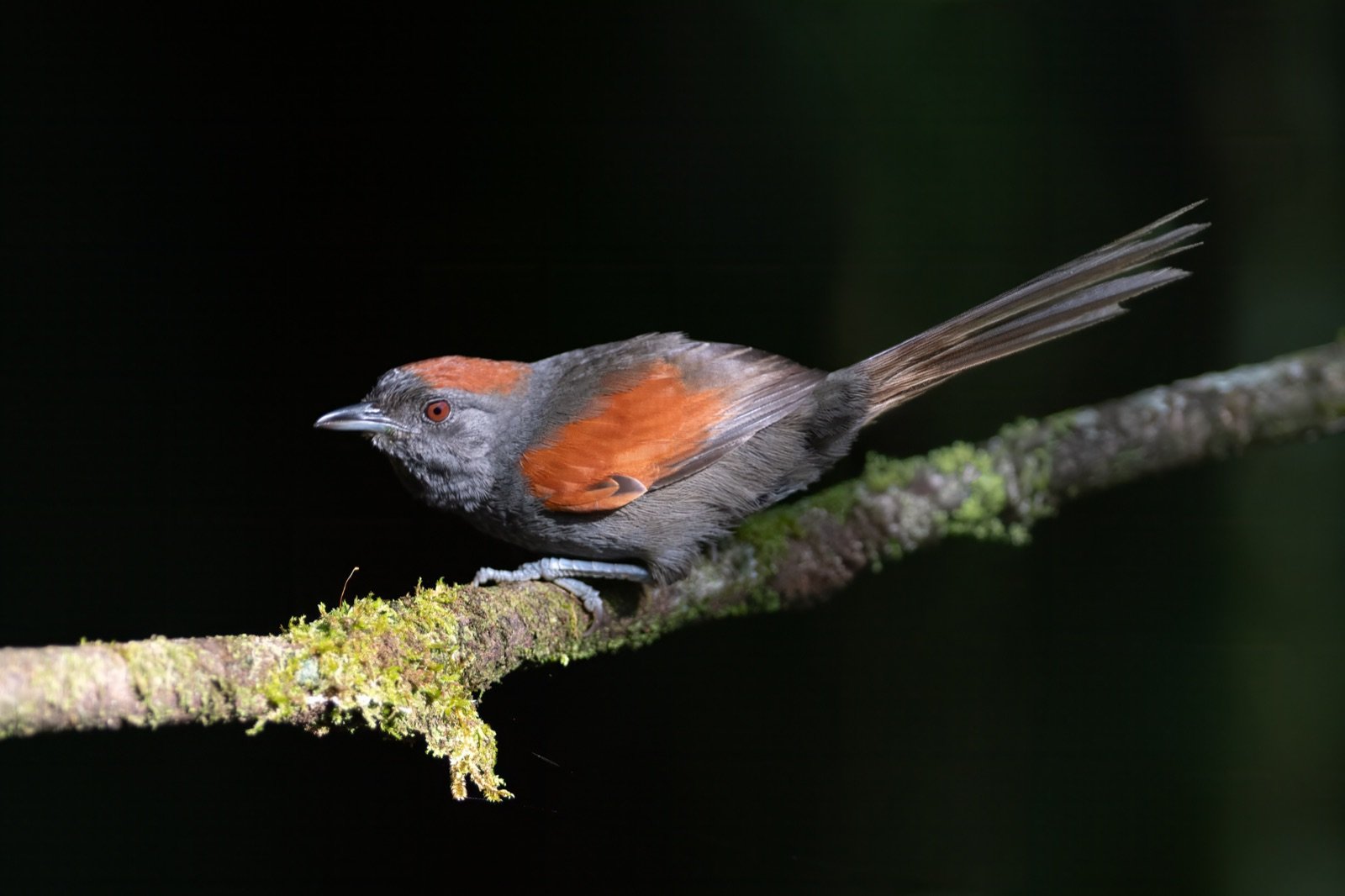
 Slaty Spinetail
Family Furnariidae
Slaty Spinetail
Synallaxis brachyura
In Spanish: Arquitecto Plomizo
- Resident
A small gray thicket skulker that rattles from cover on both slopes.
The Slaty Spinetail, Arquitecto Plomizo in Costa Rica, is a small, plain gray bird of forest edges and scrub. It lives on both the Caribbean and Pacific slopes, mostly below about 1,200 m.
On a trip we build around Los Cusingos and the San Isidro valley, you are able to spot many rare plant and tree species, as well as intriguing birds such as the Red-legged Honeycreeper or the Slaty Spinetail.
It is not a bird that shows off, yet it is a little less secretive than other Synallaxis spinetails, and it sometimes steps out of dense cover into view. A patient listener at the edge of a thicket has a fair chance of hearing it first and then catching a glimpse.
Where to see it
How to find it
Start with your ears, because its stuttering chatter often comes from thickets you cannot see into. Choose the edges of tangled, weedy growth along fields rather than the interior of tall forest. Look for pairs or small groups at the edges of thickets rather than hoping for a single bird. Stay still and let the pair move along the low vegetation, where one may step out of cover into view. Learning the trill and the short "chk" beforehand will help you pick it out. Early morning is worth trying: one bird was heard around 7 am in September on the Pacific slope in the south.
How to recognise it
This is a small bird, about 14 to 16 cm long and 16 to 21 g. It looks plain slaty gray overall, with dark olive flanks.
Look for these marks on an adult:
A rufous crown and nape.
Rufous wing patches.
A dark olive-brown back.
A slate chin and throat with white spots.
In Costa Rica it is the darker of our two spinetails, with a gray body set off by rufous on the crown and wings. Those warm touches against the gray are the quickest way to tell it from its paler relative when you finally get a clear view.
What it sounds like
Recording: Thibaud Aronson, CC BY-SA 4.0, source, read 4 Nov 2026.
Behaviour and diet
The Slaty Spinetail often forages in pairs or family groups in low, dense vegetation, so a pair or a small group is more likely than a single bird. It forages above ground level and sometimes comes out of dense cover into view, which makes it a little less secretive than other Synallaxis spinetails.
It builds a bulky, round stick nest with a long tubular entrance, set in a shrub or a vine-covered tree. The clutch is two or three greenish-white eggs. Across its range it is considered common in a variety of habitats, including shrubby woodland, forest edges, clearings and gardens.
Where it lives
In Costa Rica the Slaty Spinetail is found mostly below about 1,200 m, at forest edges and in scrub, from the lowlands up into the hills. Across its whole range it is usually found below about 1,400 m.
It occurs on both the Caribbean and Pacific slopes. Photographers have recorded it at Turrialba on the Caribbean slope, and a nesting bird was documented near Pérez Zeledón, at about 739 m elevation. Across its range it also uses second-growth scrub, riparian thickets, overgrown clearings, and locally thorn scrub, swamp edges and gardens.
When to see it
The breeding season is not well defined. In Costa Rica, eggs have been found in January, February, and from April to October.
Similar birds
The Slaty Spinetail is the darker spinetail, with a gray body, rufous wing patches and a rufous crown. Costa Rica's only other Synallaxis, the Pale-breasted Spinetail, is paler. Compare overall tone first, then check for the rufous touches.
Names and lore in Costa Rica
Costa Ricans call it Arquitecto Plomizo. Elsewhere other Spanish names are used: Chamicero Pizarra or Rastrojero Pizarra in Colombia, Cola Espina Gris in Honduras, and Colaespina Plomiza in Panama.
Status and conservation
The AOCR list marks it as a resident (R), and across its range it is considered common in a variety of habitats.
Photography tips
Look for pairs or small groups at the edges of thickets rather than a single bird, since the birds often forage together in low, dense vegetation. Be patient and watch a tangle for a few minutes. The birds can stay deep in grass, so expect brief views.
How we know this 12 sources, each read on the date shown
- Wikipedia read 2026-11-04
https://en.wikipedia.org/wiki/Slaty_spinetail - Avibase read 2026-11-04
https://avibase.bsc-eoc.org/species.jsp?avibaseid=4EB56FD3 - Macaulay Library read 2026-11-04
https://macaulaylibrary.org/asset/205686081 - Wikipedia (Spanish) read 2026-11-04
https://es.wikipedia.org/wiki/Synallaxis_brachyura - Dibird read 2026-11-04
https://dibird.com/species/slaty-spinetail/ - Cornell Birds of the World read 2026-11-04
https://birdsoftheworld.org/bow/species/slaspi1/cur/introduction - Organization for Tropical Studies, Las Cruces bird songs read 2026-11-04
https://tropicalstudies.org/sonidosaveslc/Bird%20Songs%20of%20LCBS-recording%20info%20&%20credits.pdf - Cornell/Merlin species page read 2026-11-04
https://www.hbw.com/ibc/species/slaty-spinetail-synallaxis-brachyura - Field Guides trip list, Costa Rica 2024 read 2026-11-05
https://fieldguides.com/triplists/cos24.html - Field Guides trip list, Costa Rica 2018 read 2026-11-05
https://fieldguides.com/triplists/cr118.html - Birds of Passage blog read 2026-11-05
https://birdsofpassage.wordpress.com/2014/05/04/arenal-costa-rica/ - Animalia.bio read 2026-11-05
https://animalia.bio/slaty-spinetail?taxonomy=3498