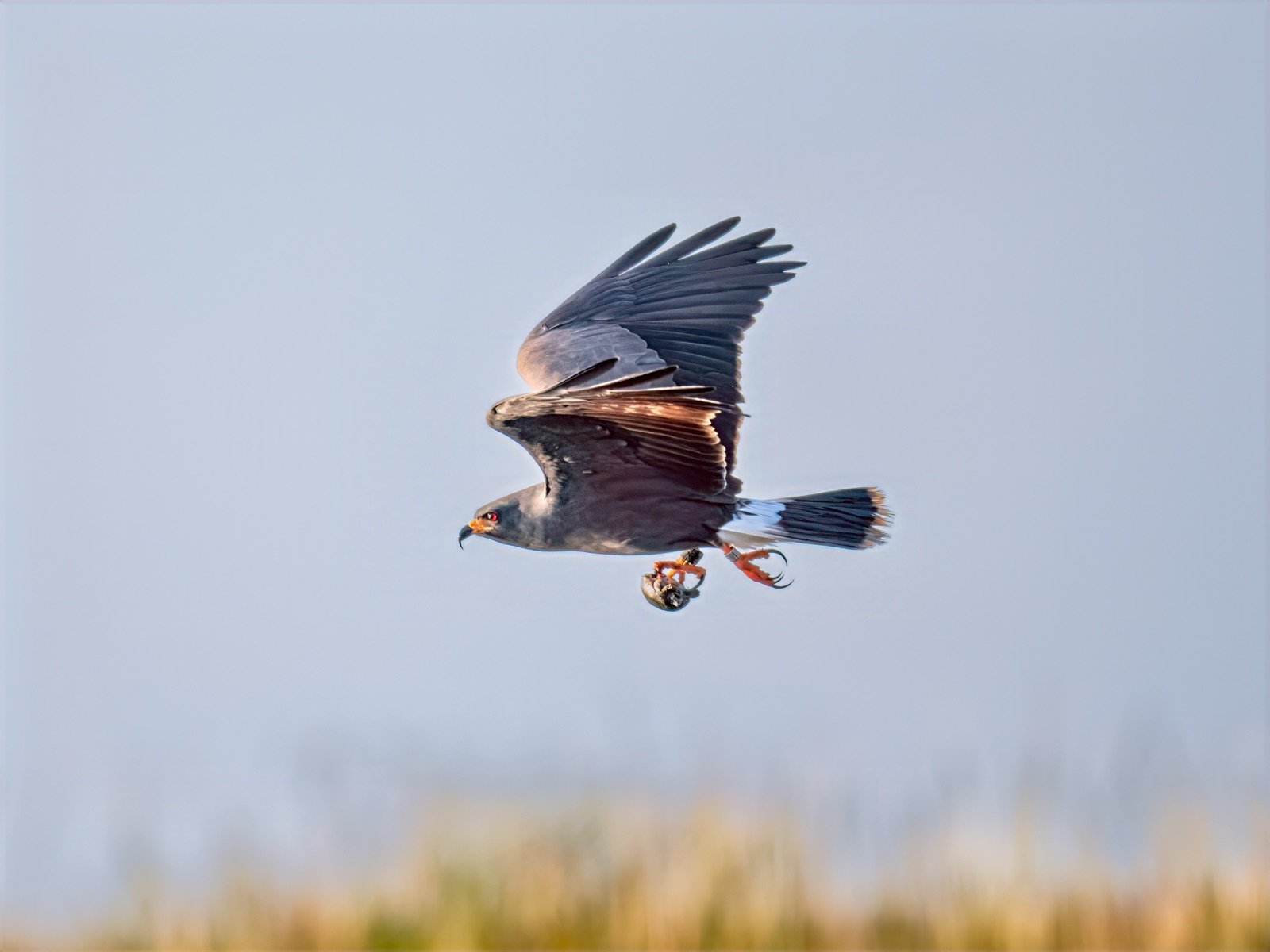
 Snail Kite
Family Accipitridae
Snail Kite
Rostrhamus sociabilis
In Spanish: Elanio Caracolero (Gavilán Caracolero)
- Resident
A hook-billed wetland raptor that lives on apple snails.
The Snail Kite is a wetland raptor with a long, thin, hooked bill, built to pull large freshwater apple snails out of their shells. In Costa Rica it is a locally common resident in the Tempisque River basin, which includes Palo Verde, and in the Río Frío region of the far north.
Away from those strongholds it is rare and sporadic in the lowlands of both slopes, so this is a bird to look for in the right marsh. Costa Ricans call it Gavilán Caracolero or Elanio Caracolero.
On a trip we build, guests meet it by boat on the Río Frío, reached from Los Chiles, or at the wetland edge in Palo Verde National Park.
How to find it
In the far north, boat tours give the best view, and early morning and late afternoon work best. Access is by boat on the Río Frío from Los Chiles, or on a guided day tour. Local guides drift slowly along the river in the early morning mist and pick out small movements in the reeds and branches. Look for kites gliding low over open water, perched near lagoons, or hunting over flooded grassland. At Palo Verde, one visitor found a kite perched at the wetland edge, very close to the trail.
How to recognise it
Start with the bill: a long, thin hook. The wings are long and rounded. The rump and base of the tail are white, and the tail ends in a thin pale band. That white rump is the mark to check as one flies away.
The adult male is slate black, with orange or red legs and a red or orange cere. Females are blackish brown with a buff face and heavily streaked buff underparts. Immatures resemble females but are more rusty.
What it sounds like
Behaviour and diet
It flies slowly with its head pointed down, looking for prey. It has been described hovering briefly before taking a snail, then returning to a perch to eat.
Unlike most raptors, it nests in colonies and roosts communally, sometimes among herons and anhingas.
Where it lives
In Costa Rica it lives in ponds, marshes and lagoons, and has been recorded mainly in lowland wetlands. It is locally common in the Tempisque River basin, which includes Palo Verde, and in the Río Frío region in the far north near the Nicaraguan border. The Palo Verde wetland is an important dry season refuge. A regional guide calls it easy to see along the river in the Sarapiquí lowlands. Elsewhere in the lowlands, on both the Caribbean and Pacific slopes, it is rare and sporadic.
When to see it
In Costa Rica it breeds from July to September, building a deep stick cup nest a few metres above the water in isolated trees in swamps. A study of a Palo Verde lagoon colony found breeding from September to January, when the lake is at its fullest.
Similar birds
The adult male looks like the Slender-billed Kite. The Snail Kite is the one with a white rump, a white tail base and a brown eye. The Slender-billed Kite has no white in its plumage and hunts in more forested habitat.
Names and lore in Costa Rica
Costa Ricans call it Gavilán Caracolero or Elanio Caracolero. Both names refer to its snail diet, since caracol means snail.
Status and conservation
It is a resident (R) on the AOCR list, and is listed as Least Concern and common in Central and South America.
Photography tips
Boat tours give the best view, early morning and late afternoon. The kite flies slowly over water, hovers briefly before taking prey, then returns to a perch to eat, steady habits that make it a good subject. Watch a perch near a lagoon and wait for it to return.
How we know this 22 sources, each read on the date shown
- Aves de Costa Rica read 2026-11-04
https://avesdecostarica.com/Rostrhamus-sociabilis.html - Áreas y Parques, Parques Nacionales de Costa Rica read 2026-11-04
https://areasyparques.com/otros/una-porcion-de-verdor/ - El Ecoturista read 2026-11-04
https://elecoturista.com/internacional/costa-rica-un-destino-ornitologico-top-y-ii-centro-y-norte/ - Jose Pablo Castillo blog read 2026-11-04
https://josepablocastillo.wordpress.com/2016/07/ - Cornell Lab, All About Birds read 2026-11-04
https://www.allaboutbirds.org/guide/Snail_Kite/overview - Simple English Wikipedia read 2026-11-04
https://simple.wikipedia.org/wiki/Snail_kite - Peru Aves read 2026-11-04
https://www.peruaves.org/accipitridae/snail-kite-rostrhamus-sociabilis/ - All About Birds, Cornell Lab of Ornithology read 2026-11-04
https://www.allaboutbirds.org/guide/Snail_Kite/sounds - BWD Magazine read 2026-11-04
https://bwdmagazine.com/species/snail-kite/ - Costa Rica Spirit read 2026-11-04
https://www.costarica-spirit.com/es/guias/observacion-aves-por-region/ - ICT Costa Rica, Ruta Nacional de Observación de Aves read 2026-11-04
https://www.ict.go.cr/es/documentos-institucionales/desarrollo-tur%C3%ADstico/infogramas-de-aves/1974-aves-guanacaste-sur/file.html - El Ecoturista read 2026-11-04
https://elecoturista.com/2026/05/27/cano-negro-el-refugio-secreto-de-costa-rica/ - Academia.edu (Palo Verde Snail Kite study) read 2026-11-04
https://www.academia.edu/7985673/Comportamiento_de_forrajeo_y_uso_del_h%C3%A1bitat_del_gavil%C3%A1n_caracolero_Rostrhamus_sociabilis_en_el_Parque_Nacional_Palo_Verde_Costa_Rica - NaturalistaUY read 2026-11-04
https://www.naturalista.uy/taxa/5349-Rostrhamus-sociabilis - Birds for Beer read 2026-11-04
https://birdsforbeer.com/2018/06/12/limpkin-and-snail-kite-at-angostura/ - Birding for Conservation read 2026-11-04
https://www.birdingforconservation.com/2019/01/birding-the-medio-queso-wetlands/ - Eagle-Eye Tours read 2026-11-04
https://www.eagle-eye.com/blog/costa-rica-birding-trip-report-jan-11-27-2026/ - WINGS Birding Tours read 2026-11-04
https://wingsbirds.com/tours/costa-rica-july/ - Caño Negro Lodge blog read 2026-11-04
https://canonegrolodge.com/snail-kite-in-cano-negro-a-wetland-specialist-bird-in-costa-rica/ - Aves de Concordia read 2026-11-04
https://avesdeconcordia.weebly.com/caracolero.html - iNaturalist guide read 2026-11-04
https://www.inaturalist.org/guide_taxa/273173 - Animalia.bio read 2026-11-04
https://animalia.bio/snail-kite