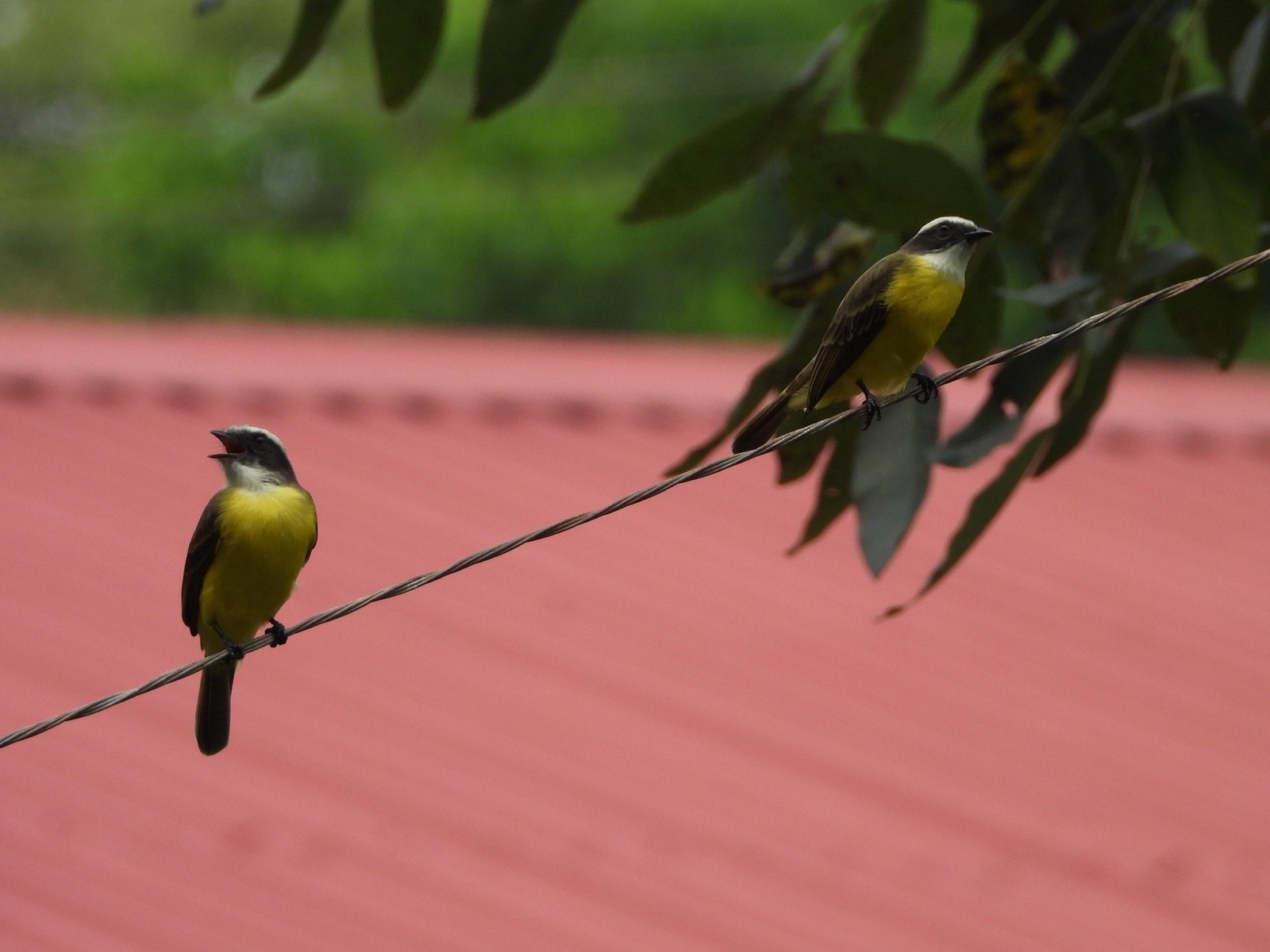
Family Tyrannidae
Social Flycatcher
Myiozetetes similis
In Spanish: Mosquero Cejiblanco (Pecho Amarillo)
- Resident
A bold-browed yellow flycatcher of edges, gardens and roadside wires
The Social Flycatcher (Mosquero Cejiblanco, Myiozetetes similis) is a common resident across Costa Rica, absent only from the highest parts of the country. It is very common and easy to find at forest edges, in open areas and in gardens.
On a trip we build, you can meet it in everyday places: a roadside perch, a tree in a park, or under the eaves of a building where it nests.
For a beginner it is a friendly bird to learn on, and it teaches a useful lesson about telling look-alike flycatchers apart.
How to find it
Start at forest edges, in open areas and in gardens, where it is very common. It likes to sit on utility wires, watching for insects, so roadsides are a good place to scan. It perches from ground level up into tall trees, sometimes wagging its tail, and is especially numerous near water. Listen for the sharp call, which often comes before you see the bird. Eaves of buildings and park trees are worth a glance too.
How to recognise it
This is a medium flycatcher. Look for these marks:
Brown upperparts.
A dark head with a bold white eyebrow, a black and white striped look.
A white throat.
Yellow underparts from the white throat down.
A short, slightly curved bill.
A hidden orange to red crown stripe is usually not visible. Across its whole range adults measure about 16 to 18.5 cm long and weigh 24 to 27 g, and males and females look alike.
What it sounds like
Behaviour and diet
It catches insects in the air on short or long flights and also takes them from vegetation. It often feeds on the ground and wades into shallow water to catch tadpoles. Berries and other small fruits are on the menu too.
It pairs up year round, and family groups do not last long once breeding is over. The big domed nest of grass and twigs is often in a spiny tree near a wasp nest or another flycatcher's nest, and often close to or over water.
Where it lives
It lives at forest edges, pastures, clearings with scattered trees, coffee farms, mangroves, riverbanks, swamps, and towns and suburbs. In Costa Rica it ranges from the lowlands up to about 1700 m, sometimes higher, and reaches the higher parts mostly during the nesting season. It occurs across most of the country and is absent only from the highest parts. Photo records place it at Corcovado National Park, Tortuguero National Park, La Selva and Arenal Volcano National Park.
When to see it
The breeding season in Costa Rica runs from February to June, and eggs are laid in those months.
Similar birds
White-ringed Flycatcher has white eyebrows that meet on the nape, a slightly longer, straighter bill and an even-pitched trill. A Costa Rican birding writer says most online photos tagged White-ringed are really Social Flycatchers. Gray-capped Flycatcher has a much fainter eyebrow. Beside Great Kiskadee and Boat-billed Flycatcher, the Social is the smaller bird, and the Boat-billed has a noticeably large bill.
Names and lore in Costa Rica
Costa Ricans call it Mosquero Cejiblanco, and the official list adds the group nickname Pecho Amarillo ('yellow breast'), shared with several other yellow-bellied flycatchers. Other countries use other names, such as luis gregario in Mexico and mosquero social in Panama.
Status and conservation
The official Costa Rica bird list marks it as a resident (R), and the IUCN rates it Least Concern because of its wide range and large populations.
Photography tips
It sits on utility wires watching for insects, which makes it easy to see and photograph along roads. It perches in the open on treetops or at the edge of vegetation, mostly at middle levels, and often nests in highly visible spots, including human structures.
How we know this 15 sources, each read on the date shown
- Wikipedia read 2026-11-04
https://en.wikipedia.org/wiki/Social_flycatcher - Costa Rica Birding Trips read 2026-11-04
https://costaricabirdingtrips.com/tyranidae/social-flycatcher-myiozetetes-similis - Aves de Costa Rica read 2026-11-04
https://avesdecostarica.com/Myiozetetes-similis.html - Planetscott read 2026-11-04
https://www.planetscott.com/speciesdetail/4405/social-flycatcher-myiozetetes-similis - Birds of the World (Cornell) read 2026-11-04
https://birdsoftheworld.org/bow/species/socfly1/cur/introduction - Wikipedia (Spanish) read 2026-11-04
https://es.wikipedia.org/wiki/Myiozetetes_similis - Lista Oficial de las Aves de Costa Rica (AOCR) read 2026-11-04
https://listaoficialavesdecostarica.wordpress.com/lista-oficial/lista-oficial-online/ - Earthlife read 2026-11-04
https://earthlife.net/social-flycatchers/ - Wikipedia via iNaturalist read 2026-11-04
https://www.inaturalist.org/taxa/16842-Myiozetetes-similis - JungleDragon read 2026-11-04
https://www.jungledragon.com/specie/7370/social_flycatcher.html - Aves Ibericas, Aves Costa Rica read 2026-11-04
https://www.avesibericas.es/costaricaaves6.htm - Birda read 2026-11-04
https://app.birda.org/species-guide/17751/Social_Flycatcher - BirdForum Opus read 2026-11-04
https://www.birdforum.net/opus/Social_Flycatcher - Native Backyards read 2026-11-04
https://nativebackyards.com/birds-of-costa-rica/ - Birdingcraft read 2026-11-04
http://birdingcraft.com/wordpress/2017/03/08/identification-tips-for-white-ringed-flycatcher/