Family Accipitridae
Solitary Eagle
Buteogallus solitarius
In Spanish: Águila Solitaria
- Resident
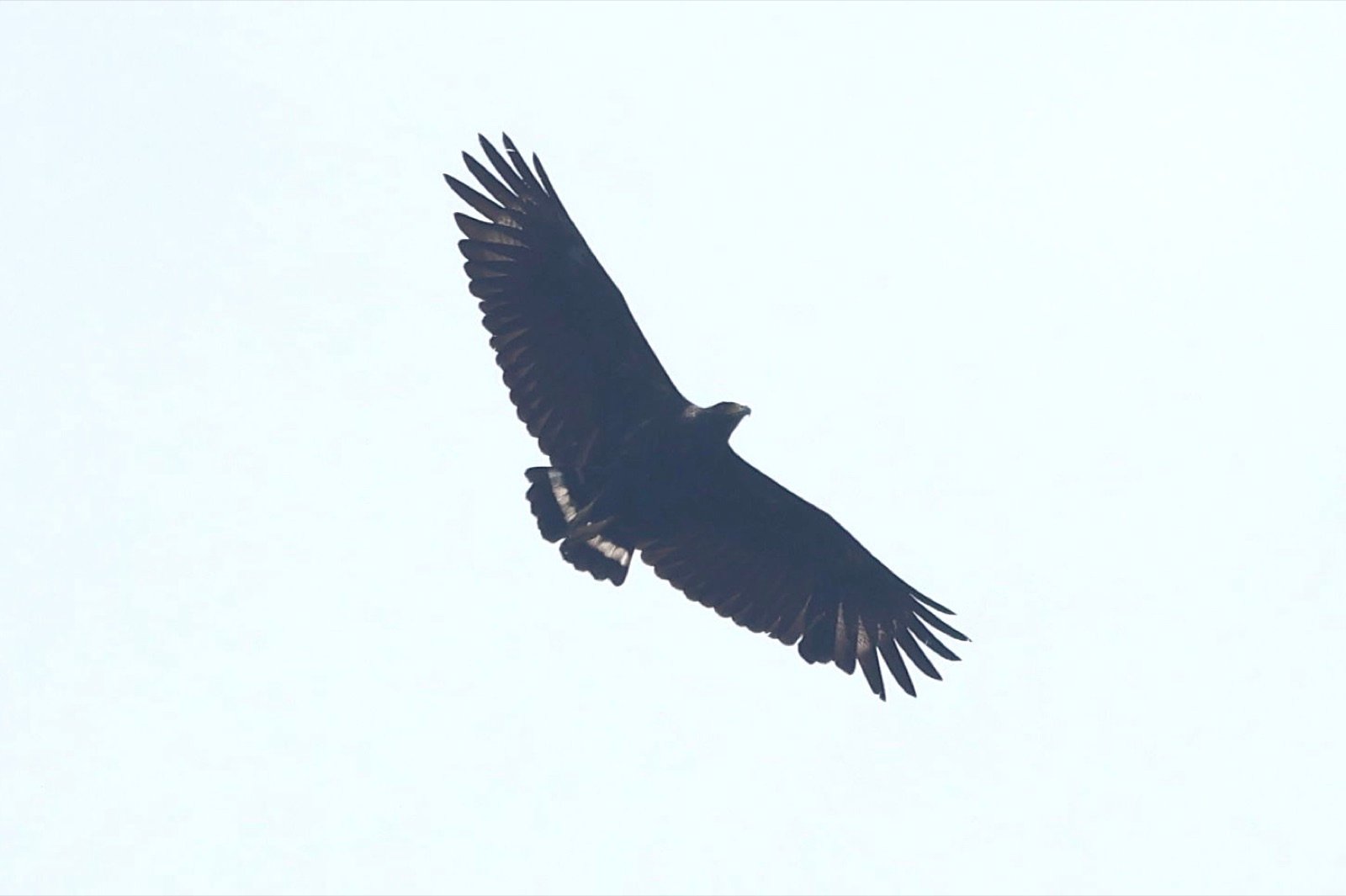
A huge slate-grey eagle of old mountain forest, and one of our hardest raptors.
The Solitary Eagle (Águila Solitaria) is a large, robust slate-grey eagle with a bushy crest at the nape. In Costa Rica it lives locally in highland areas, and a Costa Rican birding blog calls it one of the hardest raptors to see in the country.
It is restricted to primary forest, the old and undisturbed kind. For a beginning birder it is a bird to hope for rather than expect, and knowing how to tell it from the black hawks makes any glimpse of a huge dark raptor over the mountains far easier to understand.
How to find it
Patience and realistic expectations matter most with this eagle, which a Costa Rican birding blog calls one of the hardest raptors to see in the country. Focus on highland areas with large stretches of old, undisturbed forest, since it is restricted to primary forest. Scan hills and mountain slopes for a big dark raptor soaring on flat wings, usually alone or as a pair. Listen for a long rising whistle in dense forest, because the bird is mostly quiet and any call is a clue. Do not spend time in the lowlands, where reports have never been confirmed.
How to recognise it
Adults are uniformly dark grey, often looking black, with white marks on the tail. The cere, lores and legs are yellow.
Across its range the bird stands about 76 cm tall and weighs about 3 kg, with a bushy crest at the nape.
Juveniles are mottled brown and tan, with markings around the eyes.
The Costa Rican and Mexican form, sheffleri, is larger and darker grey than the South American one. It has bigger wings, heavier legs and feet, and a darker grey head, breast and back.
In flight, look for a short tail and very broad wings that reach almost to the tail tip. From above, the wings and tail show white.
What it sounds like
Recording: Thibaud Aronson, CC BY-SA 4.0, source, read 4 Nov 2026.
Behaviour and diet
The Solitary Eagle is usually seen alone, sometimes as a pair. It soars heavily on flat wings over hills and mountain forest.
Its diet is poorly known, but it seems to take large snakes often. One pair was seen hunting deer fawns, and chachalaca remains were noted in one nest. In Belize, a pair was watched carrying a snake in the talons and flying low into a canyon, and the adults landed in a tree before dropping to the probable nest.
Where it lives
Across its range the species lives in hilly or mountainous forest at about 600 to 2,200 m. It is a primary forest specialist, found in humid, densely wooded foothills and in premontane and montane forest on steep, hilly ground.
In Costa Rica the form sheffleri lives locally in highland areas. Reports from the lowlands are usually mistaken sightings of Common Black Hawk or Great Black Hawk, and none have been confirmed.
Similar birds
This large eagle is often confused with other Buteogallus species, such as the black hawks. It looks much like Common Black Hawk and Great Black Hawk but is much larger, and its wings are much broader, reaching almost to the tail tip. A Costa Rican bird photo site describes it as similar to the Great Black Hawk but found at higher altitudes, with a short tail in flight.
Names and lore in Costa Rica
Costa Rican sources use the Spanish name Águila Solitaria, the same as on the AOCR list.
Status and conservation
The AOCR lists it as a resident with scarce records (R-SC), and the IUCN lists it as Near Threatened with a decreasing population.
How we know this 14 sources, each read on the date shown
- Oiseaux-Birds.com read 2026-11-04
https://www.oiseaux-birds.com/card-solitary-eagle.html - Wikipedia read 2026-11-04
https://en.wikipedia.org/wiki/Solitary_eagle - Mr Birding Guide (blog) read 2026-11-04
https://mrbirdingguide.school.blog/2020/07/18/fantasmas-y-leyendas-las-aves-raras-mas-buscadas-de-costa-rica/comment-page-1/ - iNaturalist (Wikipedia text) read 2026-11-04
https://www.inaturalist.org/taxa/199912-Buteogallus-solitarius - Animalia.bio (Wikipedia text) read 2026-11-04
https://animalia.bio/solitary-eagle - Bird Watching Costa Rica read 2026-11-04
https://www.birdwatchingcostarica.com/ave/solitary-eagle/ - Fauna Decomisada, Costa Rica read 2026-11-04
https://faunadecomisada.go.cr/guia-de-especies/aves/accipitridae/harpyhaliaetus-solitarius - En15dias read 2026-11-04
https://en15dias.com/animales/aguila-solitaria-especie-en-peligro-de-extincion/ - Avibase read 2026-11-04
https://avibase.bsc-eoc.org/species.jsp?avibaseid=5C9AF2BEB3ADDAC6 - BirdLife International read 2026-11-04
http://datazone.birdlife.org/index.php/species/factsheet/black-solitary-eagle-buteogallus-solitarius/text - Pacific Bio student report (Kreklow Carnes) read 2026-11-04
http://pacificbio.org/initiatives/south-america/UW_student_reports/Harpyhaliaetus%20solitarius%20Report.pdf - Birds of Costa Rica (birdsofcolombia.org) read 2026-11-04
https://www.birdsofcolombia.org/costarica/Buteogallus.html - Grokipedia read 2026-11-05
https://grokipedia.com/page/Solitary_eagle - Avibase Costa Rica checklist read 2026-11-05
https://avibase.bsc-eoc.org/checklist.jsp?region=CR