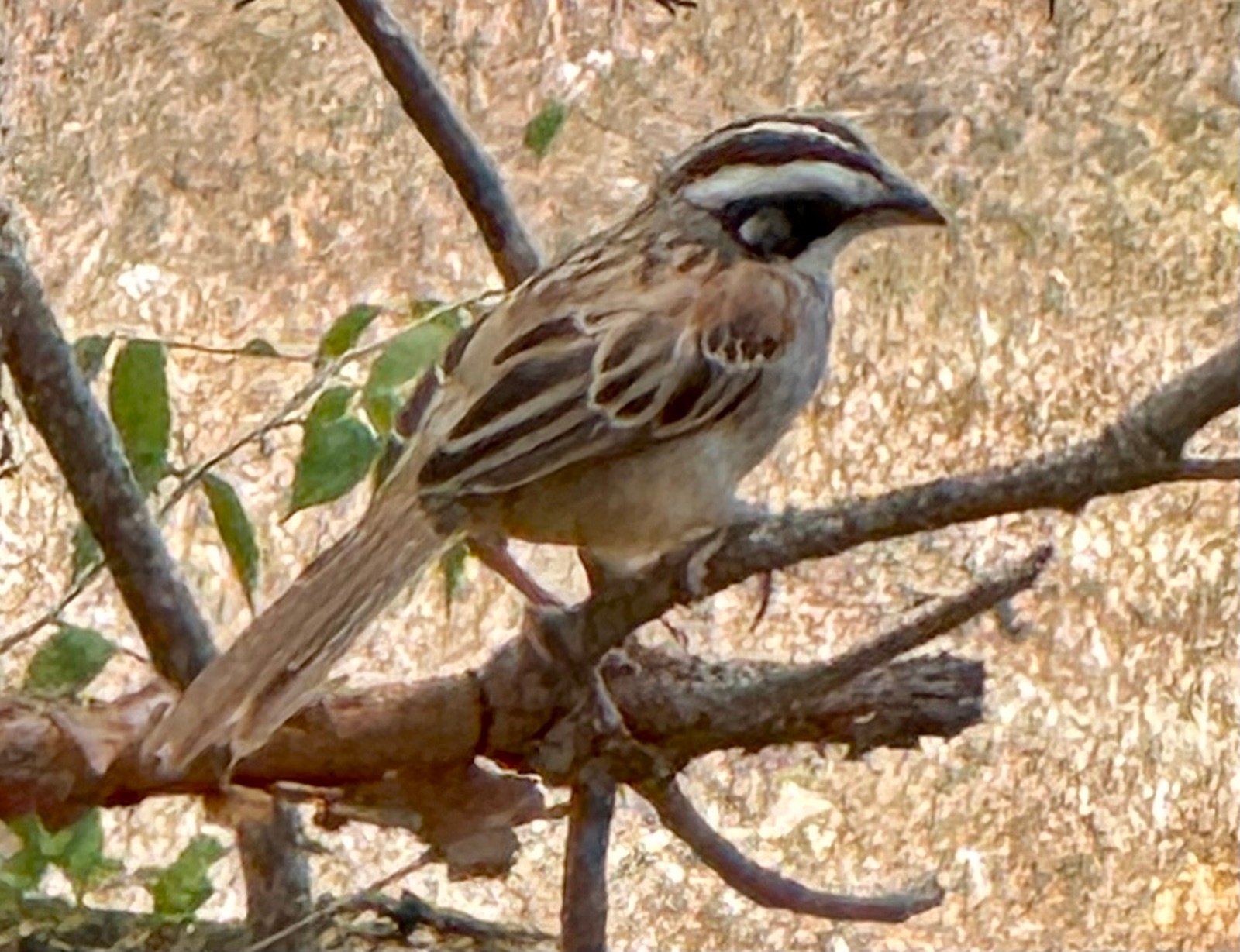
Family Passerellidae
Stripe-headed Sparrow
Peucaea ruficauda
In Spanish: Sabanero Cabecilistado (Pájaro Chicle, Albarda Nueva, Ratoncillo)
- Resident
A masked-looking sparrow of Guanacaste's dry scrub, often perched in plain view.
The Stripe-headed Sparrow is a common resident of the northern Pacific lowlands, and it often sits out in plain view. Bold black and white stripes on its head give it a masked look.
On a trip we build, guests can meet it in dry scrub forest on the southern edge of Guanacaste. It is also a bird of resort grounds and coastal scrub, where one was photographed from a courtyard alongside Inca Dove and Groove-billed Ani.
For a beginning birder it is a rewarding bird to learn, because the striped head, rufous shoulder and long tail make identification easy.
How to find it
Look for it sitting out in the open in scrubby fields and brushy areas, sometimes in the sun along a fence line. In hot Guanacaste, getting out between 5:30 and 8:00 in the morning is advised for the most bird activity. Males sing from the top of a tree or from above a tall cactus, so scan those open perches. A guided tour making short stops around Punta Caldera and the Guacimo Road in southern Guanacaste found about 7 in dry scrub forest. Birds also sang from grassy areas in scrubby coastal hills near Playa Hermosa.
How to recognise it
This is a large sparrow, about 18 cm long, with a thick bill and a long cinnamon tail.
Adults show:
- a black head top and sides
- broad white stripes down the centre of the crown and above each eye
- cinnamon and buff upperparts (across its whole range)
- bright rufous patches on the shoulders
One resident birder's first impression was of a large Rufous-collared Sparrow with a long tail, which is a handy way to picture it. Young birds look different: the head pattern is duller, with buff stripes on a brown base, and the breast is streaked. In flight it is low and fluttery, with the tail held down.
What it sounds like
Recording: David Umanzor, CC BY 4.0, source, read 4 Nov 2026.
Behaviour and diet
It feeds mostly on bare ground, moving with springy hops, and picks up grass seeds and sometimes small insects and spiders. It lives in family groups or small, loose flocks of 3 to 7 birds. At night the group roosts pressed together in a tight bunch on a branch near the top of a small tree.
The nest is a deep cup of coarse grass, set low in a dense, often thorny bush, with 2 or 3 plain pale blue eggs. Breeding runs from July to September or October.
Where it lives
It uses savannas with scrub, second growth and the edges of deciduous forest. In Costa Rica it is a common resident of the northern Pacific lowlands and does not go above 800 m, a height it reaches on the slopes of the Guanacaste Cordillera and the hills of the Nicoya Peninsula. In Mexico, by contrast, it reaches 1,800 m. To the south it extends to the area between Puntarenas and Orotina. Photo records also place it near Rincón de la Vieja National Park, at Mal País and around the Arenal volcano area near La Fortuna.
Similar birds
It looks much like the Black-striped Sparrow. The Stripe-headed lives only on the Pacific slope, while the Black-striped occurs on both slopes. Several clear differences in build and colour make both easy to identify.
Names and lore in Costa Rica
Costa Rican names for this bird include Sabanero Cabecilistado, Pájaro Chicle, Albarda Nueva and Ratoncillo. Names such as Zacatonero Corona Rayada are used in Mexico and Honduras, not in Costa Rica.
Status and conservation
It is a resident (R) on the AOCR list, and BirdLife International lists it as Least Concern.
Photography tips
Late afternoon is a feeding time, and two birds were seen moving from a tree to a fence and then to the ground to forage. Open perches such as treetops and the tops of tall cacti are good places to look, and fence lines in scrubby fields often give a clear view.
How we know this 19 sources, each read on the date shown
- Aves de Costa Rica read 2026-11-04
https://www.avesdecostarica.com/Peucaea-ruficauda.html - Naturalista Costa Rica (Wikipedia text) read 2026-11-04
https://costarica.inaturalist.org/taxa/73178-Peucaea-ruficauda - EcoRegistros read 2026-11-04
https://www.ecoregistros.org/sheet/Peucaea-ruficauda - Flickr (Aves de Costa Rica text) read 2026-11-04
https://www.flickr.com/photos/jobando/36570856860 - Birds of the World read 2026-11-04
https://birdsoftheworld.org/bow/species/sthspa1/cur/introduction?lang=es - Wikipedia read 2026-11-04
https://en.wikipedia.org/wiki/Stripe-headed_Sparrow - Meadowhawk blog read 2026-11-04
https://meadowhawk.wordpress.com/2023/04/26/costa-rica-a-birding-day-on-the-resort/ - Birding Craft read 2026-11-04
https://birdingcraft.com/wordpress/tag/banded-wren/ - Field Guides Birding Tours read 2026-11-04
https://fieldguides.com/triplists/cr216.html - Retired in Costa Rica read 2026-11-04
https://www.charliedoggett.net/2025/04/16/stripe-headed-sparrow/ - Birds for Beer read 2026-11-04
https://birdsforbeer.com/2015/07/30/stripe-headed-sparrow/ - Birding Craft read 2026-11-04
https://birdingcraft.com/wordpress/2011/09/12/birding-near-playa-hermosa-guanacaste-costa-rica/ - Lista Oficial de las Aves de Costa Rica read 2026-11-04
https://listaoficialavesdecostarica.wordpress.com/lista-oficial/lista-oficial-online/ - Avibase read 2026-11-04
https://avibase.bsc-eoc.org/species.jsp?avibaseid=B0C2CA36D4F47647 - Wikipedia (español) read 2026-11-04
https://es.wikipedia.org/wiki/Peucaea_ruficauda - Costa Rica Focus read 2026-11-04
https://www.costaricafocus.com/birding-guanacaste-costa-rica-a-complete-guide/ - Exotic Birding read 2026-11-04
https://www.exoticbirding.com/costarica/paloverde/checklist.html - Birding Craft read 2026-11-04
https://birdingcraft.com/wordpress/category/guanacaste/ - BirdGuides read 2026-11-04
https://www.birdguides.com/gallery/birds/peucaea-ruficauda/?page=1