 Striped Owl
Family Strigidae
Striped Owl
Asio clamator
In Spanish: Búho Listado
- Resident
Long-eared, white-faced owl of open ground, watched on posts and wires at dusk.
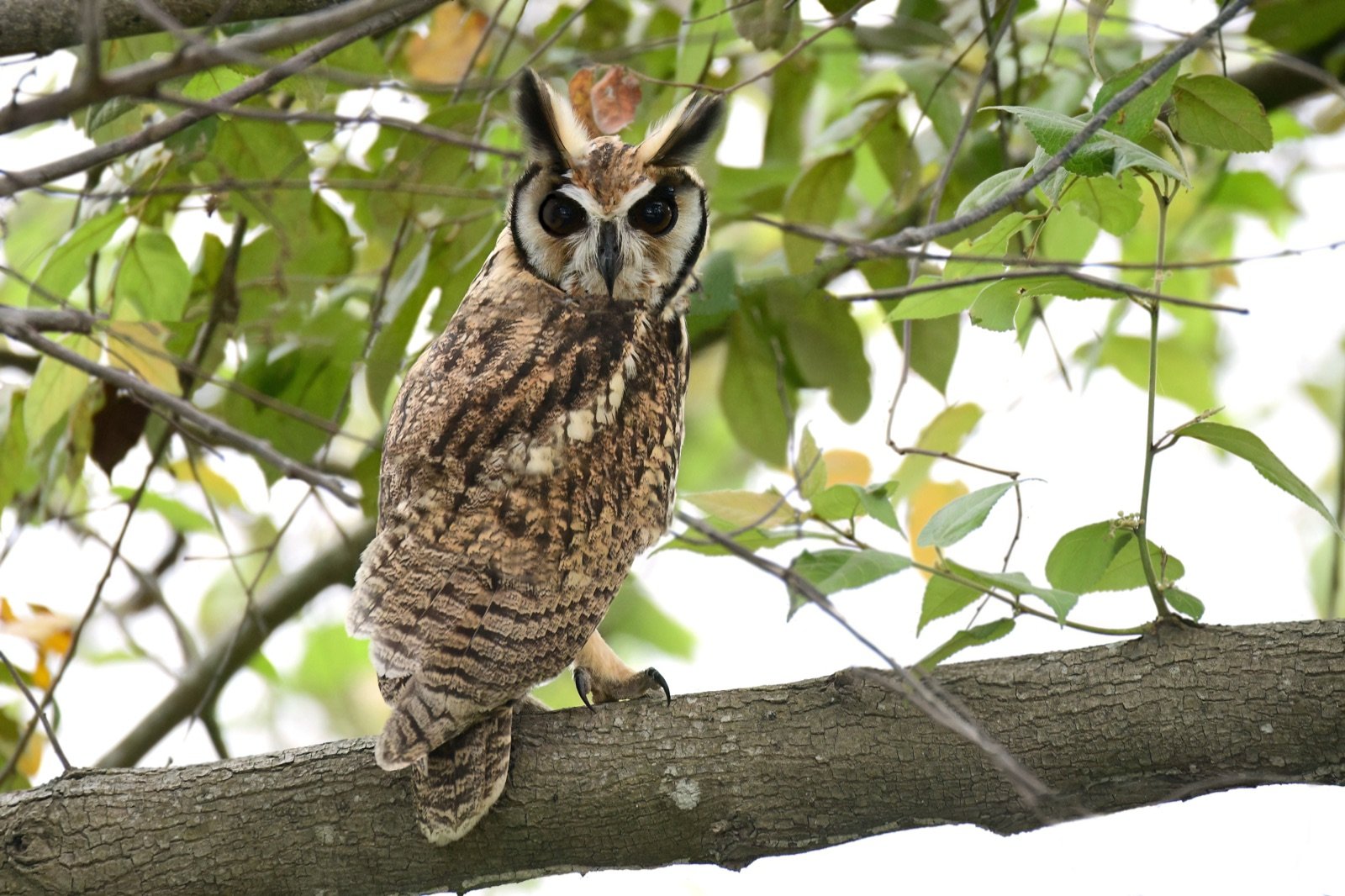
The Striped Owl (Búho Listado, Asio clamator) is a medium-sized owl, about 38 cm long, with very long ear tufts and a mostly white face edged in black. In Costa Rica it is a resident with a wide range, though generally local and uncommon along the Pacific slope.
It sleeps by day in low scrub or on the ground, so the chance usually comes at dusk or on a night drive. On a trip we build, open pasture after dark is where we would look, and its centers of abundance are the Guanacaste lowlands and the Térraba region in the south.
Guests who go owling here often search for it alongside Great Potoo, Black-and-white Owl and Pacific Screech-Owl.
How to find it
Plan for night, since this owl is more often found after dark than at a day roost. A Costa Rican tour company says it sometimes knows of a roost, but more often finds the owl perched on power lines at night. Scan fence posts, electric wires and other exposed perches along pasture roads. Watch the open ground at dusk for a low, back-and-forth hunting flight. On a pasture road night drive, one owl sat on a fencepost and stayed put when the group got out to look. On the Caribbean side, an optional night drive near the Ujarrás farmland, Paraíso area, may turn up Striped Owl and Common Pauraque.
How to recognise it
Look for a medium-sized owl, about 38 cm long, with very long ear tufts and heavy streaking.
The wings are fairly short and the tail is long. The facial disk is mostly white with a black edge, which explains the Spanish name Búho Cara Blanca.
Adults show:
- black ear tufts edged in buff
- cinnamon-buff upperparts with thick black stripes
- white underparts with dense black streaks and a buff wash on the belly
- brown to cinnamon eyes and a black bill
The ear tufts are raised only when the owl is alarmed, so a relaxed bird may show them less. Juveniles look different: a cinnamon face with a white, black and buff edge, a whitish buff crown with light black streaks, and a buff body with grey bars.
What it sounds like
Recording: pablohcapovilla, CC BY 4.0, source, read 4 Nov 2026.
Behaviour and diet
The Striped Owl is nocturnal. By day it sleeps in low scrub or on the ground. It is usually seen alone or in pairs, and it is fairly quiet and easily overlooked.
It often starts hunting at dusk, flying low back and forth over open ground and dropping fast on prey. It may also watch from a fence post, an electric wire or another exposed perch. Across its range it eats small mammals such as rodents, bats, small reptiles, birds and insects.
At a nest in the Guanacaste conservation area, the adult was very calm, perched in nearby trees and never acted aggressive.
Where it lives
In Costa Rica it is recorded from sea level up to about 1,400 m, including the Central Valley, for example Palmares in Alajuela and San Pedro de Montes de Oca. It prefers open ground with scrub and isolated forest patches, such as savannas, open marshes, pastures, airstrips and sometimes rice fields.
On the Caribbean side it has been reported only from open pastures around Cartago, from Guácimo, where one hunted near utility poles, and from rice fields near Upala. Across its wider range it also uses riparian woodland and tropical rainforest. It may be spreading in Costa Rica because deforestation opens up the land.
When to see it
It breeds in the dry season, from December to March, and lays 2 to 4 eggs.
Similar birds
Young Striped Owls have a silhouette much like the Great Horned Owl's, which has caused a few false alarms among Costa Rican birders. For adults, the useful marks are the streaked underparts, white facial disk and dark eyes. Remember that juveniles look quite different from adults.
Names and lore in Costa Rica
Costa Rican sites use more than one Spanish name. The AOCR name is Búho Listado, one natural history site calls it Lechuza orejuda, and the government guide to rescued wildlife lists it as Búho Cara Blanca, which means white-faced owl.
Status and conservation
The AOCR lists the Striped Owl as a resident (R), and the IUCN lists it as Least Concern.
Photography tips
Night drives are the usual way to find it, and a perched owl on a fencepost may stay put while a group watches from a short distance. Scan power lines and fence posts along pasture roads.
How we know this 18 sources, each read on the date shown
- Aves de Costa Rica read 2026-11-04
https://avesdecostarica.com/Asio-clamator.html - Birds of Bolivia read 2026-11-04
https://birdsofbolivia.org/species-fact-sheets-2/owls/asio-clamator - Zoo Bioparque Amaru (Ecuador) read 2026-11-04
http://www.zoobioparqueamaru.com/nuestros-animales/animal.php?Id_Animal=10-buho-listado&Grupo=aves - iNaturalist (Wikipedia text) read 2026-11-04
https://www.inaturalist.ca/taxa/558468-Asio-clamator - Focusing on Wildlife read 2026-11-04
https://focusingonwildlife.com/news/species-champions/jefferson-r-de-o-e-silva/striped-owl-asio-clamator/ - Ecos del Bosque read 2026-11-04
https://ecosdelbosque.com/fauna/asio-clamator - Lifer Tours read 2026-11-04
https://www.lifertours.com/single-post/the-owls-of-costa-rica-and-how-we-see-them - Field Guides read 2026-11-04
https://fieldguides.com/triplists/cr223.html - Área de Conservación Guanacaste read 2026-11-04
https://www.acguanacaste.ac.cr/paginas-de-especies/insectos-2/292-strigidae/732-i-asio-clamator-i-strigidae - Hillstar Nature read 2026-11-04
https://www.hillstarnature.com/costa-rica-wyncote-2025 - Naturalist Journeys read 2026-11-04
https://www.naturalistjourneys.com/tours/2027/03/18/costa-rica-monteverde-more - Heatherlea read 2026-11-04
https://heatherlea.co.uk/tour/costa-rica-classic-tour/ - Eagle-Eye Tours read 2026-11-04
https://www.eagle-eye.com/tour/costa-rica-caribbean-birding-tour/ - Birdingcraft read 2026-11-04
https://birdingcraft.com/wordpress/category/costa-rica-bird-finding-guide/ - Mr Birding Guide read 2026-11-04
https://mrbirdingguide.school.blog/2020/07/18/fantasmas-y-leyendas-las-aves-raras-mas-buscadas-de-costa-rica/comment-page-1/ - Fauna Decomisada Costa Rica (Guía de especies) read 2026-11-04
https://faunadecomisada.go.cr/guia-de-especies/aves/strigidae/pseudoscops-clamator - The Owl Pages read 2026-11-04
https://www.owlpages.com/owls/species.php?s=3580 - Oiseaux-Birds read 2026-11-04
https://www.oiseaux-birds.com/card-striped-owl.html