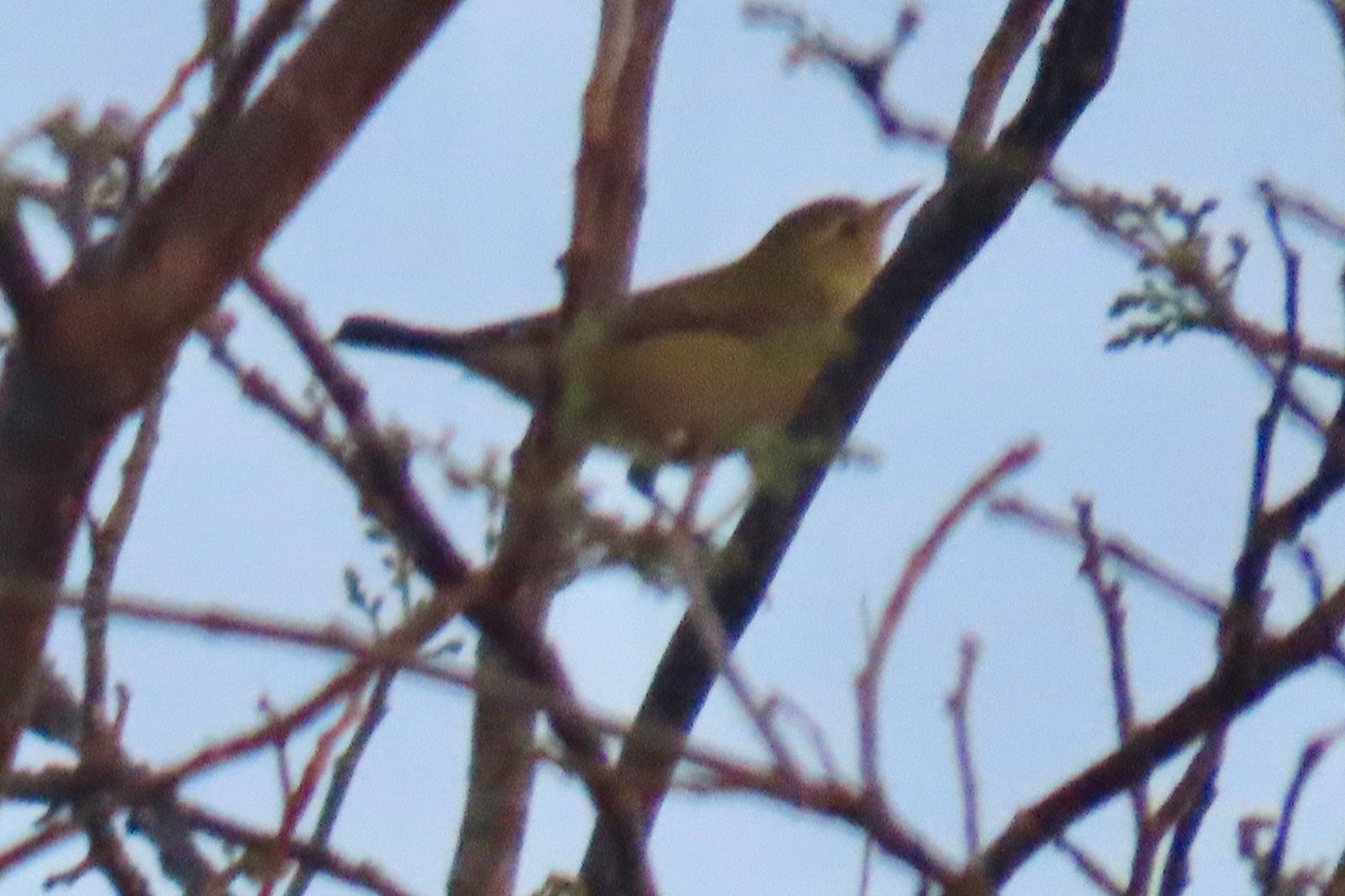
Family Parulidae
Tennessee Warbler
Leiothlypis peregrina
In Spanish: Reinita Verdilla (Cazadorcita, Choricilla)
- Migrant
A busy winter warbler of flowering trees, coffee farms and mixed flocks.
The Tennessee Warbler (Reinita Verdilla in Spanish) is a small, sparrow-sized warbler with a plain look. In Costa Rica it is a migrant visitor, not a resident, and it is one of the more common wintering warblers on the Pacific slope.
What makes it friendly for a beginner is where it feeds. It takes nectar and larvae from flowering trees and acts a bit like a sunbird, and it is one of the few warblers that will come to a fruit feeder.
On trips we build, guests meet it in places as different as the summit of Volcán Irazú and the Central Valley, where it is very abundant. Check flowering trees and mixed flocks and you are already in the right place.
How to find it
Check flowering trees, shaded coffee farms and fruit feeders first. It is typically a canopy bird in winter, so look in treetops, second growth and gardens. It tends to travel in small groups with other birds, so go through mixed flocks with honeycreepers, greenlets and other warblers. Late in the dry season many birds climb to at least 3000 m in mountain forests, when oaks bloom and new leaves sprout. During migration it can turn up almost anywhere.
How to recognise it
Think small, plain and constantly moving. It is a sparrow-sized warbler, and winter birds are gray and green-yellow.
They feed in constant motion, so a good view can be brief. Birds seen on a January trip were still in non-breeding plumage, so expect the subdued winter look.
Three marks help:
- a small, sharp, needle-fine bill
- bright white undertail feathers, even when the rest of the underparts look yellowish
- no olive-brown back or dark cap, which Philadelphia Vireo shows in this plumage
In Guanacaste in the dry season, these warblers often have faces stained orange from Combretum pollen, a vivid sign they have been feeding at flowers.
What it sounds like
Recording: Donald Davesne, CC BY 4.0, source, read 4 Nov 2026.
Behaviour and diet
This is a restless forager. In Costa Rica it feeds from the undergrowth up to the canopy, in brushy areas and in mixed flocks. Across its range it forages nervously and quickly, creeps along branches and is found at all levels.
On its wintering grounds it takes nectar and larvae from flowering trees, and it sometimes visits hummingbird feeders and banana fruit feeders. It also visits coffee farms with shade trees, especially trees in flower. At Monteverde it was described as the species with the most flexible diet, using a wide range of foods in winter.
Where it lives
In Costa Rica this warbler winters mostly on the drier Pacific slope and at higher elevations. It also occurs on the Caribbean slope, but it is less common there.
A Costa Rican natural history account calls it common to abundant in winter from sea level to about 2300 m on both slopes. It is more common at middle elevations than in the lowlands, and very abundant in the Central Valley.
In winter it prefers partly open second growth, coffee farms and gardens, and you can expect it in dry forest and many edge habitats. It is regular in the canopy and at forest edges.
When to see it
Birds usually arrive between mid and late September, with big waves from mid October through November, and the wintering season runs to March. Spring migration passes through Costa Rica in April and early May.
Similar birds
Orange-crowned Warbler is the main lookalike. It has a weaker eyeline and yellower feathers under the tail, while Tennessee has whiter undertail feathers. A quick glimpse can also be confused with a Philadelphia Vireo, which has a thicker bill, a bigger head and a wider eyebrow and eyeline. Red-eyed and Warbling Vireos have thicker hooked bills and a stronger pale eyebrow, and a needle-fine bill rules out any vireo.
Names and lore in Costa Rica
The Costa Rican list name is Reinita Verdilla. Local nicknames are Cazadorcita ('little hunter') and, in some lists, Choricilla.
Status and conservation
The AOCR list marks it as a migrant (M), and the IUCN rates it Least Concern because its breeding range is very wide, it adapts to disturbed areas and its population looks stable.
Photography tips
Flowering trees and fruit feeders hold still-ish birds better than open branches. Try shaded coffee farms with trees in bloom, where it feeds in constant motion at nectar.
How we know this 24 sources, each read on the date shown
- Avionary read 2026-11-04
https://www.avionary.info/blog-post/what-do-tennesee-warblers-do-in-costa-rica/ - Birding Craft read 2026-11-04
https://birdingcraft.com/wordpress/tag/tennessee-warbler/ - Birds by Jake read 2026-11-04
https://www.birdsbyjake.com/photo/tennessee-warbler/ - Macaulay Library read 2026-11-04
https://macaulaylibrary.org/asset/653164696 - ResearchGate (Costa Rican diet records) read 2026-11-04
https://www.researchgate.net/publication/365186626_Nuevos_registros_en_la_dieta_de_nueve_especies_de_aves_Neotropicales_de_Costa_Rica - Smithsonian National Zoo read 2026-11-04
https://nationalzoo.si.edu/migratory-birds/news/coffee-warbler - Houston Chronicle read 2026-11-04
https://www.houstonchronicle.com/life/gardening/article/Meet-a-very-special-neotropical-songbird-15162455.php - My Beautiful World blog read 2026-11-04
https://mybeautifulworldblog.com/tag/tennessee-warbler/ - Animalia read 2026-11-04
https://animalia.bio/tennessee-warbler - Wickersham's Conscience read 2026-11-04
https://wickershamsconscience.wordpress.com/2023/06/17/return-of-bird-of-the-week-tennessee-warbler/ - Aves y Ventanas Costa Rica read 2026-11-04
https://avesyventanascostarica.wordpress.com/algunas-aves-que-han-golpeado-contra-ventanas-en-costa-rica/ - Aves de Costa Rica read 2026-11-04
https://www.avesdecostarica.com/Oreothlypis-peregrina.html - Costa Rican natural history text (Flickr, Providencia de Dota) read 2026-11-04
https://www.flickr.com/photos/jobando/30860162714 - 10,000 Birds read 2026-11-04
https://www.10000birds.com/in-costa-rica-fall-is-our-spring.htm - Mistico Park read 2026-11-04
https://misticopark.com/blog/costa-rica-travel-tips/migratory-birds-costa-rica/ - 10,000 Birds read 2026-11-04
https://www.10000birds.com/what-do-tennesee-warblers-do-in-costa-rica.htm - Cornell Birds of the World read 2026-11-04
https://birdsoftheworld.org/bow/species/tenwar/cur/sounds - Cornell All About Birds read 2026-11-04
https://www.allaboutbirds.org/guide/Tennessee_Warbler/species-compare/ - Cornell All About Birds read 2026-11-04
https://www.allaboutbirds.org/guide/Philadelphia_Vireo/species-compare/ - Houston Audubon read 2026-11-04
https://birdshouston.org/programs/birding/gallery/tennessee-warbler.html - Field Guides trip list read 2026-11-04
https://fieldguides.com/triplists/crh21b.html - Birds Outside My Window read 2026-11-04
https://www.birdsoutsidemywindow.org/2026/02/08/warblers-at-home-in-costa-rica/ - Cloudbridge Nature Reserve bird list read 2026-11-04
https://www.cloudbridge.org/wp-content/uploads/2020/04/Especies-de-Aves-Costa-Rica-13-April-2020.pdf - BioKIDS, University of Michigan read 2026-11-04
https://www.biokids.umich.edu/critters/Vermivora_peregrina/