Family Grallariidae
Thicket Antpitta
Myrmothera dives
In Spanish: Tororoi Pechicanelo (Hormiguero)
- Resident
A plump, tailless skulker of Caribbean thickets, heard often and seen rarely.
The Thicket Antpitta (Tororoi Pechicanelo) is a bird you meet with your ears first. It calls constantly from dense cover yet almost never comes out into the open, so listening matters more than scanning.
In Costa Rica it lives on the Caribbean slope and is described as fairly uncommon. The species was first described from Costa Rica, with its type locality at Tucurrique, in the Turrialba area.
On a trip we build, a rising run of clear whistles from a tangle is the cue to stop, stay still and wait. A brief glimpse of a very round bird on the ground is the reward for patience.
How to find it
Listen first, then find a spot near a singing bird where you can see the ground and wait patiently. Scan the low undergrowth and forest floor for movement, and expect only a brief glimpse. Streamsides, forest edges and treefalls are good places to stand and wait. Birding the Peninsula Road or similar spots will probably let you hear it. At La Mariola it is heard almost daily around the cabins, river, trails, cacao area and denser vegetated edges, though it is hard to photograph. A tour group once heard it several times near Arenal but could not see it through the thick vegetation, so treat hearing it as a success.
How to recognise it
This is a small bird, about 14 cm long and around 44 g.
Look for these marks:
- very plump body
- almost no tail
- long, sturdy legs
- rich rufous flanks
- darker streaking on the breast
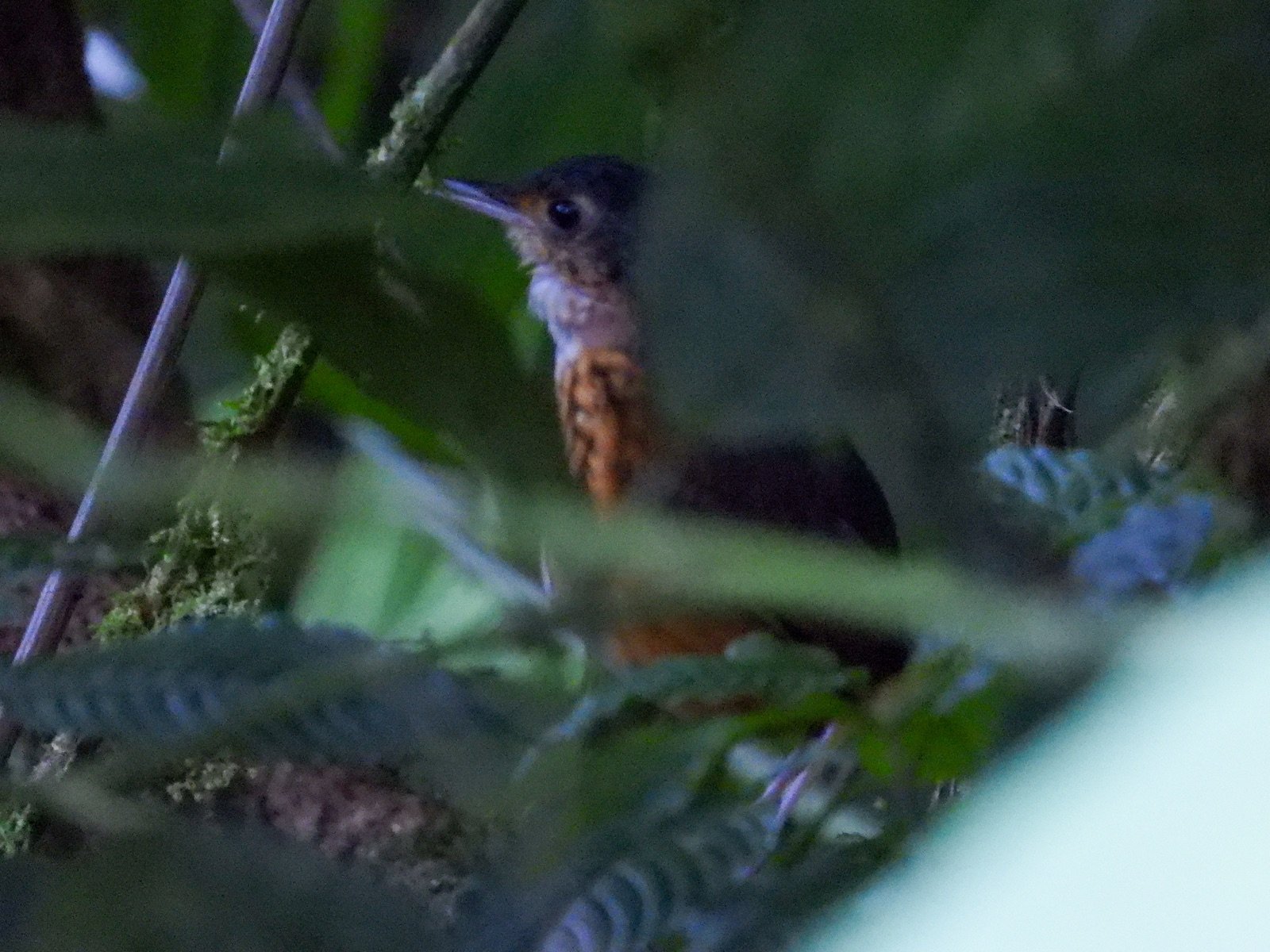
The rufous flanks and streaked breast tell it from other antpittas. Its Spanish name, Pechicanelo, points to that breast. Because it hides in thick vegetation, most views are brief glimpses of a low, half-hidden body, so the round shape on strong legs is often what you notice first.
What it sounds like
Recording: Tommy Andriollo, CC BY 4.0, source, read 4 Nov 2026.
Behaviour and diet
It hops on the ground in dense forest, edges and tangles, flicking through leaf litter for insects. It sometimes sings from a low perch but stays hidden. It eats mainly invertebrates and is sedentary, so it does not migrate.
A nest was studied in Volcán Arenal National Park, where an adult brooded two nestlings on 19 September 2012 and also fed its young arthropods.
Where it lives
In Costa Rica it lives on the Caribbean slope and is found only up to about 900 m. It lives in tropical moist lowland forest and in heavily degraded former forest, always in dense cover. It favors tangled thickets along streams and forest edges, and it loves wet, thick second growth. Inside mature forest it is generally found only where the forest is disturbed, such as along streams and at treefalls. It can occur anywhere in the Caribbean lowlands and may be most frequent in the Tilaran Mountains, mostly the Arenal area.
When to see it
It is most active at dawn and dusk, when calls are most frequent.
Similar birds
Costa Rica's only other lowland antpitta is the Streak-chested Antpitta, reliably found at Carara National Park on the Pacific side, where it gives a sad whistled song. The Thicket Antpitta was long treated as a subspecies of the White-lored Antpitta, and the combined species was called Fulvous-bellied Antpitta. The White-lored form lives in South America, so it does not overlap with Costa Rican birds.
Names and lore in Costa Rica
Costa Ricans call it Tororoi Pechicanelo, sometimes written toroide pechicanelo. Nicaragua uses Hormiguero Pechicanelo, Colombia uses Tororoi Buchifulvo, and Honduras uses Hormiguero panza ocre.
Status and conservation
The official Costa Rican list (2025-2026) gives it resident (R) status, it is described as fairly uncommon here, and the IUCN rates it Least Concern.
Photography tips
Photographing it takes patience. One photographer spent over an hour in the forest working out an angle on a close bird, with vegetation in front, little light and a half-hidden body. Mosquitoes and dim, patchy light make the waiting harder.
How we know this 17 sources, each read on the date shown
- Wikipedia read 2026-11-04
https://en.wikipedia.org/wiki/Thicket_antpitta - Field Guides trip list (Far North 2023) read 2026-11-04
https://fieldguides.com/triplists/cr223.html - EcoRegistros read 2026-11-04
https://www.ecoregistros.org/site_en/imagen.php?id=163733 - Zeledonia 16 (Dialnet) read 2026-11-04
https://dialnet.unirioja.es/descarga/articulo/7505374.pdf - JungleDragon read 2026-11-04
https://www.jungledragon.com/specie/33402/hylopezus_dives.html - Oiseaux.net read 2026-11-04
https://www.oiseaux.net/birds/thicket.antpitta.html - DiBird read 2026-11-04
https://dibird.com/species/thicket-antpitta/ - Lista Oficial de las Aves de Costa Rica (AOCR) read 2026-11-04
https://listaoficialavesdecostarica.wordpress.com/lista-oficial/lista-oficial-online/ - Birdingcraft read 2026-11-04
https://birdingcraft.com/wordpress/tag/costa-rica-antpittas/ - Birds & Breakfast read 2026-11-04
https://birdsandbreakfast.com/en/thicket-antpitta/ - La Mariola read 2026-11-04
https://lamariola.com/journal-thicket-antpitta.html - Wikipedia (es) read 2026-11-04
https://es.wikipedia.org/wiki/Myrmothera_dives - Avibase read 2026-11-04
https://avibase.bsc-eoc.org/species.jsp?avibaseid=FF02D7B124A51F2A - Exotic Birding read 2026-11-04
https://www.exoticbirding.com/costarica/arenal/target-birds.html - Municipalidad de Turrialba read 2026-11-04
https://www.muniturrialba.go.cr/docs/turismo/Guia%20de%20Aves%20de%20Turrialba%202020.pdf - Ornitología Neotropical (Greeney and Vargas-Jiménez) read 2026-11-04
https://ornneo.ornitologianeotropical.org/index.php/ornneo/article/download/142/ON%2028%20(2017)%20181-185.pdf/1609 - Avibase read 2026-11-04
https://avibase.bsc-eoc.org/species.jsp?avibaseid=601048C685EF7BCF