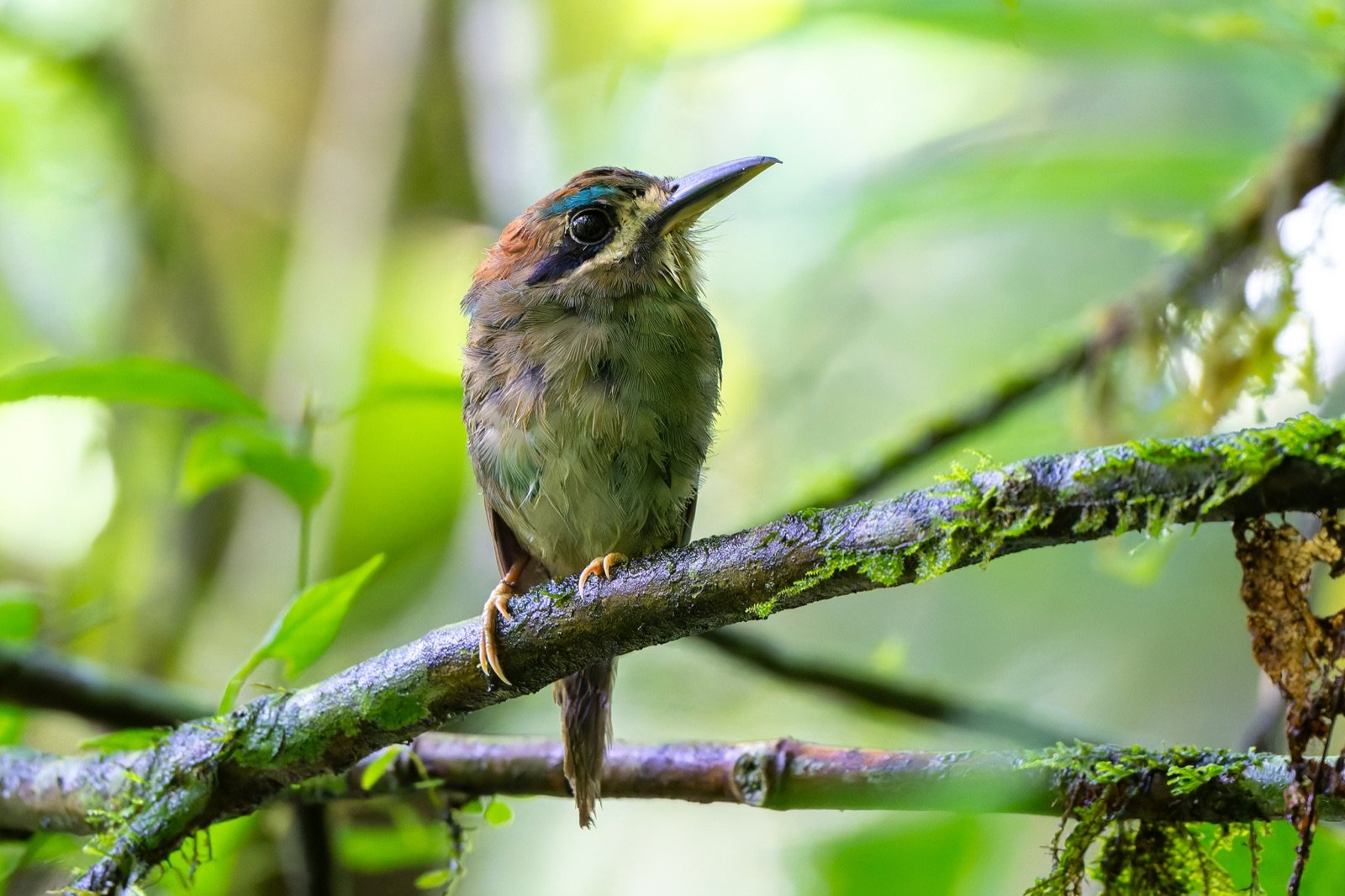
Family Momotidae
Tody Motmot
Hylomanes momotula
In Spanish: Momoto Enano (Pájaro Bobo)
- Resident
The smallest motmot, a shy whistler of shady northern ravines.
The Tody Motmot is the smallest motmot, only about six inches long, and the only Costa Rican motmot without a racket tail. In Costa Rica it is a very uncommon, local resident of the Cordillera de Guanacaste and the northern foothills.
Birders describe it as a charismatic, surreptitious little bird of dense, shadowy forest, usually heard before it is seen. One magazine article lists it among the hardest motmots to see in the country, which is part of its appeal if you enjoy a patient search.
It is a bird to plan around rather than hope for. On a trip we build, the aim is to put you in the right shady ravine with your ears tuned to a rising whistle.
How to find it
Listen first, since the song is usually the easiest way to detect it. A whistled imitation of the song often draws a singing bird out of dense, shady growth beside a stream and into the open. Motmots in general favour forested ravines and streams, perhaps for nesting banks or larger insects, so shady riparian zones are a good place to search. Look at eye level in the understory rather than high in the trees. Expect to give it time, because it is uncommon and local.
How to recognise it
Size is the first clue. At about 16.5 to 18 cm long, this is the smallest motmot, and it is by far the smallest of the six motmots in Costa Rica.
Then look for the pattern:
Green crown.
Rufous neck.
Green back.
Blue eyebrow.
Black face mask edged in white.
White throat.
There is no racket tail, which sets it apart from its relatives. The English name comes from a passing resemblance to the todies of the Caribbean. In deep shade, look for the face pattern rather than a flash of colour.
What it sounds like
Behaviour and diet
The Tody Motmot perches quietly at eye level and makes short flights to catch insects, spiders or snails from the vegetation. It also catches butterflies, including Morpho, and dragonflies in flight. It is solitary or in pairs. Because it sits still and low in dim light, it is easy to walk past, so scan slowly at eye level and stop to listen.
Where it lives
It lives in the dark understory of evergreen rainforest, mostly along ravines and gullies. In Costa Rica it occurs at about 500 to 1000 m elevation, a narrow band.
It is a very uncommon, local resident on the Pacific side of the Cordillera de Guanacaste. It sometimes reaches the Caribbean side through mountain passes, for example at Bijagua de Upala. A population was also found in 2011 on the Caribbean slope of the Tilarán Mountains, at 550 to 750 m in primary forest.
Similar birds
Within Costa Rica there is little to confuse it with. It is the only motmot here without a racket tail and is far smaller than the other five, so a small green motmot with a black mask and rufous neck is this species.
Names and lore in Costa Rica
The AOCR name for Costa Rica is Momoto Enano, also written Pájaro Bobo. Elsewhere in the region you may hear Guardabarranco Enano in Nicaragua, Taragón chico in Honduras and Tolobojo Enano.
Status and conservation
It is a resident (R) on the AOCR list, uncommon and local in a narrow elevation band in Costa Rica, not known to migrate, and Least Concern with the IUCN across its overall range.
Photography tips
Expect a challenge. One birder got close views of Keel-billed Motmot at a lodge on Tenorio volcano but had poor luck photographing the Tody Motmot, which hints at how hard it is to photograph in its dark understory. Its habit of perching quietly at eye level helps once you have located a singing bird.
How we know this 13 sources, each read on the date shown
- Birda species guide read 2026-11-04
https://app.birda.org/species-guide/10689/Tody_Motmot - Cornell Birds of the World read 2026-11-04
https://birdsoftheworld.org/bow/species/todmot1/cur/introduction - Flickr, Historia Natural caption (Rincón de la Vieja) read 2026-11-04
https://www.flickr.com/photos/jobando/21263544008 - Área de Conservación Guanacaste read 2026-11-04
https://www.acguanacaste.ac.cr/galerie/fotos/fauna-der-acg/26-fauna-del-acg/detail/567-fauna-del-acg?tmpl=component - Stevens 2012, Journal of Field Ornithology (ResearchGate) read 2026-11-04
https://www.researchgate.net/publication/260101250_A_New_Location_for_the_Tody_Motmot_Hylomanes_momotula_in_Costa_Rica - BirdForum gallery read 2026-11-04
https://www.birdforum.net/gallery/tody-motmot.703478/ - El Observador CR read 2026-11-04
https://observador.cr/tapir-valley-la-reserva-en-costa-rica-donde-la-conservacion-de-la-danta-permite-recuperar-el-arbol-endemico-jicaro-danto/ - BirdLookup read 2026-11-04
https://www.birdlookup.com/birds/tody-motmot - Avibase read 2026-11-04
https://avibase.bsc-eoc.org/species.jsp?avibaseid=6436068455E6923D - Birdingcraft read 2026-11-04
https://birdingcraft.com/wordpress/2014/06/13/where-to-see-motmots-when-birding-costa-rica/ - Howler Magazine read 2026-11-04
https://howlermag.com/motmots-of-costa-rica/ - Oiseaux.net read 2026-11-04
https://www.oiseaux.net/en/oiseaux/tody.motmot.html - costarica.com read 2026-11-04
https://www.costarica.com/wildlife/blue-crowned-motmots