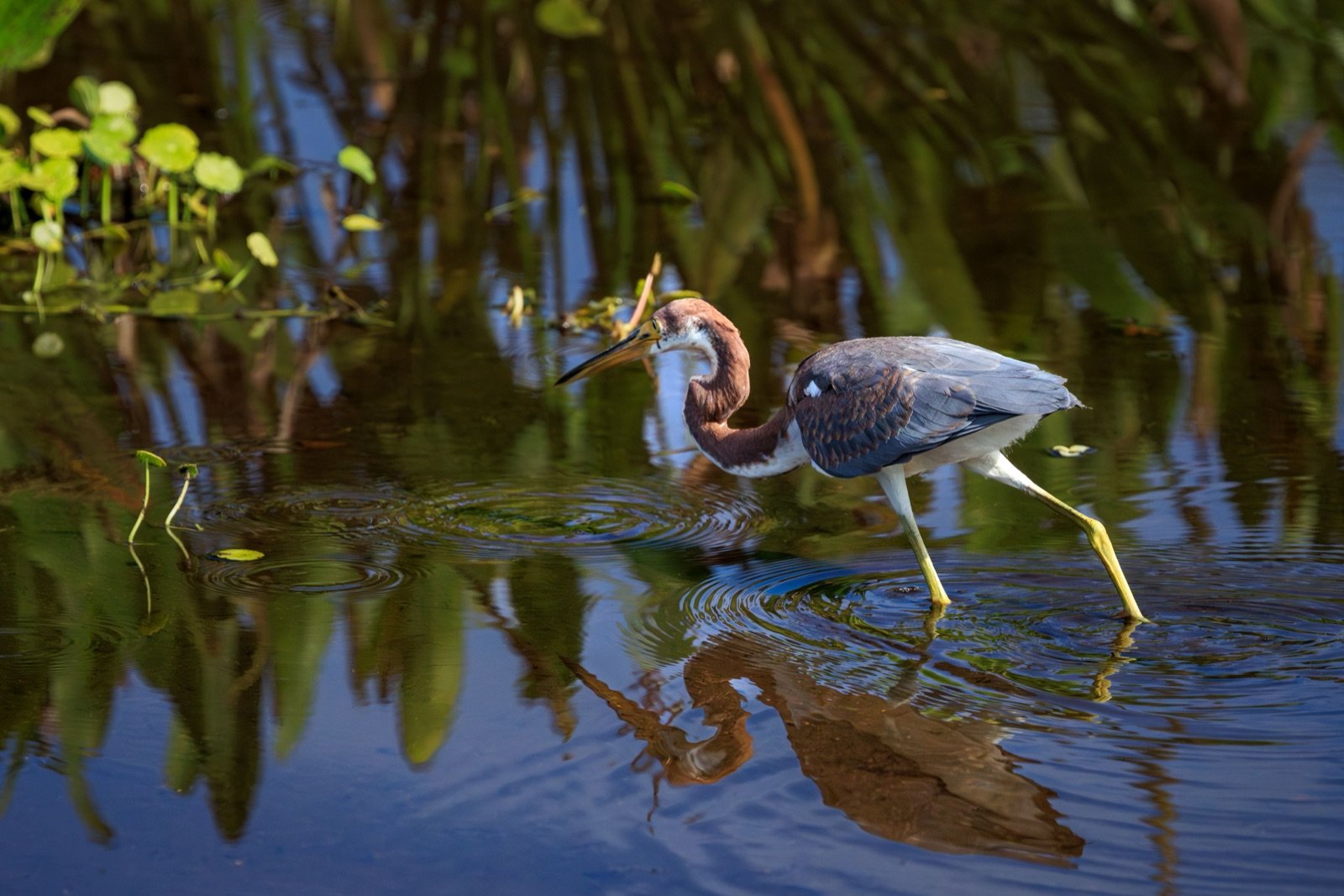
 Tricolored Heron
Family Ardeidae
Tricolored Heron
Egretta tricolor
In Spanish: Garceta Tricolor
- Resident
Slender blue-grey heron with a white belly, hunting in coastal shallows.
The Tricolored Heron (Garceta Tricolor, Egretta tricolor) is a slender wader of Costa Rica's coastal lagoons, mangroves and estuaries. One Costa Rican source calls it fairly common and widespread, and it hunts in shallow water.
On a trip we build along the coast, guests can meet it on boat trips and at lagoon edges, including the south Pacific coast of Puntarenas, where birds have been photographed at Uvita, Dominical and Paquita.
It is a fine bird for a beginner to practise on, because its white belly is the detail that separates it from the much more common Little Blue Heron.
How to find it
Scan the shallow edges of lagoons and look in coastal estuaries. Check the edge of a group of other waders for a lone dark bird. Its active feeding style helps separate it from the slower Great Blue Heron. Watch marsh edges for the stiff, upright pose with the bill pointed at the sky. Boat trips through mangroves and along rivers such as the Tárcoles have given birders good views.
How to recognise it
Adults have a blue-grey head, neck, back and wings.
A white line runs down the front of the neck, and the belly is white.
The build is slender, with a very long bill, neck and legs.
The bill base and bare face skin are yellowish for most of the year and turn bright blue in the breeding season.
Juveniles are brown with white streaks on the neck and underparts.
A visitor who saw one at Tárcoles at dawn noted its mix of blue-grey, lavender and white beside a Great Blue Heron. These field marks describe the species across its whole range, not only Costa Rica.
What it sounds like
Recording: Guy Babineau, CC BY 4.0, source, read 4 Nov 2026.
Behaviour and diet
It mostly hunts alone, wading through the shallows, and small fish are its main food. It also takes crustaceans, shrimp, insects and small amphibians. It often feeds at the edge of mixed groups of waders, and it forages in open water and pools more than Snowy Egrets and Little Blue Herons do. Its hunting is energetic: it often runs and stops with quick turns and starts. At other times it stalks slowly or stands still and waits. When it senses danger it freezes upright with its bill pointed at the sky.
Where it lives
In Costa Rica it is a bird of coastal lagoons, mangroves and estuaries, and it hunts in shallow water. It also shows up on remote beaches and in mangrove lagoons. A Costa Rican source says it uses fresh and salt water, ponds and pool edges. It is generally uncommon in the lowlands of both slopes, and it sometimes climbs to about 1500 m in the Central Valley. Around Turrialba, the Angostura Dam is the spot to look for it. The national museum shows it in its lagoon habitat group.
When to see it
A Costa Rican museum catalogue lists it as both resident and migratory and gives the breeding period as the rainy season. A Costa Rican bird database says it breeds in June, and a few non-breeding young birds stay through the summer.
Similar birds
Adults look a lot like the much more common Little Blue Heron, and the Tricolored's white belly and its bill colour settle the identification. A young Little Blue Heron moulting from white to blue can cause confusion, so check the belly and bill carefully on patchy birds. A photographer at Río Tárcoles notes that dark and pale birds can look very different.
Names and lore in Costa Rica
Costa Ricans call it Garza or Garceta Tricolor. Its older scientific name was Ardea tricolor.
Status and conservation
The AOCR list marks it as R,M (resident and migrant), and the IUCN lists the species as Least Concern.
Photography tips
A wildlife photography site calls the species wary of people and suggests keeping about 10 m away. Dawn light at Tárcoles gave one visitor a striking view.
How we know this 19 sources, each read on the date shown
- Birds for Beer read 2026-11-04
https://birdsforbeer.com/2019/12/26/tricolored-heron/ - Hotel Rivel blog read 2026-11-04
https://hotelrivel.online/the-tricolored-heron-a-graceful-resident-of-costa-rican-coasts/ - Audubon Field Guide read 2026-11-04
https://www.audubon.org/field-guide/bird/tricolored-heron - Cornell Lab, All About Birds read 2026-11-04
https://www.allaboutbirds.org/guide/Tricolored_Heron/overview - Wikipedia read 2026-11-04
https://en.wikipedia.org/wiki/Tricolored_heron - Museo Nacional de Costa Rica, heron catalogue read 2026-11-04
https://www.museocostarica.go.cr/wp-content/uploads/Investigaciones/historia-natural/garzas/diversidad/catalogo-garzas-cr-mncr.pdf - Aves de Costa Rica read 2026-11-04
http://www.avesdecostarica.com/Egretta-tricolor.html - Dan Mennill, Bird Songs of the Yucatan Peninsula read 2026-11-04
https://web2.uwindsor.ca/courses/biology/dmennill/Mexico/TRHE.html - All About Birds, Cornell Lab of Ornithology read 2026-11-04
https://www.allaboutbirds.org/guide/Tricolored_Heron/sounds - Museo Nacional de Costa Rica read 2026-11-04
https://www.museocostarica.go.cr/nuestro-trabajo/investigaciones/historia-natural/garzas/historia-natural/ - Animalspot read 2026-11-04
https://www.animalspot.net/tricolored-heron.html - Aves de Costa Rica read 2026-11-04
https://www.avesdecostarica.com/Egretta-tricolor.html - Flickr (species notes) read 2026-11-04
https://www.flickr.com/photos/gogolac/53966286725 - Travel To Eat read 2026-11-04
https://traveltoeat.com/birdwatching-on-the-tarcoles-river-in-costa-rica/ - Veloso Tours read 2026-11-04
https://www.veloso.com/costa-rica/reasons-to-visit/costa-rica-bird-life/ - Nigel Forrow Photography read 2026-11-04
https://www.nigelforrow.co.uk/tricolored-heron-adult-costa-rica - Zoopicker read 2026-11-04
https://zoopicker.com/en/animals/14902 - WildlifePhotographer read 2026-11-04
https://www.wildlifephotographer.app/es/especie-salvaje/garceta-tricolor/?id=1008590 - Retired in Costa Rica read 2026-11-04
https://www.charliedoggett.net/tag/rio-tarcoles/