Family Cotingidae
Turquoise Cotinga
Cotinga ridgwayi
In Spanish: Cotinga Turquesa
- Resident
- Regional endemic
Metallic blue canopy fruit-eater of the south Pacific slope and the Osa
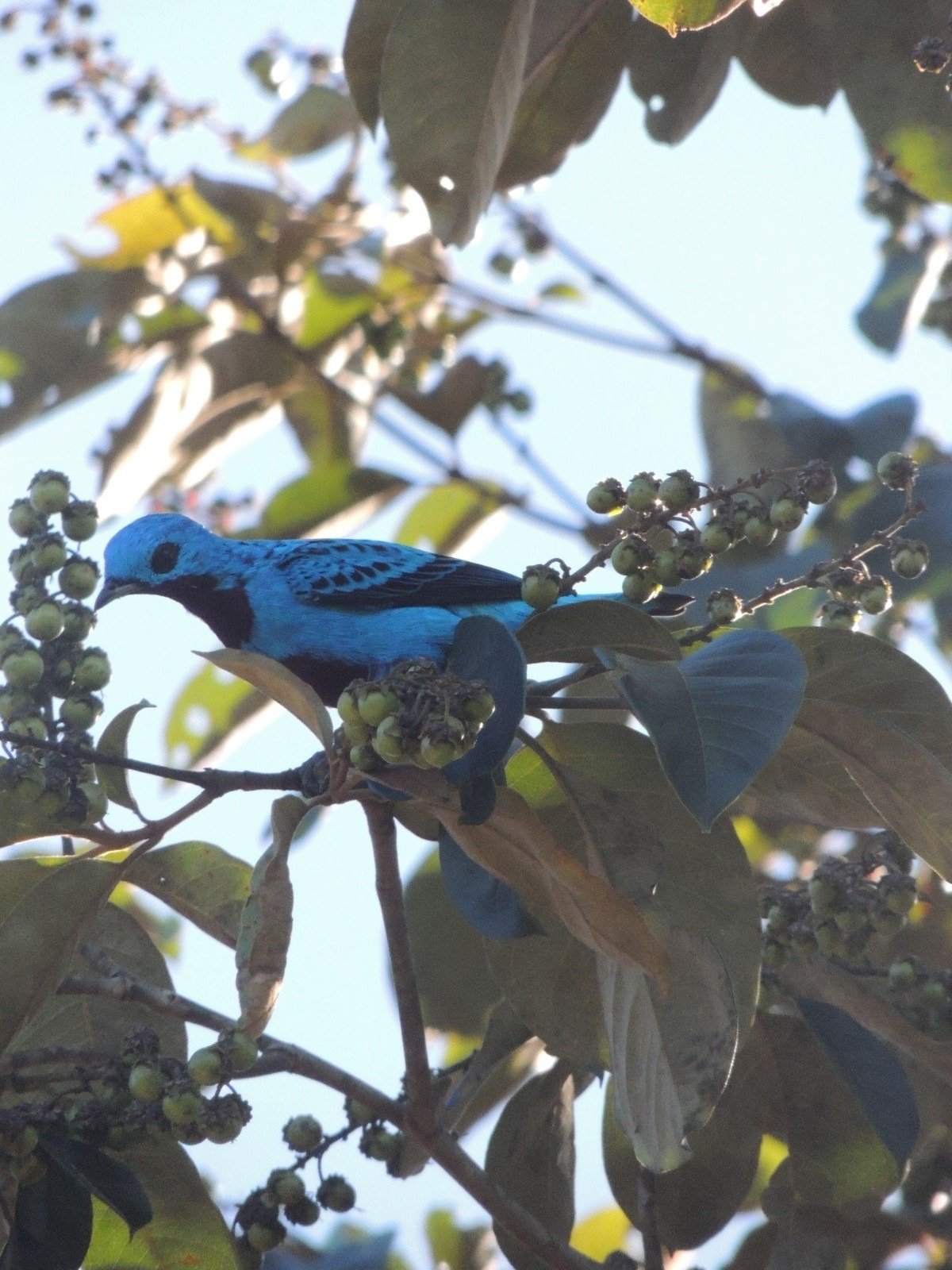
Male Turquoise Cotingas perched on tall bare trees in mature Osa forest look like Christmas decorations. The male is bright metallic turquoise blue with purple on the throat and belly, and it is a target bird on the Osa Peninsula.
It lives on the Pacific slope, from the southern Gulf of Nicoya south toward Panama. It is found only in Costa Rica and the far west of Panama, so Costa Rica holds most of its range.
It is considered uncommon here, so finding one takes patience at a fruiting tree. Costa Rica has no canopy towers, which is why a tree heavy with figs is the surest place to scan.
Where to see it
How to find it
Look for fruiting trees, especially figs and laurel family trees, then scan the branches and wait a while. Wild figs with ripe fruit are a good place to look, and Cecropia trees are another good place to find it eating. Perched birds are often scoped from in front of Bosque del Rio Tigre, so bring a scope if you can. The best areas are around San Isidro del General, sites near San Vito, and the Osa Peninsula, where many reports come from. Do not count on Carara National Park, where it is very rare, and remember that a tour made a hot, unsuccessful stop at San Isidro del General in 2026.
How to recognise it
The male is the showpiece: bright metallic turquoise blue, with purple on the throat and belly and black wings and tail. The blue is structural colour, like that of morpho butterfly wings, quetzals and hummingbirds, so it shifts and shimmers with the angle of the sun.
The female looks very different. She is dusky brown above with pale scaly feather edges, and buffy below with grayish brown spots.
Across its range the bird is small, about 17 to 18.5 cm long. In Costa Rica it is usually seen perched on tall bare trees in mature forest and in nearby open areas, where the male stands out against the sky.
Behaviour and diet
The Turquoise Cotinga eats fruit and berries. It is usually seen alone or in small groups, in flocks of fewer than six across its range.
Males often sit high and still on a bare perch, so a bird can go unnoticed until it flutters. Scanning the branches and waiting a while is the way to see one.
It does not migrate and is believed to stay in the same area all year, but it may make irregular moves when fruit availability changes. Only one nest has ever been documented: found in March, a shallow cup of plant fibres and fungus strands about 9 m up in an isolated tree, with two eggs.
Where it lives
It lives inside humid evergreen forest and secondary woodland, in the canopy and at the edges. It also turns up in tall trees on shade coffee farms.
In Costa Rica it is mainly a lowland bird, found mostly below 900 m, with a few records up to about 1,850 m. It reaches 1,800 m in other accounts. In Panama it is more of a mid-elevation bird.
Its Costa Rican range is the Pacific slope, from the southern Gulf of Nicoya south toward Panama, and it seems most common in the lowland rainforest of the Osa Peninsula.
When to see it
The bird is believed to live in the same area all year, though it may move when fruit availability changes.
Similar birds
It looks much like the Lovely Cotinga of the Caribbean side. Their ranges do not overlap, so location makes identification easy. The Yellow-billed Cotinga shares the Osa rainforest, but it is white and easy to tell from the blue male. Both have been seen feeding together in fruiting figs near Rincon de Osa.
Names and lore in Costa Rica
The Costa Rican Spanish name is Cotinga Turquesa. Spanish sources also call it Cotinga de Ridgway, after the American ornithologist who described it in 1887.
Status and conservation
It is a resident endemic (R-END) on the AOCR list and Vulnerable for the IUCN, and it is considered uncommon in Costa Rica.
Photography tips
Males perched on tall bare trees can be scoped from a distance, so a scope helps. Pick a fruiting fig or Cecropia, scan the branches and wait. The blue shifts with the angle of the sun, so the light changes how it looks.
Trips that find it
- Carara, the Osa and the Quetzal11 nightsSee the trip
- Coast to Coast Birding, Tortuguero to the Osa18 nightsSee the trip
- The Grand Birding Circuit16 nightsSee the trip
Tell us when you are travelling and our team in Costa Rica builds the trip around the birds you want to see.
Plan my birding tripHow we know this 19 sources, each read on the date shown
- Wikipedia read 2026-11-04
https://en.wikipedia.org/wiki/Cotinga_ridgwayi - Birding Craft read 2026-11-04
http://birdingcraft.com/wordpress/2011/02/28/the-best-sites-for-seeing-cotinga-species-when-birding-costa-rica/ - Destination: Wildlife read 2026-11-04
https://www.destinationwildlife.com/blog/costa-rica-birds - Birding Craft read 2026-11-04
https://birdingcraft.com/wordpress/tag/yellow-billed-cotinga/ - Birding Craft read 2026-11-04
https://birdingcraft.com/wordpress/tag/turquoise-cotinga/ - Costa Rica Birding Trips read 2026-11-04
https://www.costaricabirdingtrips.com/cotingidae/turquoise-cotinga-cotinga-ridwayi - BirdNET+ (Wikipedia text) read 2026-11-04
https://birdnet.cornell.edu/taxonomy/species/Cotinga%20ridgwayi - Birdingcraft read 2026-11-04
https://birdingcraft.com/wordpress/2014/07/18/need-turquoise-cotinga-near-san-jose-visit-rancho-mastatal/ - Osa Tourism read 2026-11-04
https://www.osatourism.com/osa-peninsula-birding/ - Ballena Tales read 2026-11-04
https://ballenatales.com/birdwatching-cotingas-species/ - Rainforest Cruises read 2026-11-04
https://www.rainforestcruises.com/guides/costa-rica-birding - WINGS Birding Tours read 2026-11-04
https://wingsbirds.com/tours/costa-rica-spring - Avibase read 2026-11-04
https://avibase.bsc-eoc.org/species.jsp?avibaseid=EADC7DCB - Cornell Birds of the World read 2026-11-04
https://birdsoftheworld.org/bow/species/turcot1/cur/introduction - EcoRegistros read 2026-11-04
https://www.ecoregistros.org/ficha/Cotinga-ridgwayi - Wikipedia read 2026-11-04
https://en.wikipedia.org/wiki/Turquoise_cotinga - Grokipedia (IUCN summary) read 2026-11-04
https://grokipedia.com/page/turquoise_cotinga - Bird Watching Costa Rica read 2026-11-04
https://www.birdwatchingcostarica.com/ave/turquoise-cotinga/ - We Sell Paradise read 2026-11-04
https://we-sell-paradise.com/cotingas-of-costa-rica/