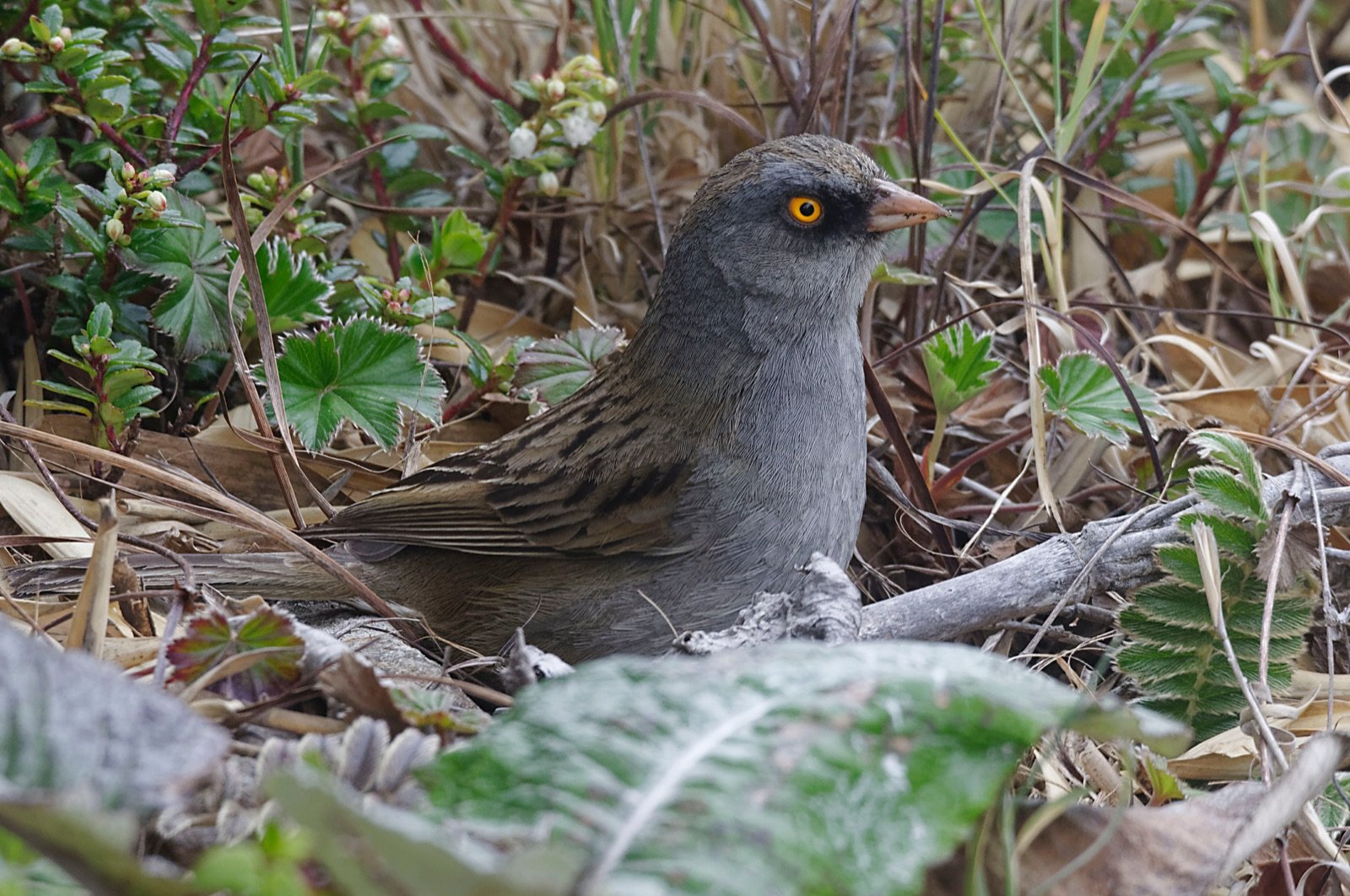
 Volcano Junco
Family Passerellidae
Volcano Junco
Junco vulcani
In Spanish: Junco Paramero (Junco Volcanero)
- Resident
- Regional endemic
Yellow-eyed, pink-billed junco of cold volcano summits and páramo
The Volcano Junco (Junco Paramero in Spanish) is a fairly common resident above the treeline on the Irazú-Turrialba massif and on all main peaks of the Talamanca range, especially above 3000 m. Its range is limited to Costa Rica and western Panama.
The summit area of Irazú near treeline looks like a moonscape, and the junco is one of the few birds living there. Irazú can be driven almost to its top, so birders do not need to climb to see high-elevation specialists.
It is the southernmost junco and is not closely related to the other juncos. On a trip we build, the cold, windswept summits and páramo are where guests meet it.
How to find it
Go high: it is often quite tame around parking areas and trails near volcano summits. It is often seen on roadcuts and parking areas at Irazú, Turrialba, Poás and Chirripó. On Irazú it sings from the tops of bushes and hops next to cars. It lives at low density, so it is less common than you might expect and patience helps. Scan the ground and the roadside first, then low bushes and boulders. Recordists on Cerro de la Muerte found birds calling from low in a short bush and from the top of a large boulder.
How to recognise it
This is a fairly large, stocky grassland bird, 16 cm long. Look for these marks:
A pale pink bill.
Bright yellow eyes.
Dull grey underparts.
A dull brown back with dark streaks.
Young birds are a brighter brown above, with blacker streaks, and their underparts are more buff-coloured, so a juvenile can look quite different from its parents.
Behaviour and diet
The Volcano Junco is usually found in pairs, sometimes alone or in family groups. It typically feeds on the ground, hopping and running to pick up seeds. It rarely flies far, which keeps it near roadsides and trail edges.
The nest is a grass cup placed on the ground under a rock, log or bush, or in a mossy bank. The female lays two pale blue eggs. Breeding runs from March to July.
Where it lives
It lives in open páramo with grass or shrubs, small scrub regrowth after eruptions, old pastures and roadsides at very high sites. One source gives its elevation range as roughly 2600 to 3800 m. Forest clearing on Cerro de la Muerte lets it live as low as about 2600 m.
In Costa Rica it occurs above the treeline on the Irazú-Turrialba massif and on the Talamanca peaks. An isolated group lives at about 2100 m on the Durika savanna.
When to see it
It is a year-round resident and does not migrate, so you can see it in any month. Breeding runs from March to July.
Similar birds
The Timberline Wren shares the habitat but is a small, skulking, chestnut-brown bird of brush, about 10 cm long. The junco is much bigger, about 16 cm, and grey below. Its high volcano and páramo range also sets it apart from the northern juncos.
Names and lore in Costa Rica
In Costa Rica the official Spanish name is Junco Paramero. Other Spanish names listed are Junco Volcanero and Junco de los Volcanes. Páramo is the high, cold habitat where it lives.
Status and conservation
The AOCR lists it as a resident endemic (R-END), and the IUCN rates it Least Concern.
Photography tips
On Irazú the junco is not shy, singing from the tops of bushes and hopping next to cars. Because it forages on the ground by running and hopping, it stays near roadside and trail edges, which makes it approachable for photographs. Low density means patience helps.
How we know this 22 sources, each read on the date shown
- Aves de Costa Rica read 2026-11-04
https://avesdecostarica.com/Junco-vulcani.html - Costa Rica Guide (Irazú Volcano National Park) read 2026-11-04
https://translate.google.com/translate?u=https%3A%2F%2Fcosta-rica-guide.com%2Fnature%2Fnational-parks%2Firazu-volcano%2F&hl=es&sl=en&tl=es&client=srp - costarica-information.com read 2026-11-04
http://costarica-information.com/nature/national-parks-other-protected-areas/national-parks/a-g/chirripo-tapanti-orosi-national-park/ - Birds for Beer read 2026-11-04
https://birdsforbeer.com/2018/03/04/high-places-in-costa-rica-the-volcano-junco/ - Wikipedia: Costa Rican páramo read 2026-11-04
https://en.wikipedia.org/wiki/Costa_Rican_P%C3%A1ramo - Featherscan read 2026-11-04
https://www.featherscan.com/birds/volcano-junco - Animalia.bio (from Wikipedia) read 2026-11-04
https://animalia.bio/volcano-junco - Birdingcraft read 2026-11-04
https://birdingcraft.com/wordpress/tag/irazu-volcano/ - Wikipedia read 2026-11-04
https://en.wikipedia.org/wiki/Volcano_junco - Oiseaux-Birds read 2026-11-04
https://www.oiseaux-birds.com/card-volcano-junco.html - Optics Mag read 2026-11-04
https://opticsmag.com/volcano-junco/ - Xeno-canto read 2026-11-04
https://xeno-canto.org/species/junco-vulcani - Museo Nacional de Costa Rica read 2026-11-04
https://www.museocostarica.go.cr/nuestro-trabajo/investigaciones/historia-natural/paramos-de-talamanca/ - ArgentiNat / Naturalista read 2026-11-04
https://www.argentinat.org/taxa/10115-Junco-vulcani - Museo Nacional de Costa Rica read 2026-11-04
https://www.museocostarica.go.cr/nuestro-trabajo/investigaciones/historia-natural/paramos-de-talamanca/aves/ - Birding Craft read 2026-11-04
https://birdingcraft.com/wordpress/tag/timberline-wren/ - La Nación read 2026-11-04
https://www.nacion.com/ancora/el-cambio-climatico-acelera-la-desaparicion-de-los/DIKOB5GIIZCFLLXVO2CO7JPK2A/story/ - Ojo al Clima read 2026-11-04
https://ojoalclima.com/articles/10-especies-ticas-recibiran-golpes-del-cambio-climatico - Museo Nacional de Costa Rica read 2026-11-04
https://www.museocostarica.go.cr/divulgacion/articulos-educativos/insectos-del-paramo-de-costa-rica/ - LatinClima read 2026-11-04
https://latinclima.org/es/articulos/mayor-area-protegida-ayudara-bosque-de-paramo-enfrentar-el-cambio-climatico-en-costa-rica - Flickr (Spanish natural history text) read 2026-11-04
https://www.flickr.com/photos/jobando/26822942290 - Wikipedia read 2026-11-04
https://en.wikipedia.org/wiki/Timberline_wren