Family Diomedeidae
Waved Albatross
Phoebastria irrorata
In Spanish: Albatros de Galápagos
- A
A huge, yellow-billed ocean wanderer, rare offshore in the Pacific.
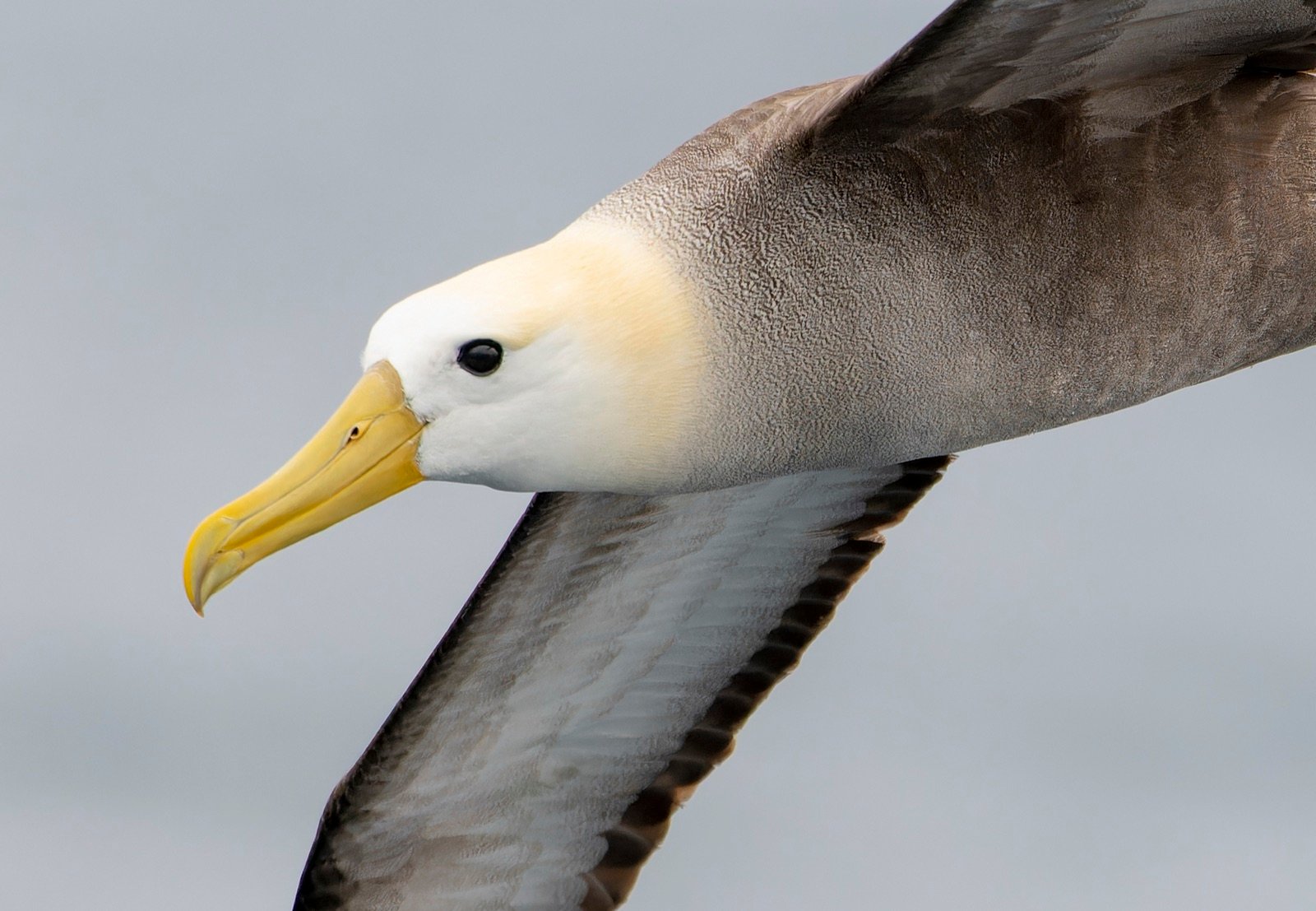
The Waved Albatross (Albatros de Galápagos) is a large seabird with a long yellow bill, a brown body, and a white head and neck. In Costa Rica it is a rare visitor over open Pacific water, and every photographed record so far has been of a single bird.
Costa Rica is the northern limit of the species' known range. The first record was a bird in flight near Islote Ulloa, Isla del Coco National Park, on 7 May 1992. The first photographed record came 24 km off Cabo Blanco on 9 January 2014.
This is not a bird for a walk on land. It belongs to an offshore boat day, and between 2015 and 2023 another 18 photographed records were gathered in our Pacific waters.
How to find it
Look for it on offshore Pacific boat trips. Costa Rican sightings came mostly from fishermen and tour boat operators, so the crews who work these waters are your best allies. Scan flocks of other tubenose seabirds and watch behind fishing boats, where the albatross was usually found. It is so large that a lone bird stands out at a distance among other seabirds. Have your camera ready early, because a visit may be short.
How to recognise it
Look for a large albatross with a long yellow bill, a brown body, and a white head and neck. The neck often has a pale yellowish wash, and Costa Rican photos show these same marks.
Up close, the lower neck and breast show a fine dark and white barred pattern. The rump is barred too, and from a distance it can look like a whitish horseshoe in flight. The legs are pale gray.
Across the species, adults stand about 80 to 90 cm tall, with a wingspan of roughly 220 to 250 cm, and males are larger than females. A fishing captain off Herradura identified one from its size, white head, dark brown body and pale yellow bill, a useful short list to note if one appears.
Behaviour and diet
The Waved Albatross eats fish, sharks, rays, crustaceans and squid, and it often follows fishing boats and scavenges. In Costa Rican waters it was usually with other tubenose seabirds or trailing fishing boats. Each record here has been of a single bird.
It is drawn to boats. Off California, one stayed with a tour boat for about 45 minutes, but the Herradura bird came close to the boat only briefly before flying off.
Where it lives
It is an open ocean bird. Normally it ranges south from the Galápagos to the waters off Ecuador and Peru, so Costa Rica is far north of its usual range. It breeds mainly on Isla Española in the Galápagos.
In Costa Rica it has been recorded only over Pacific water: off the Nicoya Peninsula, the central Pacific and the Osa Peninsula, and as far out as Isla del Coco, which lies about 550 km offshore.
When to see it
Most of the newer Costa Rican records fall in August and March, which suggests the bird is in our waters more often than once thought. Dated records off Marino Ballena and Cabo Blanco point to August in particular, and there is also a May record off Herradura.
Similar birds
Around the Galápagos it is the only albatross you are likely to see. In Costa Rica the only other albatross on the AOCR list is the Atlantic-side Yellow-nosed Albatross, a different bird. Seabird tours here also see Black-footed and Laysan albatrosses, which have dark or white bodies and dark bills. The Waved has a white head, brown body and bright yellow bill.
Names and lore in Costa Rica
The Spanish name on the Costa Rican list is Albatros de Galápagos. Another Spanish name in use is Albatros Ondulado, which matches the English 'Waved'.
Status and conservation
It is category A on the AOCR list, with few Costa Rican records, and it is Critically Endangered worldwide.
Photography tips
Fishing or tour boats give the best chance for close photos, since this albatross is drawn to boats. Be ready early, because a visit may be short. Keep in mind the white head, brown body and bright yellow bill when sorting it from other large albatrosses.
How we know this 12 sources, each read on the date shown
- Zeledonia 28(1), Arias 2024 (UCR) read 2026-11-04
https://www.kerwa.ucr.ac.cr/server/api/core/bitstreams/a837e834-1437-4435-88cb-e79e7181a727/content - Birds of the World (Cornell Lab) read 2026-11-04
https://birdsoftheworld.org/bow/species/wavalb/cur/identification - Animal Diversity Web read 2026-11-04
https://animaldiversity.org/accounts/Phoebastria_irrorata/ - Zeledonia 28(1), Arias 2024 read 2026-11-04
https://www.researchgate.net/publication/384844710_First_record_of_Salvin's_Albatross_Thalassarche_salvini_and_new_records_of_the_Waved_Albatross_Phoebastria_irrorata_in_Costa_Rica - Macaulay Library read 2026-11-04
https://macaulaylibrary.org/asset/658680541 - ACAP read 2026-11-04
https://www.acap.aq/latest-news/1657-crossing-the-line-a-waved-albatross-goes-north-to-costa-rica - ACAP species assessment (Spanish) read 2026-11-04
https://acap.aq/es/resources/especies-acap/218-albatros-de-galapagos/file - ACAP news read 2026-11-04
https://www.acap.aq/latest-news/crossing-the-line-a-waved-albatross-goes-north-to-costa-rica - ResearchGate (Arias 2024 excerpt) read 2026-11-04
https://www.researchgate.net/publication/377776499_Waved_Albatross_Phoebastria_irrorata_version_11 - Birdwatching in Costa Rica read 2026-11-04
https://birdwatchingincostarica.com/aves-oceanicas-en-costa-rica-un-pais-de-mar-un-tesoro-por-descubrir/ - Press Democrat read 2026-11-04
https://www.pressdemocrat.com/2025/10/08/endangered-albatross-spotted-off-marin-county-coast-marks-first-ever-documented-sighting-north-of-costa-rica/ - Birdingcraft read 2026-11-04
https://birdingcraft.com/wordpress/2010/11/16/pelagic-day-trip-off-the-pacific-coast-of-costa-rica/