Family Ardeidae
Whistling Heron
Syrigma sibilatrix
In Spanish: Garza Silbadora
- A
A pink-billed grassland heron, new to Costa Rica in 2016.
The Whistling Heron is one of the newest names on the Costa Rican bird list. The national bird committee announced it as a new species in 2016, after a single bird was seen feeding on a soccer field at Manzanillo, in Limón province on the Caribbean side, on 16 February 2016.
It is a heron of open ground rather than water's edge. Both Costa Rican places on record are open, human-made grassy areas: that village soccer field and Ciudad Neily, in the south Pacific region of Puntarenas, where a first nest was confirmed.
For a beginning birder this is a bird to know about and scan for, not one to count on. It is a good reason to look carefully at short grass and pastures.
How to find it
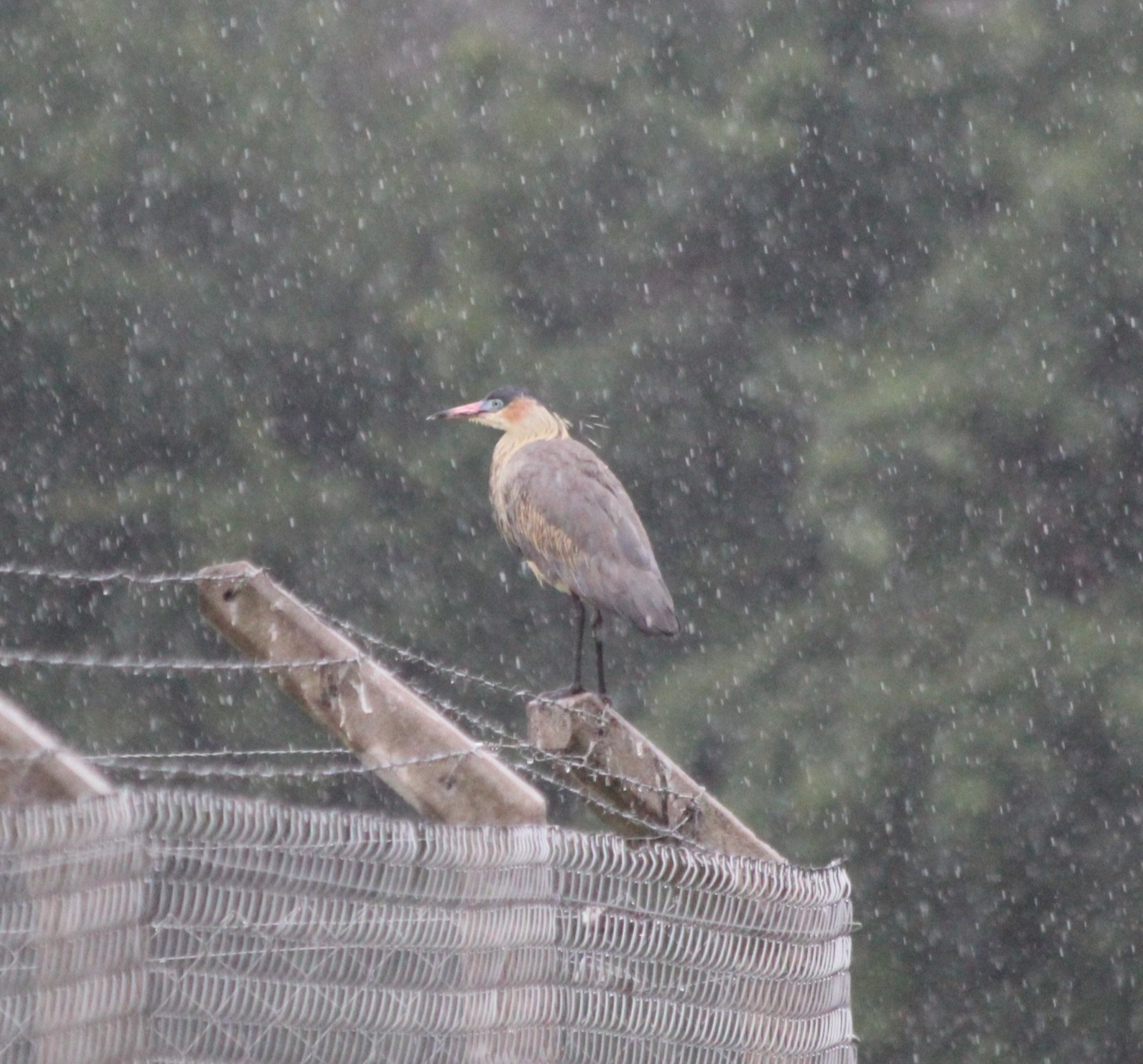
Look in open, short grass, where it is often alone or in pairs. It stands or walks very slowly, so scan patiently rather than waiting for movement. Open grassy areas near the Caribbean coast are the place to scan, and Ciudad Neily is the other place on record. Village soccer fields, pastures and flooded fields are worth checking, since both Costa Rican records come from open, human-made grass. Elsewhere it often perches on fenceposts, so check those too, and listen for the far-carrying whistle.
How to recognise it
This is a medium-sized heron, about 53 to 64 cm long. The field marks are easy to read in plain parallel phrases:
Upperparts blue-gray.
Head, neck and breast creamy white with a golden tint.
Lower back, belly and tail white.
Bill bright pink, with a blue base and a dark tip.
Skin around the eye bright blue.
Adults of the southern subspecies have a black crest.
In flight it beats its wings quickly and does not tuck its neck in fully, as other herons do. Its colour pattern is quite unlike other herons, which makes it easy to identify once you have a good view.
What it sounds like
Recording: Miguel A. Paixão, CC BY 4.0, source, read 4 Nov 2026.
Behaviour and diet
The Whistling Heron spends most of its time on the ground, walking slowly or standing still while it hunts. The first Costa Rican bird walked slowly across a soccer field until it spotted prey, then stayed still. Elsewhere it eats mostly insects, plus earthworms, frogs and small fish, and it often appears behind ploughs. It often perches in tall trees in dry areas.
In the evening it gathers in tree roosts, arriving about an hour before dark. There the birds get noisy, with raised crests, preening and sparring.
Where it lives
Across its range this heron favours drier, more land-based habitats than most herons: grasslands, savannas, pastures and seasonally flooded fields. It often feeds far from water and tolerates farmland and disturbed areas. Typically it occurs up to about 500 m elevation.
In Costa Rica it is a lowland bird, with an elevation given as 0 to 30 m above sea level. The two places on record are on the Caribbean side in Limón and in the south Pacific region of Puntarenas.
Similar birds
The Capped Heron looks somewhat similar, but it has a mostly blue bill and a white body, while the Whistling Heron has a pink bill with a black tip. The Capped Heron is the more likely mix-up in Panama and South America. Habitat helps as well: the Capped Heron prefers forested streams and pond edges, while the Whistling Heron is a bird of open savanna that feeds in short grass.
Names and lore in Costa Rica
In Costa Rica the bird is called Garza Silbadora, a name that points to its whistled call. The Latin name also means roughly 'whistler'. Elsewhere in South America it is known as garza chiflona, chiflón and garza amarilla, and in Paraguay it also has the folk name 'flauta del sol'.
Status and conservation
It is category A on the AOCR list, and the first confirmed nest, found at Ciudad Neily in February 2016, changed its status from uncertain resident to resident.
Photography tips
The bird may stay still for long spells while hunting, which gives patient photographers time. It may let people come fairly close rather than leave a good feeding spot. It sometimes catches dragonflies in the air from a standing position, and in flight it holds its neck stretched out.
How we know this 12 sources, each read on the date shown
- Lista Oficial de las Aves de Costa Rica (AOCR) read 2026-11-04
https://listaoficialavesdecostarica.wordpress.com/2016/02/19/nueva-especie-para-cr-garza-silbadora/ - Check List (Alfaro-Rodríguez and Venegas-Vargas 2016) read 2026-11-04
https://www.researchgate.net/publication/309103042_First_record_of_the_Whistling_Heron_Syrigma_sibilatrix_Temminck_1824_Aves_Ardeidae_in_Costa_Rica - Aves de Perú read 2026-11-04
https://avesdeperu.org/ardeidae/garza-silbadora-syrigma-sibilatrix/ - HeronConservation read 2026-11-04
https://www.heronconservation.org/herons-of-the-world/list-of-herons/whistling-heron/ - Birds of Bolivia read 2026-11-04
https://birdsofbolivia.org/species-fact-sheets-2/herons-egrets-bitterns/syrigma-sibilatrix/ - Kushlan et al. 1982 (Academia.edu) read 2026-11-04
https://www.academia.edu/53012481/Behavior_of_Whistling_and_Capped_Herons_in_the_Seasonal_Savannas_of_Venezuela_and_Argentina?uc-sb-sw=8740401 - Wikipedia read 2026-11-04
https://en.wikipedia.org/wiki/Whistling_heron - Birds Colombia read 2026-11-04
https://birdscolombia.com/2018/08/25/garza-silbadora-whistling-heron-syrigma-sibilatrix/ - Lista Oficial de las Aves de Costa Rica (AOCR) read 2026-11-04
https://listaoficialavesdecostarica.wordpress.com/nuevos-registros/ - Museo Nacional de Costa Rica read 2026-11-04
https://www.museocostarica.go.cr/nuestro-trabajo/investigaciones/historia-natural/garzas/diversidad/ - Museo Nacional de Costa Rica read 2026-11-04
https://www.museocostarica.go.cr/wp-content/uploads/Investigaciones/historia-natural/garzas/diversidad/catalogo-garzas-cr-mncr.pdf - Museo Nacional de Costa Rica read 2026-11-04
https://www.museocostarica.go.cr/nuestro-trabajo/investigaciones/historia-natural/garzas/historia-natural/