Family Tyrannidae
White-fronted Tyrannulet
Acrochordopus zeledoni
In Spanish: Mosquerito Frentiblanco
- Resident
A tiny, rare canopy flycatcher of Costa Rica's highland forest.
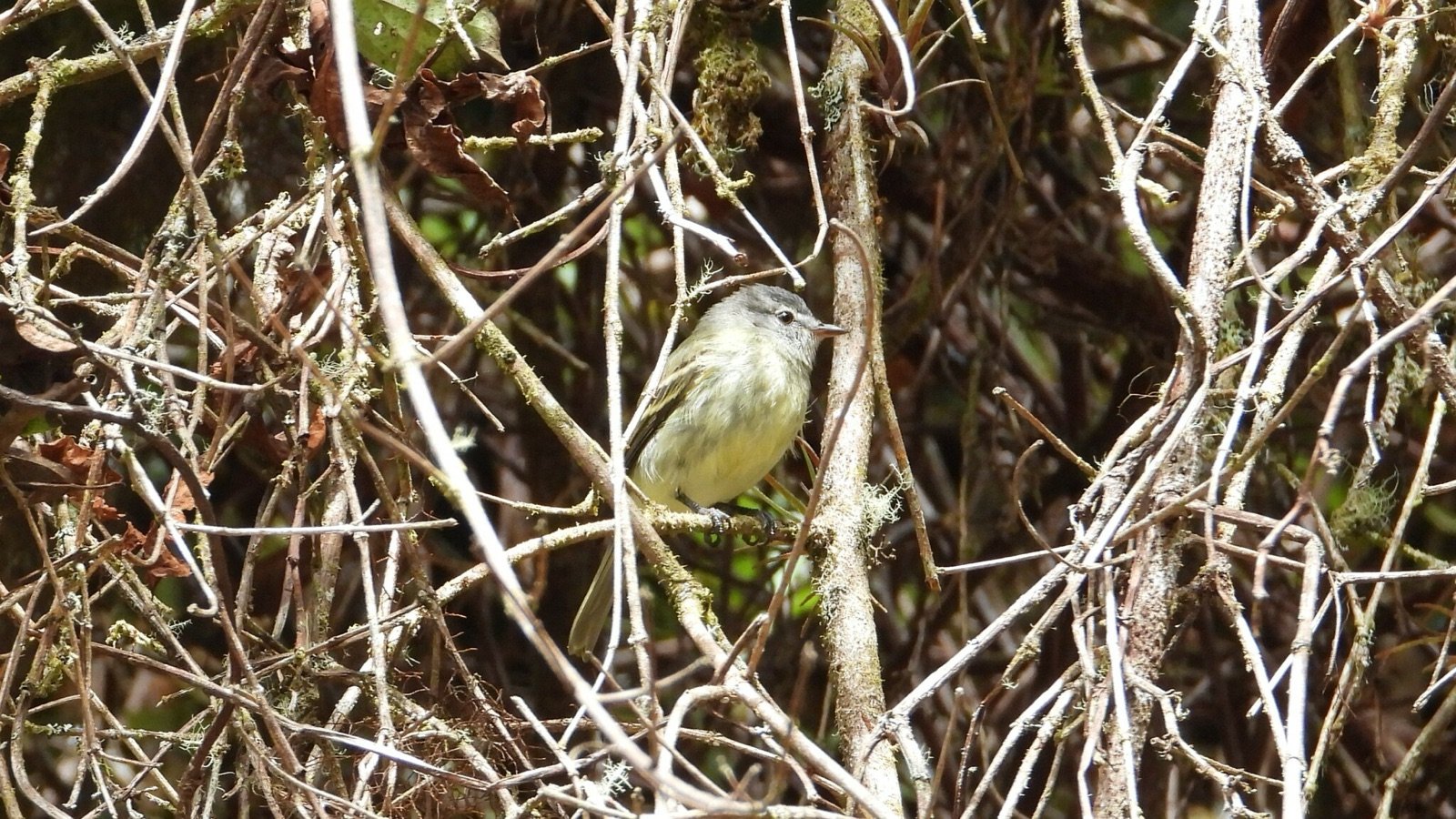
The White-fronted Tyrannulet (Mosquerito Frentiblanco, Acrochordopus zeledoni) is a small, quiet flyer that keeps to the forest canopy. The white in front of its eye joins across the forehead, which gives the species its name.
It is considered rare in Costa Rica, yet it was first described from Dota, so the highlands are its real home here. Finding one means scanning high in the forest tops rather than at eye level.
Costa Rica sits at the northern edge of the range of the group once called the Rough-legged Tyrannulet, and most reports come from middle and upper elevations, away from both coasts.
How to find it
Scan high in the forest tops rather than at eye level, because this bird stays in the canopy. Look for small movement, since it switches perches often and may flick its wings. Listen for the sharp 'pseet' call, which can help you place a bird you cannot yet see. It is generally uncommon and inconspicuous, so give it time and keep checking the same stretch of canopy. Humid forest within its elevation range is the place to try.
How to recognise it
This is a small bird, olive above with a gray cap, yellowish underparts and two yellow wingbars.
The Costa Rica form adds details to look for:
- a slate gray crown
- a narrow pale eyebrow
- a white eyering
- white in front of the eye that joins across the forehead
That forehead patch is the mark that names the bird. Two Turrialba guides also advise noting where the two eyebrow stripes meet, and watching for a streaky breast and an orangish bill. In Costa Rica the pale wingbars are not very conspicuous and can look whitish rather than yellow, so the white forehead and the streaky breast are the better marks.
What it sounds like
Behaviour and diet
It is mostly a canopy bird that switches perches often and may flick its wings actively. It is also inconspicuous, so the best clue is small movement high in the treetops rather than a bird sitting in the open. It is generally uncommon, which makes it easy to pass right under without knowing it is there.
Where it lives
Across its range it lives mostly in the canopy of humid evergreen forest, in the tropical and subtropical zones. In Costa Rica it occurs at roughly 800 to 2,800 m elevation. The Costa Rica form ranges from the Cordillera de Tilarán in the north south into western Panama. A checklist for San Gerardo de Dota, at about 2,200 m in cloud forest, lists it.
Similar birds
It was long treated as the same species as the Rough-legged Tyrannulet of South America, and was split again as a full species in 2023, after studies found clearly different vocalizations. The South American bird has an olive crown, not a gray-blue one, and it lacks the white eyebrow stripe of the White-fronted. Its typical song also differs.
Names and lore in Costa Rica
In Costa Rica the bird is called Mosquerito Frentiblanco, a name that refers to the white forehead where the eyebrow stripes meet. It is also called Mosquerito de Zeledón, after Costa Rican naturalist José Zeledón. Elsewhere other names are used, such as Tiranuelo Cejiblanco in Colombia and Tiranolete Tarsirrasposo in Panama.
Status and conservation
The official Costa Rican bird list gives it resident status (R), and it is considered rare here, though the IUCN rates the species Least Concern.
Photography tips
Photographing a canopy bird that moves often is a matter of patience. Learn the white forehead, the streaky breast and the orangish bill first, since these are the marks Turrialba guides single out. A photographer's note on a South American bird also mentions a grey head, thick yellow wingbars and a pinkish lower bill.
How we know this 16 sources, each read on the date shown
- Cornell Birds of the World read 2026-11-04
https://birdsoftheworld.org/bow/species/roltyr1/cur/introduction - Wikipedia read 2026-11-04
https://en.wikipedia.org/wiki/White-fronted_tyrannulet - Exotic Birding read 2026-11-04
http://www.exoticbirding.com/costarica/san-gerardo/checklist.html - Cloudbridge Nature Reserve read 2026-11-04
https://www.cloudbridge.org/wp-content/uploads/2020/04/Bird-Species-List-Costa-Rica-13-April-2020.pdf - Lista Oficial de las Aves de Costa Rica (AOCR) read 2026-11-04
https://listaoficialavesdecostarica.wordpress.com/lista-oficial/lista-oficial-online/ - Wikipedia (Spanish) read 2026-11-04
https://es.wikipedia.org/wiki/Phyllomyias_zeledoni - Dibird read 2026-11-04
https://dibird.com/species/white-fronted-tyrannulet/ - Avibase checklist read 2026-11-04
https://avibase.bsc-eoc.org/checklist.jsp?region=CRal03 - BirdPhotos.com read 2026-11-04
https://www.birdphotos.com/photos/index.php?q=gallery&g2_itemId=428881&g2_imageViewsIndex=1 - Birds for Beer (Turrialba) read 2026-11-05
https://birdsforbeer.com/2021/03/13/rough-legged-tyrannulet/ - Avibase read 2026-11-05
https://avibase.bsc-eoc.org/checklist.jsp?region=CRca05 - Avibase read 2026-11-05
https://avibase.bsc-eoc.org/checklist.jsp?region=CRca02 - Exotic Birding read 2026-11-05
http://www.exoticbirding.com/costarica/cerro-de-la-muerte/checklist.html - Municipalidad de Turrialba, Guía de Aves 2020 read 2026-11-05
https://www.muniturrialba.go.cr/docs/turismo/Guia%20de%20Aves%20de%20Turrialba%202020.pdf - SACC baseline, Remsen (LSU) read 2026-11-05
https://www.museum.lsu.edu/~Remsen/SACCBaseline08.htm - Rancho Naturalista checklist read 2026-11-05
https://ranchonaturalista.com/wp-content/uploads/2021/12/Birding-Checklist-Rancho-Naturalista.pdf