Family Zeledoniidae
Wrenthrush
Zeledonia coronata
In Spanish: Zeledonia
- Resident
- Regional endemic
A plump, dark, orange-crowned skulker of misty highland bamboo.
The Wrenthrush, Zeledonia coronata, is a plump, very dark bird of wet, foggy highland forest, and the AOCR list marks it as a resident endemic (R-END). Despite the name it is neither a wren nor a thrush. It has a whole family to itself, Zeledoniidae.
In Costa Rica it ranges from the Cordillera de Guanacaste in the north southward through the highlands, in a patchy, discontinuous pattern, and it continues into western Panama. It has been photographed on Cerro de la Muerte in San José province and on Mt. Irazú.
It keeps low in dense, wet growth, so finding one is a matter of learning its voice and knowing where to look.
Where to see it
How to find it
Learn the voice before you go. A high, rising call from low, dense vegetation suggests a Wrenthrush is nearby. Check wet, bamboo or herb understory at forest edges above 1,500 m. Walk slowly and stop often to listen, especially at dawn and dusk when it sings most. Scan the ground and the lowest layer of cover rather than the canopy. Any low, dense, wet growth in the highlands is worth a patient look.
How to recognise it
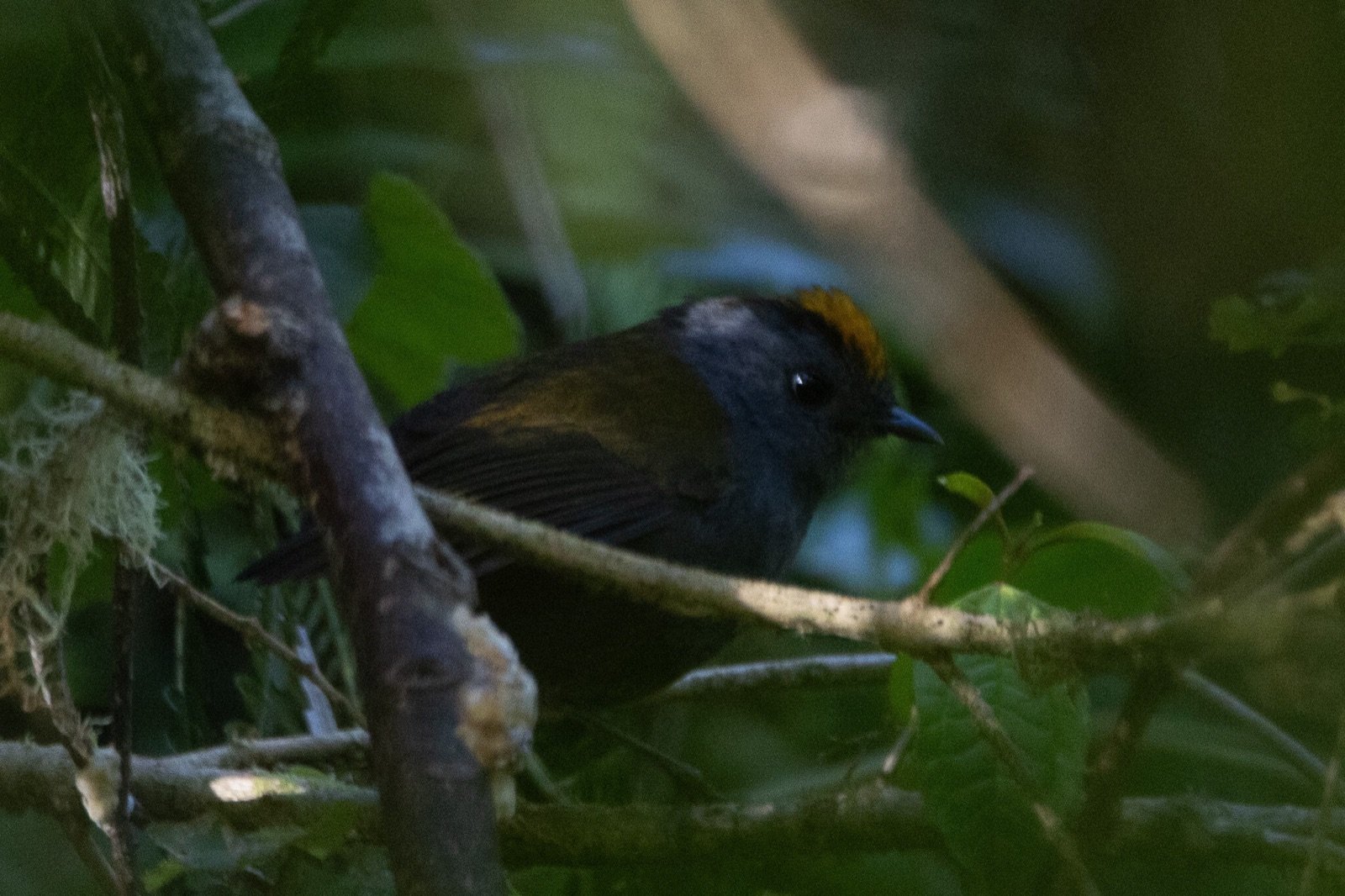
Look for a plump, short-tailed bird that looks very dark overall.
Upperparts: olive.
Underparts: slate-gray.
Face and sides of the neck: gray.
Crown: a black-bordered orange-rufous stripe down the middle.
The crown stripe is the best mark and makes the bird unmistakable if seen well. It is about 10 to 11.5 cm long and weighs about 21 g. Males and females look alike, so there is no need to sort out the sexes.
What it sounds like
Behaviour and diet
The Wrenthrush forages mostly on the ground in dense cover, often in bamboo, in the manner of a thrush or an antpitta. It is a skulker kept close to the ground, so expect it in low, dense, wet vegetation rather than on open perches. That tells you where to look: low down and inside the tangle, not up in the branches. A photographer got a singing bird at Savegre in 2015, a reminder that the voice often leads you to it.
Where it lives
It lives in wet, foggy montane evergreen forest and elfin forest, and favors dense growth near streams, including Chusquea bamboo thickets. Across its range it mostly lives above about 1,500 m and in places reaches the treeline. In Costa Rica it mostly occurs around 2,500 m, higher than the lower limit of its overall range. Its Costa Rican distribution runs from the Cordillera de Guanacaste southward through the highlands in a patchy, discontinuous pattern.
When to see it
The breeding season appears to run from March to early July, and the bird is more vocal then.
Similar birds
Its plump, very short-tailed shape can suggest a small antpitta or a wren. The orange crown stripe is the best mark and sets it apart. It is neither a wren nor a thrush, and has its own family, Zeledoniidae.
Names and lore in Costa Rica
In Spanish it is called zeledonia in Costa Rica and Panama, as well as reinita de Zeledón or chipe ratona. The name honors Costa Rican ornithologist José Castulo Zeledón.
Status and conservation
The AOCR list marks it as a resident endemic (R-END), and the IUCN lists it as Least Concern with a population trend that appears stable.
Photography tips
Expect low, dense, wet vegetation rather than open perches, since this skulker stays close to the ground. Listening for the song first gives you a direction to aim, as a singing bird was photographed at Savegre in 2015.
Trips that find it
- Dancing with Quetzals11 nightsSee the trip
- The Five-Night Birding Sampler5 nightsSee the trip
Tell us when you are travelling and our team in Costa Rica builds the trip around the birds you want to see.
Plan my birding tripHow we know this 12 sources, each read on the date shown
- Wikipedia read 2026-11-04
https://en.wikipedia.org/wiki/Wrenthrush - Flickr (photo caption) read 2026-11-04
https://www.flickr.com/photos/antpitta/36573375793/ - BirdForum Opus read 2026-11-04
https://www.birdforum.net/opus/Zeledonia_coronata - Cornell Birds of the World read 2026-11-04
https://birdsoftheworld.org/bow/species/wrenth1/cur/introduction - Fat Birder read 2026-11-04
https://fatbirder.com/ornithology/zeledoniidae-wrenthrush/ - Birding Craft read 2026-11-04
https://birdingcraft.com/wordpress/2025/12/20/birding-costa-rica-tips-best-sites-for-wrenthrush/ - Creagrus (Don Roberson) read 2026-11-04
http://creagrus.home.montereybay.com/Zeledonia.html - Wikipedia (es) read 2026-11-04
https://es.wikipedia.org/wiki/Zeledonia - Wikispecies read 2026-11-04
https://species.wikimedia.org/wiki/Zeledonia_coronata - Wikipedia via The Bio Files read 2026-11-04
http://thebiofiles.com/info/7415 - Animalia.bio read 2026-11-04
https://animalia.bio/es/wrenthrush - BirdLens read 2026-11-04
https://birdlens.secondwindltd.xyz/en/birds/d45c33f455