Family Icteridae
Yellow-backed Oriole
Icterus chrysater
In Spanish: Bolsero Dorsidorado
- A
Bright yellow and black oriole with a few coastal records here; not one to count on.
The Yellow-backed Oriole (Bolsero Dorsidorado, Icterus chrysater) is a bright yellow and black bird, and in Costa Rica it is a rare find. The AOCR official list gives it Accidental (A) status, so a trip should not count on seeing it.
Its story here is a recent one. The species has a split range with a gap of about 600 km, and Costa Rica sits inside that gap. Northern birds live from southern Mexico to Nicaragua, and southern birds from Panama to Colombia.
The first records for mainland Costa Rica began with an adult photographed in April 2008 in a rice field at Zancudo, Golfito. That makes it a bird worth keeping in mind while you sort through the common orioles of the lowlands.
How to find it
Treat any sighting as a bonus rather than a goal, since no place can be counted on for this bird. The Costa Rican records are coastal and lowland, mostly in Puntarenas, so open farmland and rice fields near the south Pacific coast are where recent birds have turned up. Across its range, flowering trees and banana plants are good places to wait, because it visits both. Listen for clear whistled songs from high perches. Check every yellow oriole for a yellow back and solid black wings.
How to recognise it
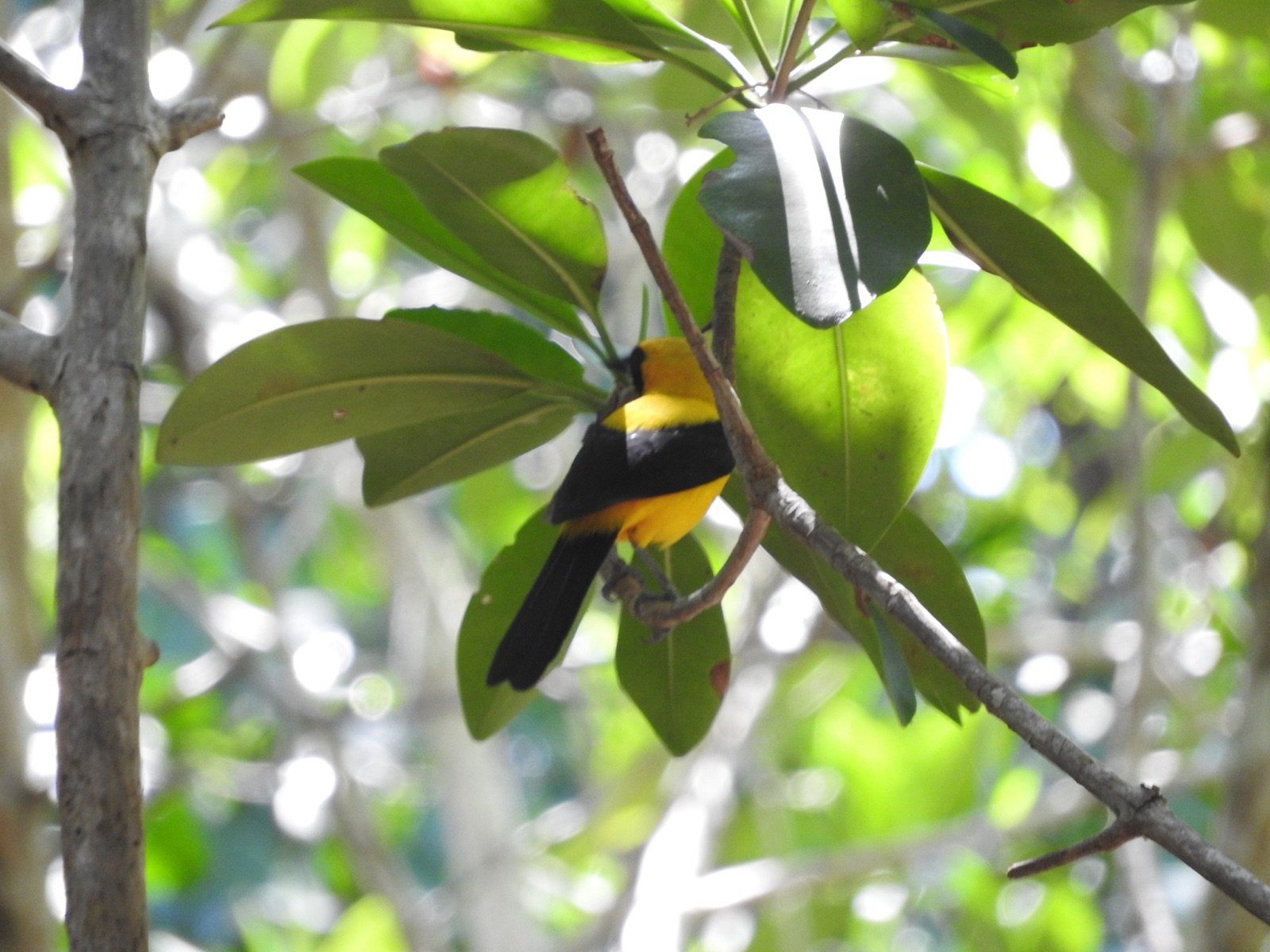
Adults are bright yellow and black.
The face, throat, wings and tail are black, and a black patch runs from the chest over the throat up to the eye. The back and underparts are very bright yellow. Females look much like males, but their yellow is slightly greener.
The wings are solid black with no pale or yellow edges, unlike most other orioles. Very few orioles have a yellow back, so the plain two-colour pattern stands out when you see it well.
One source gives a length of about 24 cm. The bill is thick at the base and thin at the tip.
What it sounds like
Recording: Andrés Felipe SantoDomingo J., CC BY 4.0, source, read 4 Nov 2026.
Behaviour and diet
Across its range this oriole eats insects, fruit and nectar. It is often seen on banana stems and visits flowering trees. It usually travels in pairs, sometimes in groups of up to ten, and is very vocal.
Individual birds use a varied repertoire of sounds when foraging, defending territory or calling to others. The bird moves nimbly through branches while it forages, and it will chase other birds, including hawks, from its territory.
Where it lives
Across its range it uses open woodland, scrub, coffee plantations, clearings and farmland with forest patches. It is found from sea level up to about 2500 m, with some records higher, and up to nearly 2,700 m in Colombia.
In Costa Rica the sightings have come from the coast and lowlands: a rice field at Zancudo near Golfito, the mouth of the Parrita river near Quepos, Portalón de Quepos, Isla Chira in the Gulf of Nicoya, and Ciudad Neily in southern Puntarenas.
When to see it
The dated Costa Rican records fall in several months, from January to October, with no clear season.
Similar birds
Female and young Black-cowled Orioles, which are common in Costa Rica, can be mistaken for this oriole. The Yellow-backed is brighter yellow on the head and back, has less black on the face, and has a stouter, straighter bill. Solid black wings with no pale edges are another helpful mark.
Names and lore in Costa Rica
The AOCR Spanish name is Bolsero Dorsidorado. The Costa Rican press has called it bolsero espalda dorada, and other Spanish names listed include bolsero dorso dorado, calandria dorso amarillo and turpial toche, or simply toche. Elsewhere it is turpial montañero in Colombia, toche in Venezuela, bolsero dorsiamarillo in Panama, chichiltote dorsiamarillo in Nicaragua and chorcha lomiamarilla in Honduras.
Colombian farmers say the mountain oriole seems to sing a different song in each village. They used to keep it caged for its song.
Status and conservation
The AOCR official list gives the Yellow-backed Oriole Accidental (A) status in Costa Rica, accepted with documented evidence, though a nest found in 2016 led the committee to change the earlier uncertain status to resident.
Photography tips
Birds often feed in flowering trees alongside other orioles, so a flowering tree or a stand of banana plants is a sensible place to wait. In Colombia a coffee farm gave views of a pair singing from a tall tree above live fences.
How we know this 13 sources, each read on the date shown
- AOCR Lista Oficial Online read 2026-11-04
https://listaoficialavesdecostarica.wordpress.com/lista-oficial/lista-oficial-online/ - AOCR Zeledonia 18:2 (2014) read 2026-11-04
https://listaoficialavesdecostarica.wordpress.com/wp-content/uploads/2015/02/aocr-lista-oficial-2014-zeledonia-18-2.pdf - La Nación read 2026-11-04
https://www.nacion.com/ciencia/medio-ambiente/gaviota-y-bolsero-se-dejan-ver-por-primera-vez-en-el-pais/CTD55AGWDVCFHDIJV6U6OFTSF4/story/ - The Wilson Journal of Ornithology read 2026-11-04
https://bioone.org/journals/the-wilson-journal-of-ornithology/volume-128/issue-1/wils-128-01-22-31.1/Morphological-and-genetic-variation-of-the-Yellow-backed-Oriole-Icterus/10.1676/wils-128-01-22-31.1.full - Animalia.bio read 2026-11-04
https://animalia.bio/yellow-backed-oriole/1000 - Flickr (photo caption) read 2026-11-04
https://www.flickr.com/photos/pris63/49733224601 - Wikipedia (Spanish) read 2026-11-04
https://es.wikipedia.org/wiki/Icterus_chrysater - EcuRed read 2026-11-04
https://www.ecured.cu/Icterus_chrysater - Wikipedia (Black-cowled oriole) read 2026-11-04
https://en.wikipedia.org/wiki/Black-cowled_oriole - Wikipedia (Yellow-backed oriole) read 2026-11-04
https://en.wikipedia.org/wiki/Yellow-backed_Oriole - Cornell Birds of the World read 2026-11-04
https://birdsoftheworld.org/bow/species/yebori1/cur/introduction - Lista Oficial Aves de Costa Rica (AOCR) read 2026-11-04
https://listaoficialavesdecostarica.wordpress.com/nuevos-registros/ - Birds of the World read 2026-11-05
https://birdsoftheworld.org/bow/species/yebori1/cur/introduction?lang=es