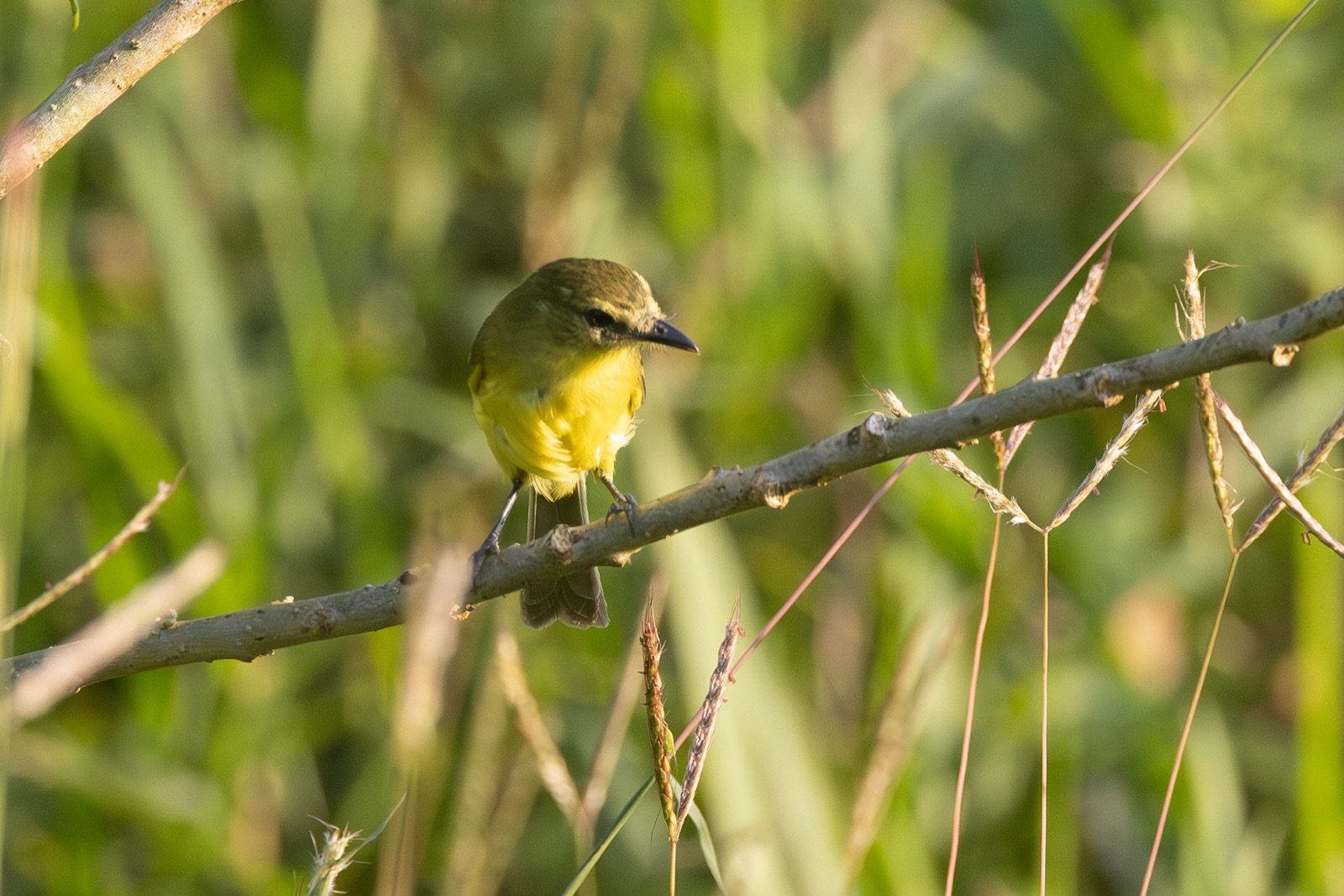
Family Tyrannidae
Yellow Tyrannulet
Capsiempis flaveola
In Spanish: Mosquerito Amarillo
- Resident
A tiny, restless yellow flycatcher of shrubby edges, fields and bamboo.
The Yellow Tyrannulet (Mosquerito Amarillo) is a tiny flycatcher, about 10 to 11.5 cm long, with bright yellow underparts and a bright yellow eyebrow. It is considered common in Costa Rica, though it is easy to miss because it is so small and fast.
It is a bird of openings and edges rather than tall forest. Shrubby second growth, bushy pastures, stream edges and stands of bamboo are the places to look, and a chattery song is usually the first sign that one is close.
On the Caribbean-side routes we build, it turns up on the Sarapiqui and La Selva leg and around Arenal and La Fortuna. That makes it a friendly small target for a beginner learning to scan edges and listen.
How to find it
Check shrubby second growth, bamboo stands and field edges. It is easy to overlook because it is small and quick, so listen for the chattery song and then watch low exposed perches. Look for pairs, since it is usually seen with a mate or family group. Open fields and forest edges worked for one tour at La Selva, where a pair was working through grasses along the Police Station Road. Wet fields and scrubby field habitat on the southern Pacific side have also produced it, and so has a short walk at Virgen del Socorro, a brief stop along the road down from Cinchona.
How to recognise it
Look for a very small flycatcher with these marks:
Bright yellow underparts.
A bright yellow eyebrow.
A dark line through the eye.
A somewhat bushy crest.
Two wide but faint wing bars.
Olive green upperparts.
Its slender build and thin bill make it look like a tiny vireo or warbler. Males and females look alike, while young birds are browner above and paler yellow below.
It often perches horizontally with the tail partly raised, and sits more upright when resting. That posture helps you pick it out among the foliage.
What it sounds like
Recording: Pablo H Capovilla, CC BY 4.0, source, read 4 Nov 2026.
Behaviour and diet
This is an active, restless bird that flicks its tail. It makes short sallies to catch insects in the air and often returns to low, exposed perches, which can give good views. It is usually seen in pairs or family groups.
It apparently breeds nearly year-round in Costa Rica. The only fully described nests came from here: open cups of plant fibres, grass and bark, usually with moss on the outside.
Where it lives
It lives in shrubby second growth with some trees, and is sometimes found near stands of tall bamboo. It also uses thickets, forest and stream edges, dense second growth, and bushy pastures or clearings. It has a special liking for bamboo and avoids tall forest, preferring openings and edges with dense low vegetation.
In Costa Rica it reaches about 600 m on the Caribbean slope and about 1,200 m on the Pacific slope. The Costa Rican form occurs on the Caribbean slope, and on the Pacific slope from San José and central Puntarenas provinces southward into Panama.
Similar birds
It is a brighter yellow than most other tyrannulets, which helps separate it from them. Small yellow tyrannulets can still be hard to separate by ear. A tour group in the far north could not tell a calling Ornithion tyrannulet (Yellow-bellied or Brown-capped) apart west of Caño Negro, so learn the voices before you go.
Names and lore in Costa Rica
Costa Ricans call it Mosquerito Amarillo. Other Spanish-speaking countries use different names, such as tiranuelo amarillo in Colombia and mosquitero amarillo in Nicaragua.
Status and conservation
Listed as a resident (R) on the AOCR list, it is considered common in Costa Rica and is rated Least Concern worldwide.
Photography tips
Between flights after insects it often sits on low, open perches, so watch those and wait. Listen for the chattery song to locate it first, since it moves fast. Its horizontal posture with the tail partly raised helps you pick it out among the foliage.
How we know this 16 sources, each read on the date shown
- Wikipedia read 2026-11-04
https://en.wikipedia.org/wiki/Yellow_tyrannulet - Animalia.bio read 2026-11-04
https://animalia.bio/yellow-tyrannulet - Birds & Breakfast Costa Rica read 2026-11-04
https://birdsandbreakfast.com/en/yellow-tyrannulet/ - Aves Ibéricas, Aves Costa Rica read 2026-11-04
http://www.avesibericas.es/costaricaaves6.htm - Macaulay Library read 2026-11-04
https://macaulaylibrary.org/asset/52419391 - Field Guides Birding Tours, Costa Rica 2024 trip list read 2026-11-04
https://fieldguides.com/triplists/cos24.html - Eagle-Eye Tours trip report read 2026-11-04
https://www.eagle-eye.com/blog/costa-rica-sampler-jan-18-28-2024-trip-report/ - Field Guides Birding Tours, Deep South 2023 read 2026-11-04
https://fieldguides.com/triplists/cr123.html - Field Guides Birding Tours, Far North 2017 read 2026-11-04
https://fieldguides.com/triplists/cr217.html - Nina O'Hanlon, Birding Costa Rica read 2026-11-04
https://ninajohanlon.wordpress.com/2020/05/03/birding-costa-rica/ - Naturalist Journeys trip report, Feb 2024 read 2026-11-04
https://www.naturalistjourneys.com/pdf/trip-reports/1178-202402-central_america-costa_rica-trip_report.pdf - Wikipedia (es) read 2026-11-04
https://es.wikipedia.org/wiki/Capsiempis_flaveola - Wikipedia read 2026-11-04
https://en.wikipedia.org/wiki/Yellow_Tyrannulet - Birding by Locals read 2026-11-04
https://www.birdingbylocals.com/tour/costa-rican-sunrise-centennial-trees-cooking-class-and-breakfast/ - Wikipedia read 2026-11-04
https://en.wikipedia.org/wiki/Capsiempis_flaveola - Birds of the World read 2026-11-04
https://birdsoftheworld.org/bow/species/yeltyr1/cur/introduction