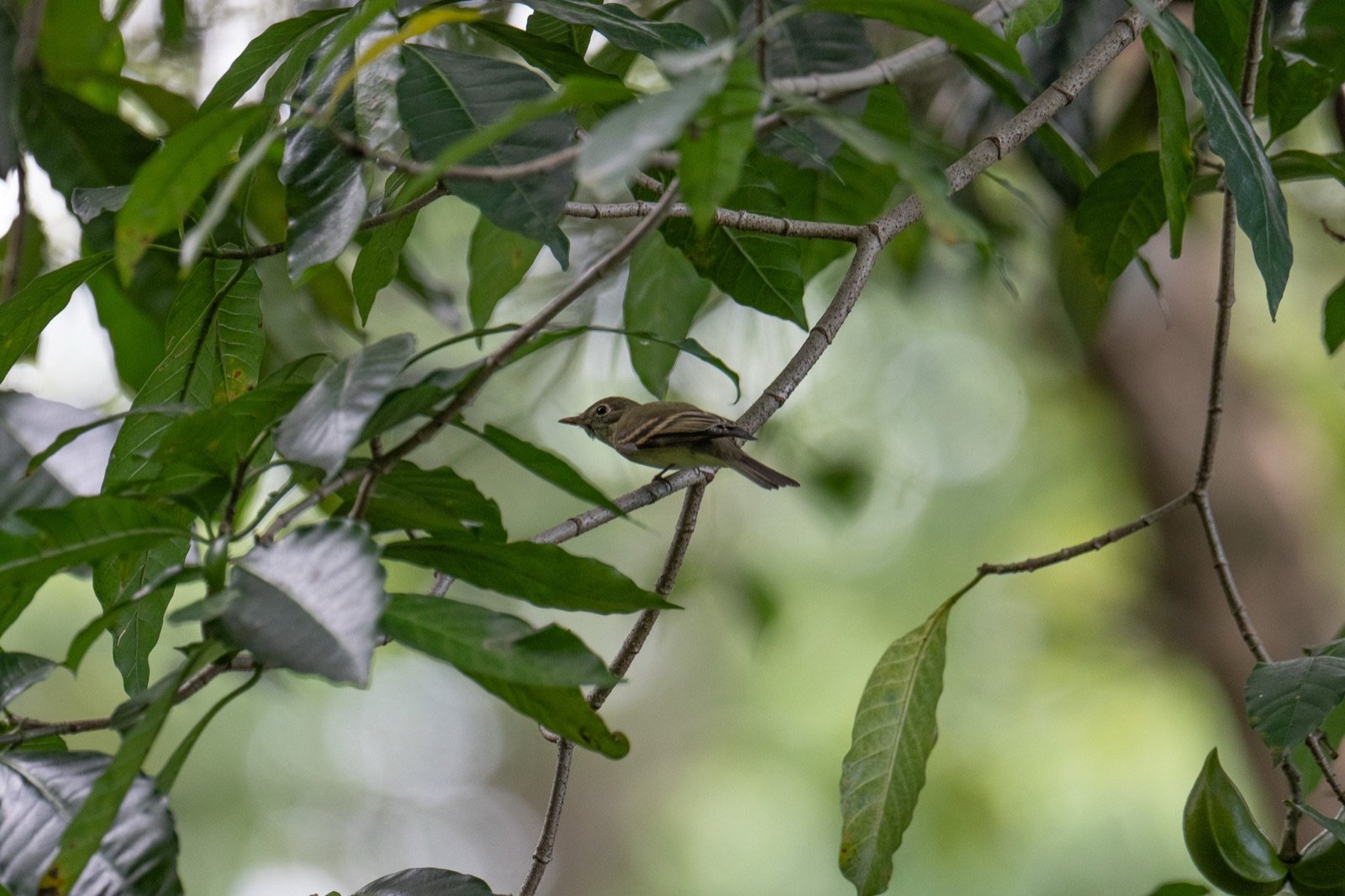
Family Tyrannidae
Acadian Flycatcher
Empidonax virescens
In Spanish: Mosquerito Verdoso
- Migrant
A green, long-winged Empidonax of Caribbean lowland forest, here as a migrant.
The Acadian Flycatcher (Mosquerito Verdoso) does not breed in Costa Rica. It is a fairly common passage migrant and an uncommon winter resident, so every bird you meet is a traveller from eastern North America.
Most are found in the Caribbean lowlands, low in forest understory and along forest edges where the vegetation is dense. It belongs to the Empidonax group, which tests beginners, but this one offers clear clues: a quite green back, a bright pale yellow belly and a longer wing tip than any other Empidonax in the country.
A little patience, a good look at the wings and an ear for its squeaky call note go a long way.
How to find it
Look low in forest understory and along forest edges in dense vegetation, mainly in the Caribbean lowlands during the migration and winter months. Check thickets and gaps in the understory, where it tends to sit. Listen for the loud, squeaky "psei'ip" call note, which can lead you to a bird you might otherwise miss. It is inconspicuous, so you must look for it. When you find a small olive flycatcher, check the wing tip, the pale yellow belly and the grey legs before you decide. Older forest is worth your effort.
How to recognise it
Start with the overall impression: a rather large, quite green Empidonax, about 15 cm long and about 12 g.
Upperparts: olive.
Eye ring: narrow, conspicuous and yellowish white.
Wing bars: buff to whitish.
Throat: white.
Breast: olive wash, yellowish olive.
Lower breast: white.
Rest of the underparts: pale yellow.
Bill: black upper bill, pale lower bill.
Legs: grey.
Wings: long and pointed.
The wings give the best check. Its primary projection (how far the wing tip extends) is longer than that of any other Empidonax in Costa Rica, which helps separate it from lookalikes once you have a good view.
What it sounds like
Recording: Leila Dasher, CC BY 4.0, source, read 4 Nov 2026.
Behaviour and diet
It feeds on insects and other arthropods, mostly picked from under leaves, and it also catches insects in the air. It sallies out and hovers at foliage for prey, and it sometimes takes berries from bushes.
It perches in deep shade, usually under 6 m up and well below the canopy. It is more lethargic than other Empidonax, flicks its wings and tail little unless excited, and often perches with drooped wings. Across its range it prefers thickets and gaps in the understory and at forest edges, so look low in dense growth.
Where it lives
In Costa Rica it is mostly found in the Caribbean lowlands, though it is possible elsewhere, up to about 1,200 m elevation. A Spanish-language Costa Rican source calls it a common migrant there in both autumn and spring. It is most likely in the understory of forests and at forest edges, in dense vegetation.
It winters on both slopes of the country. On the wider wintering grounds it uses lowland and foothill (premontane) mature forest.
When to see it
Passage migrants move through from mid-September to early November and from early March to mid-May, and one Costa Rican source stretches the autumn passage to late November. Winter residents stay from mid-September to mid-May.
Similar birds
Its main lookalikes are other Empidonax, including Alder and Willow Flycatchers. The Acadian has a brighter pale yellow belly and flanks than those two, and a longer primary projection than any other Empidonax in Costa Rica. Grey legs and long, pointed wings add to the picture.
Names and lore in Costa Rica
The Spanish name used in Costa Rica is Mosquerito Verdoso, also used in Ecuador, Panama, Honduras and Colombia. Other regions differ: Bobito Verde in Cuba and Mosquitero Cuellioliváceo in Nicaragua. The genus name Empidonax comes from Greek words meaning 'mosquito' and 'lord'.
Status and conservation
On the AOCR list it is a migrant (M): a fairly common passage migrant and an uncommon winter resident that does not breed in Costa Rica.
Photography tips
Look for it low in dense growth, in thickets and gaps in the understory and at forest edges. Its habit of perching in deep shade means you will need patience and good light settings.
How we know this 11 sources, each read on the date shown
- Bird Watching Costa Rica read 2026-11-04
https://www.birdwatchingcostarica.com/ave/acadian-flycatcher/ - Aves de Costa Rica read 2026-11-04
https://avesdecostarica.com/Empidonax-virescens.html - The Land Between read 2026-11-04
https://www.thelandbetween.ca/the-land-between-species-at-risk/acadian-flycatcher/ - Ropero Aventuras read 2026-11-04
https://roperoaventuras.com/2017/01/05/atrapamoscas-verdoso-empidonax-virescens-acadian-flycatcher/ - COSEWIC status report 2010 read 2026-11-04
https://www.canada.ca/en/environment-climate-change/services/species-risk-public-registry/cosewic-assessments-status-reports/acadian-flycatcher-2010.html - Wikipedia (Spanish) read 2026-11-04
https://es.wikipedia.org/wiki/Empidonax_virescens - NatureServe Explorer read 2026-11-04
https://explorer.natureserve.org/Taxon/ELEMENT_GLOBAL.2.103712/Empidonax_virescens - NC GAP species report read 2026-11-04
http://www.basic.ncsu.edu/ncgap/sppreport/abpae33020.html - Birdingcraft read 2026-11-05
http://birdingcraft.com/wordpress/category/caribbean-slope/ - Field Guides tour list read 2026-11-05
https://fieldguides.com/triplists/cr217.html - Cornell Lab Birds of Forest Landscapes read 2026-11-05
http://static.birds.cornell.edu/bfl/speciesaccts/acafly.html