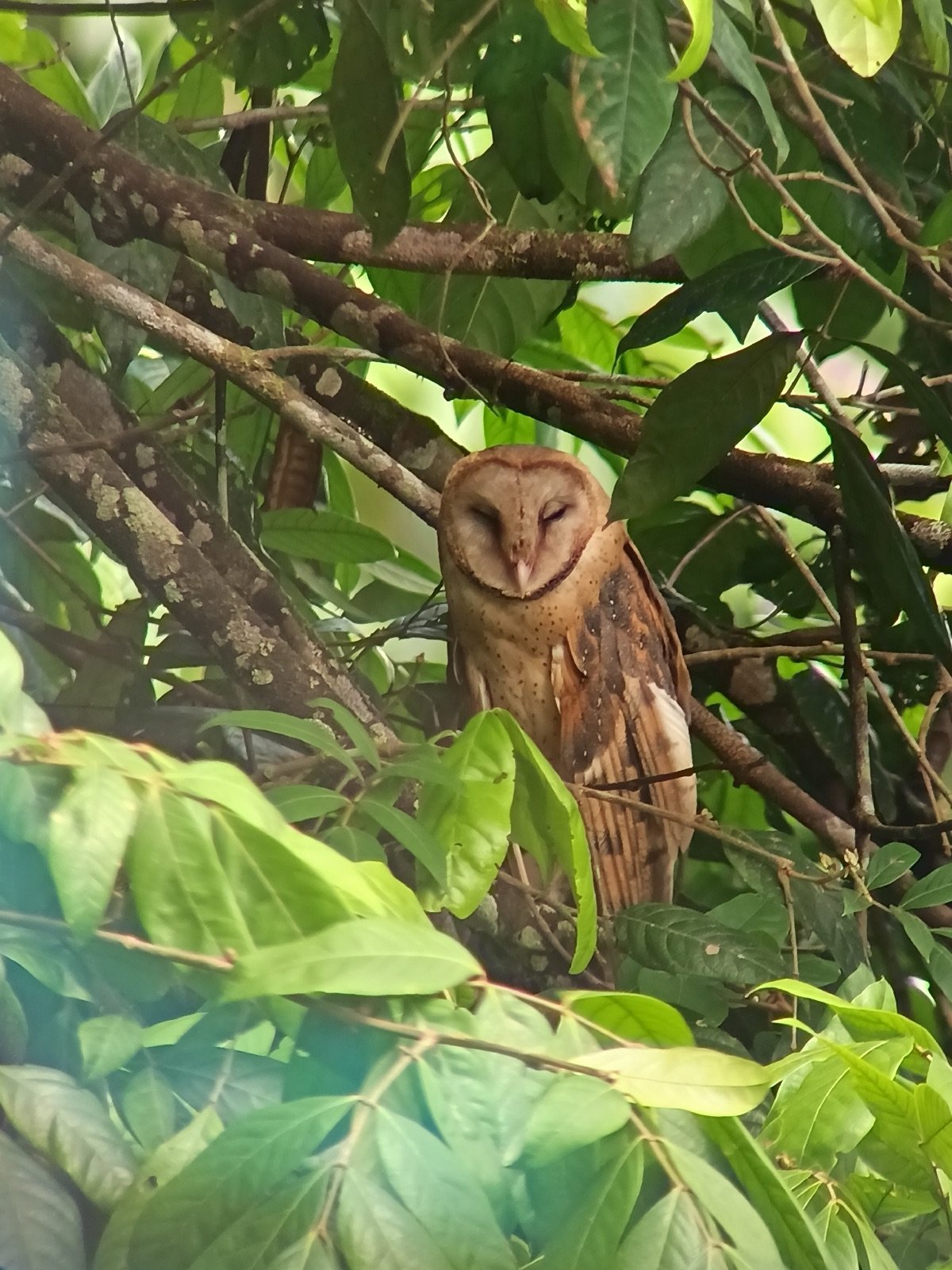
Family Tytonidae
American Barn Owl
Tyto furcata
In Spanish: Lechuza Ratonera Americana (Lechuza de Campanario, Cara de Gato, Búho)
- Resident
Pale, heart-faced owl of church towers, town squares and open country.
The American Barn Owl is a pale owl with a heart-shaped face and long, fully feathered legs. In Costa Rica it is a widespread resident on both the Caribbean and Pacific slopes, and it often lives close to people.
Costa Rican names tell the story: Lechuza de Campanario means church-tower owl, and Cara de Gato means cat face. On a trip we build, you can look for it roosting by day in the town square of Paraíso, in the Central Valley, where Tropical Screech-Owls roost too.
It is an owl for towns by day, open country at night, and the foot of an old bell tower at dusk.
How to find it
Start with day roosts in towns. A guided group saw a Barn Owl roosting by day in Paraíso's town square, and another tour itinerary stops on the way back toward the Central Valley to look for day-roosting owls. For night birding, try open country: in the far north, guides spotlighted one on a dead palm snag during a night drive, and a spotlight found one there on an earlier tour too. Barn and Striped Owls can also show up at night at Zamora Estate in Santa Ana, near San José. Owls roosting under a roof can be hard to see, so look carefully.
How to recognise it
Plain, parallel field marks make this owl easy to place:
A pale owl with a heart-shaped face. The face is whitish with a thin orange-brown rim.
Long, fully feathered legs.
No ear tufts, dark eyes, and a short, hooked bill.
Upperparts a fine mottle of buff, golden and gray.
Underparts whitish to cream with sparse but distinct dark spots.
In Costa Rica it measures about 40 cm and weighs about 425 g.
What it sounds like
Recording: Josiah Londerée, CC BY 4.0, source, read 4 Nov 2026.
Behaviour and diet
The Barn Owl hunts mostly at night and relies on very sharp hearing to find prey in complete darkness. Its flight is silent, and it eats mainly small mammals, especially rodents.
By day it hides in caves, tree hollows or buildings, and it is usually solitary. In Costa Rica it nests in tree cavities, among rocks, or on ledges inside buildings, such as a church in Palmares, Alajuela. The nest is only a loose pile of twigs and trash, and clutches are 4 to 5 eggs.
Where it lives
This owl prefers open country such as farmland, open marshes, scattered trees, towns and cities, and it avoids thick forest. In Costa Rica it is found nearly everywhere except very high altitudes, in humid areas at both high and low elevations.
Its centers of abundance are the northwest lowlands and the Central Valley. Conservation areas listed for it include Guanacaste, Tempisque, Arenal, Osa, Tortuguero and Amistad. Deforestation has almost certainly raised its numbers in recent years.
Similar birds
Tropical Screech-Owls roost in the same Paraíso square, but this species has no ear tufts and a heart-shaped face. Night drives in the far north can also turn up Striped, Pacific Screech and Black-and-white Owls, so look for the pale face and pale body of the Barn Owl.
Names and lore in Costa Rica
Costa Rican names include Lechuza Ratonera, Lechuza de Campanario (church-tower owl), Cara de Gato (cat face) and plain Búho or Lechuza. The national museum's catalogue of birds of the metropolitan area lists it as Lechuza ratonera americana and marks it as a resident.
Status and conservation
Resident (R) on the AOCR list, Least Concern globally and in a Costa Rican wildlife guide, with a stable population and CITES Appendix II listing.
Photography tips
One photographer spent many nights at the base of a church tower with a camera and flash. The owls left at dusk and came back before dawn, and a sharp flight shot took many attempts. Owls under a roof can be hard to see: at a supermarket, a visitor digiscoped the front owl while the second was harder to make out.
How we know this 22 sources, each read on the date shown
- Flickr (Costa Rican natural history text) read 2026-11-04
https://www.flickr.com/photos/jobando/33856787671 - EcoRegistros read 2026-11-04
https://www.ecoregistros.org/sheet/Tyto-furcata?idusuario=15&idlugardetallado=1493 - The Owl Pages read 2026-11-04
https://www.owlpages.com/owls/species.php?s=20 - SIB Argentina read 2026-11-04
https://sib.gob.ar/especies/tyto-furcata - Wikipedia read 2026-11-04
https://en.wikipedia.org/wiki/Tyto - Fauna Decomisada Costa Rica read 2026-11-04
https://faunadecomisada.go.cr/guia-de-especies/aves/tytonidae/tyto-alba - Eagle-Eye Tours read 2026-11-04
https://www.eagle-eye.com/tour/costa-rica-birding-tour/ - Eagle-Eye Tours trip report read 2026-11-04
https://www.eagle-eye.com/blog/costa-rica-birding-tour-trip-report-jan-22-feb-7-2025/ - Birds & Wildlife tour itinerary read 2026-11-04
https://birdswildlife.com/costa-rica-the-ultimate-tour-feb-20th-09th-march-2027/ - Field Guides trip list 2023 read 2026-11-04
https://fieldguides.com/triplists/cr223.html - Field Guides trip list 2015 read 2026-11-04
https://fieldguides.com/triplists/cr215.html - Birdingcraft read 2026-11-04
https://birdingcraft.com/wordpress/2014/02/24/where-to-start-a-birding-trip-to-costa-rica/ - Oh Uruguay read 2026-11-04
https://oh.com.uy/tours/lechuza-de-campanario/ - EcoRegistros read 2026-11-04
https://www.ecoregistros.org/ficha/Tyto-furcata - Flickr (Costa Rican natural history caption) read 2026-11-04
https://www.flickr.com/photos/jobando/33856804131 - Museo Nacional de Costa Rica, Catálogo de Aves GAM read 2026-11-04
https://www.museocostarica.go.cr/wp-content/uploads/Investigaciones/historia-natural/gam/datos-biodiversidad/aves/catalogo/catalogo_aves_gam_2.pdf - Lifer Tours read 2026-11-04
https://www.lifertours.com/single-post/the-owls-of-costa-rica-and-how-we-see-them - Take Me To The Wild read 2026-11-04
https://www.takemetothewild.com/stories/owls-of-costa-rica/ - Outside My Window read 2026-11-04
https://www.birdsoutsidemywindow.org/2026/02/04/barn-owls-at-the-supermarket/ - The Tico Times read 2026-11-04
https://ticotimes.net/2024/02/14/costa-rica-birding-meet-the-barn-owl - Pinterest read 2026-11-04
https://www.pinterest.com/pin/434315957808038342/ - Lifer Tours read 2026-11-04
https://www.lifertours.com/single-post/the-5-most-common-owls-in-costa-rica