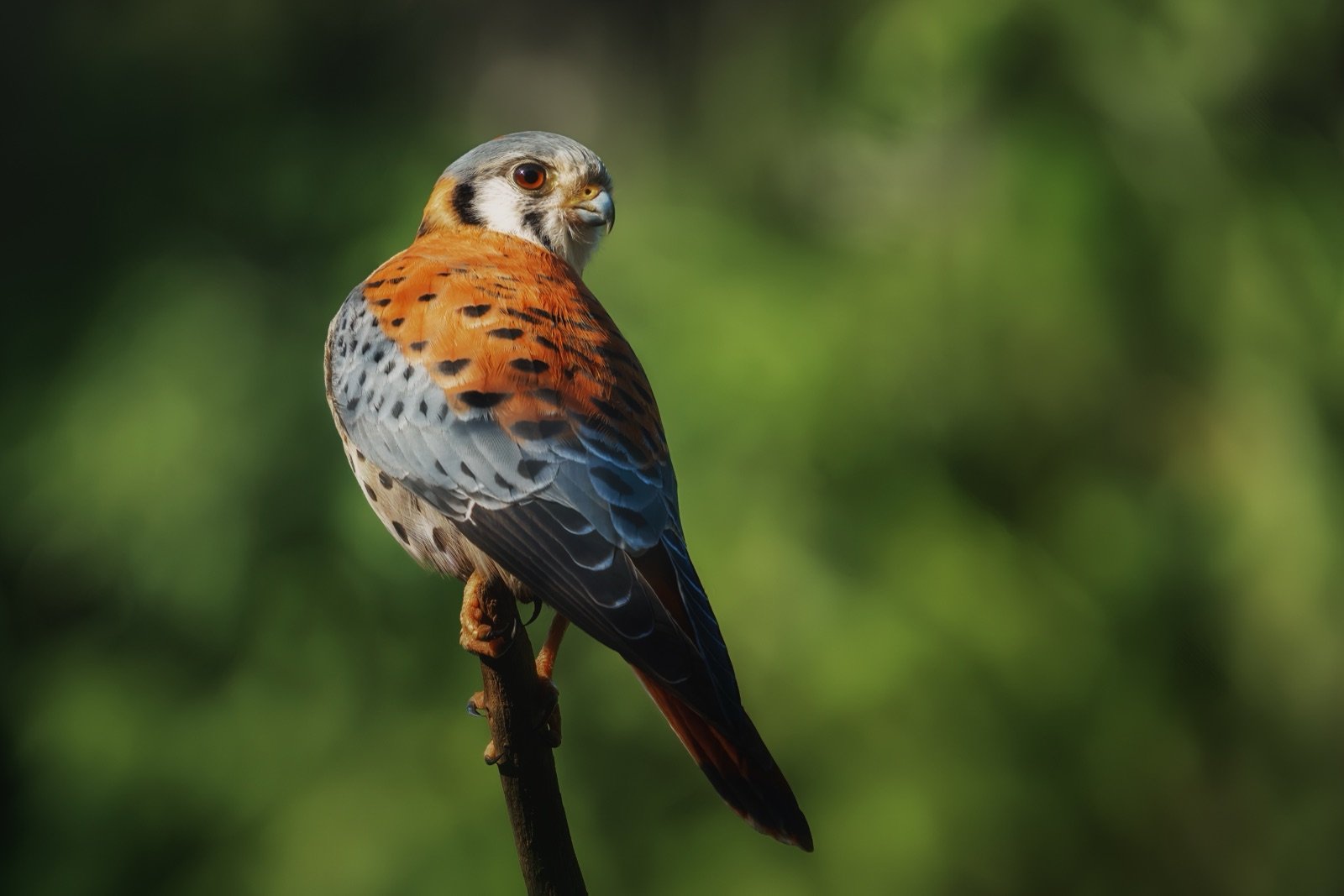
 American Kestrel
Family Falconidae
American Kestrel
Falco sparverius
In Spanish: Cernícalo Americano (Klis-Klis, Camaleón)
- M,R
The smallest falcon in the Americas, watching open country from a wire.
The American Kestrel is the smallest falcon in the Americas, roughly 22 to 31 cm long, with a size between a blue jay and a mourning dove. In Costa Rica it is widespread but usually uncommon and local, and it is described as a winter resident.
Look in open country for a small falcon perched on a power line, pole or fence post, often bobbing its tail. Costa Ricans know it as Cernícalo Americano, Klis-Klis or Camaleón.
On a trip we build in the north, an open road a few miles before a wetland area normally gives good chances for it, and the guides know the stop well.
How to find it
Scan open country for a small falcon on a wire, pole or fence post, and watch for the tail bobbing. Check fields too, since it may hover over one while hunting. Do not expect one on every roadside wire. A Turrialba birder calls it quite rare around Turrialba, while sightings are fairly frequent to the west in the Central Valley. One female wintered at Florencia for several years. Flooded cattle pasture in the north has produced it on a tour in late January and early February, alongside ibises, storks and kingfishers.
How to recognise it
Start with size: it falls between a blue jay and a mourning dove, and it is the smallest falcon in the Americas.
The male has:
- a rufous back and tail
- blue-gray wings with black spots
- a white belly with black spotting
The female has:
- a rufous back and wings with dark barring
- a buff belly with brown streaks
Both sexes have a white face with two narrow black vertical marks on each side, where other falcons have only one. The nape carries two black false-eye spots, a good detail if the bird turns away from you. In the Costa Rican account, the rufous face pattern and the rufous tail are each diagnostic, and the female shows rufous and black bars on the upperparts and wings with brown streaks below.
What it sounds like
Recording: Priyantha Wijesinghe, CC BY 4.0, source, read 4 Nov 2026.
Behaviour and diet
The kestrel mostly hunts by perching and watching the ground for prey. It also hovers on rapid wingbeats, and in Costa Rica it often hovers briefly before dropping on its target. It can also soar on thermals like a Buteo hawk.
Before striking, it bobs its head and tail, then flies straight at the prey and grabs it with its talons.
The birds are described as solitary. Once a kestrel holds a territory rich enough in food, it becomes fully sedentary, so a spot where you see one is likely to produce it again.
Where it lives
In Costa Rica it occurs from the lowlands to middle elevations on both the Caribbean and Pacific slopes. It favors open ground with scattered trees, fence posts and power lines.
It is most numerous in parts of Guanacaste, especially near mountain passes in the Cordillera. It is also more numerous around the Río Frío region and in the Central Valley.
Range wide, the species uses grasslands, farm fields, desert, tropical lowlands and suburban or urban areas. It needs perches, nesting cavities and plentiful prey.
When to see it
It is described as a winter resident in Costa Rica, with occasional reports between June and August, most likely of non-breeding birds. Passage migrants are occasionally common in autumn (September to October) and spring (March to April), mostly along the Pacific coast and over the central highlands.
Similar birds
Costa Rica's Merlin is a small migratory falcon, slightly larger and less colorful than the kestrel. A local birder says Merlin is the more frequent visitor around Turrialba. The kestrel's two black vertical face marks on each side, where other falcons have only one, help separate them.
Names and lore in Costa Rica
Costa Ricans know the kestrel as Klis-Klis, Camaleón, Halconcito Americano, Halconcito Golondrín and Cernícalo Americano. Klis Klis is also the name used in El Salvador, so that name is shared with neighbours.
Status and conservation
The AOCR list codes it M,R, a migrant with resident birds, and the IUCN rates the species Least Concern.
Photography tips
Kestrels often perch on fence posts, scattered trees and power lines in open country while scanning for prey. The hovering stop before a dive is typical, which gives chances for flight shots. An early-morning perch on a man-made lookout can also give a clean, close view.
How we know this 13 sources, each read on the date shown
- Flickr (account quoting Costa Rican bird guide text) read 2026-11-04
https://www.flickr.com/photos/jobando/28824050580 - Trek.zone read 2026-11-04
https://trek.zone/en/costa-rica/animals/american-kestrel - Birds for Beer (Paul Pickering) read 2026-11-04
https://birdsforbeer.com/2019/03/10/falcons-and-caracaras-in-turrialba/ - The Peregrine Fund read 2026-11-04
https://peregrinefund.org/explore-raptors-species/falcons/american-kestrel - Wikipedia (via iNaturalist Costa Rica) read 2026-11-04
https://costarica.inaturalist.org/taxa/4665-Falco-sparverius - Guía de fauna decomisada, Costa Rica read 2026-11-04
https://faunadecomisada.go.cr/guia-de-especies/aves/falconidae/falco-sparverius - Birds by Bijs read 2026-11-04
https://birdsbybijs.com/costa-rica-northern-region-birding-tour/ - Eagle-Eye Tours read 2026-11-04
https://www.eagle-eye.com/blog/costa-rica-birding-tour-trip-report-jan-22-feb-7-2025/ - Animalia read 2026-11-04
https://animalia.bio/american-kestrel?custom_list=16538 - Las Aves que Viven en Chile read 2026-11-04
http://avesvivenchile.blogspot.com/2007/11/cerncalo.html - iNaturalist guide (adapted from Spanish Wikipedia) read 2026-11-04
https://www.inaturalist.org/guide_taxa/915570 - Gallery of Birds read 2026-11-04
http://www.galleryofbirds.com/costarica/AmericanKestrel.htm - Hotel Rivel read 2026-11-04
https://hotelrivel.online/the-tiny-hunter-unveiling-the-american-kestrel-in-the-costa-rican-highlands/