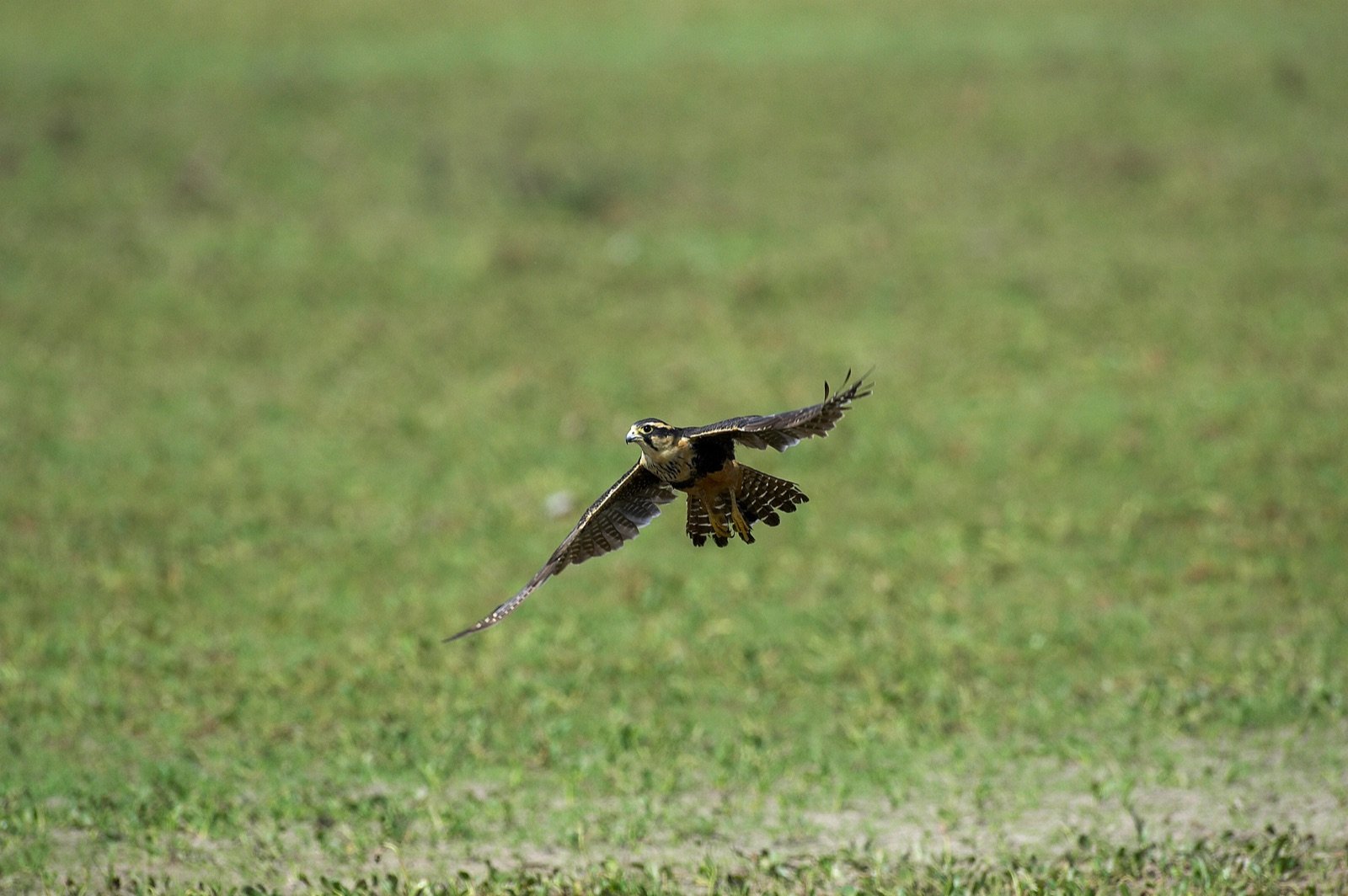
 Aplomado Falcon
Family Falconidae
Aplomado Falcon
Falco femoralis
In Spanish: Halcón Aplomado
- M?
A rare falcon of open grassland, here only as a young wanderer.
The Aplomado Falcon is not a resident in Costa Rica. Records are few, and most seem to be young birds that wander into the country in the northern winter season.
That makes it a bird for the patient rather than one to plan a day around. An older natural history account knew of only one Costa Rican report, a young bird photographed near Taboga, Guanacaste, in mid-October.
Still, when one stays put, word spreads. A young bird lingered for at least a month in the Coris area of Cartago, and birders gathered to see it.
How to find it
Finding one by chance is unlikely, because so much open land where it could occur is hard to reach. Birders have mostly seen it when a bird stayed put and word spread. So keep an ear open for local reports if you travel in the northern winter. At Coris, birders waited an hour or two before the falcon appeared. Scan the prominent perches over open country with scattered trees, and bring patience along with a scope.
How to recognise it
Look for a slender, long-tailed falcon with a bold face pattern, described as diagnostic.
Adults show:
- blackish upperparts
- a pale buff cheek, throat and chest
- a broad pale stripe over the eye
- a cinnamon belly and thighs
- yellow bare skin around the eye and yellow legs
The male is about 38 cm long and the female about 43 cm.
Young birds, the ones most likely to turn up here, look like adults in general form, though this detail comes from the species across its range. The chest is streaked with black, the pale areas are buffy, and the cinnamon underparts are paler.
What it sounds like
Recording: Rodrigo Paiva Lazaro, CC BY 4.0, source, read 4 Nov 2026.
Behaviour and diet
It watches from a prominent perch, then dives hard onto prey and returns to the perch to eat. Prey includes small birds, small mammals and large insects flushed by pasture fires.
In flight it uses long, narrow wings to skim low over the ground between distant perches. At Coris it was reported to be hunting doves.
Across its range it chases doves and small to medium songbirds in the air, and pairs often hunt together, with one flushing prey for the other.
Where it lives
It prefers savannas and grasslands with scattered trees.
In Costa Rica most of the few records come from Guanacaste, which has plenty of wide open habitat for this falcon.
One young bird also stayed at Coris in Cartago. Coris is the largest remaining open grassland there, in an industrial and farming zone.
When to see it
It may arrive with the northern winter migration, especially in Guanacaste. The one early report was from mid-October.
Similar birds
Bat Falcon and Orange-breasted Falcon share the black, white and rust pattern below. They are built more like a Peregrine, with solid blackish heads and darker rufous bellies, while the Aplomado has a pale eyebrow stripe. The Bat Falcon is much smaller, and the Orange-breasted Falcon is more compact. The Aplomado's flight shape is closest to an American Kestrel's. When you see a dark falcon, compare it also with Merlin and Peregrine.
Names and lore in Costa Rica
Spanish speakers also call this falcon halcón aleto, halcón perdiguero, halcón fajado and halcón plomizo. These names come from a general Spanish-language account, not a Costa Rican one.
Status and conservation
The AOCR list marks it M?, a migrant whose status is uncertain, and it is Least Concern worldwide on the IUCN Red List, though numbers are reported to be falling.
Photography tips
At Coris the falcon stayed too far away for good photos, even though a nearby White-tailed Kite came close enough to shoot. Bring a scope and a long lens.
How we know this 10 sources, each read on the date shown
- 10,000 Birds read 2026-11-04
https://www.10000birds.com/aplomado-twitch-in-costa-rica.htm - Aves de Costa Rica read 2026-11-04
https://avesdecostarica.com/Falco-femoralis.html - Animalia.bio read 2026-11-04
https://animalia.bio/aplomado-falcon?environment=162 - Flickr (Historia Natural, INBio text) read 2026-11-04
https://www.flickr.com/photos/jobando/36490245915 - All About Birds, Cornell Lab of Ornithology read 2026-11-04
https://www.allaboutbirds.org/guide/Aplomado_Falcon/sounds - Wikipedia read 2026-11-04
https://en.wikipedia.org/wiki/Aplomado_falcon - Birds of North America Online (Keddy-Hector), via ResearchGate read 2026-11-04
https://www.researchgate.net/publication/250143925_Aplomado_Falcon_Falco_femoralis - NaturaLista Colombia (from Wikipedia) read 2026-11-04
https://colombia.inaturalist.org/taxa/4645-Falco-femoralis - Holistic Birding read 2026-11-04
https://holisticbirding.wordpress.com/aplomado-falcon-falco-femoralis/ - Instituto Costarricense de Turismo read 2026-11-04
https://www.ict.go.cr/es/root-documentos-no-apagar/infogramas-1/espa%C3%B1ol/2232-aves-rapaces/file.html