Family Falconidae
Bat Falcon
Falco rufigularis
In Spanish: Halcón Cuelliblanco
- Resident
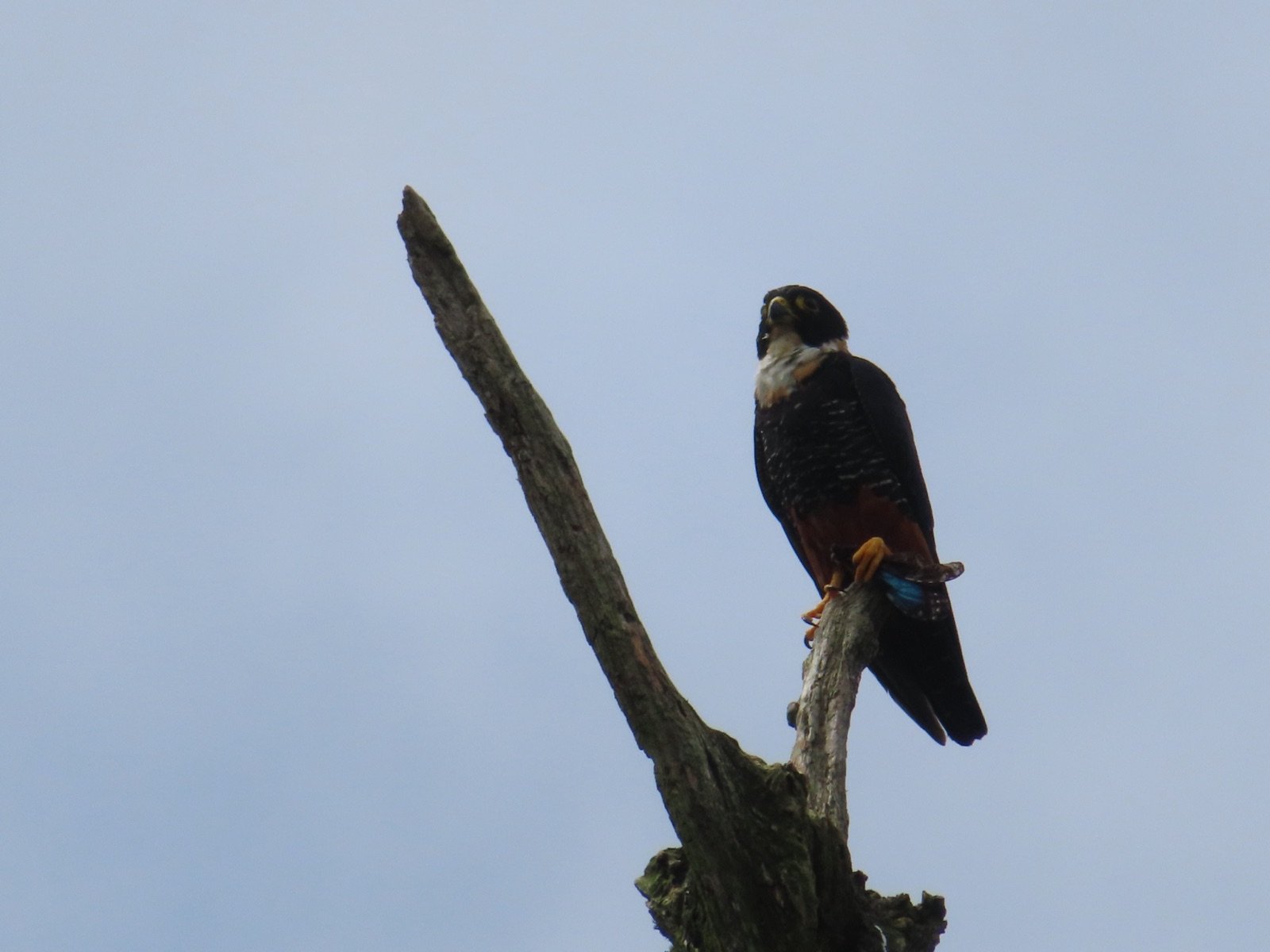
A small dark falcon on the tallest bare snag, quick to dive on prey
The Bat Falcon (Halcón Cuelliblanco, Falco rufigularis) is a small falcon that chases fast-flying prey from a high perch, diving diagonally. Swallows, swifts, hummingbirds and even bats are on its menu.
In Costa Rica it is a resident of the lowlands and intermediate elevations, found locally on both slopes. On trips we build, guests often meet it on roadside and river birding, on Carara area and Tarcoles tours, and on Cano Negro boat trips.
For a beginner it is a rewarding bird to learn: once you know to scan the very tops of dead trees, a perched falcon is often in plain view.
How to find it
Scan snags and tall bare treetops along roads and river canyons. The larger female is the more obvious one, often sitting on the very top of a snag. A calling bird can lead you to the smaller male. Open views help: a raptor tower or open fields with tall trees over the Carara area gave good looks at perched birds. A guide suggests a boat tour at Laguna del Lagarto if you want to watch one catch a bat.
How to recognise it
Look for these marks on an adult:
A dark blue-black head and back.
A white to buff throat and upper chest.
A finely barred black chest and sides.
Rufous chestnut thighs and rear belly.
Dark brown eyes, with yellow bare skin around the eye and yellow feet.
The female is clearly bigger than the male. Across the species' range, females measure about 30 cm and the smaller males about 23 to 25 cm. Many Costa Rican birds show a rusty band around the white throat and chest. It is a small falcon, but larger than a Merlin or an American Kestrel. In flight it often resembles a White-collared Swift.
What it sounds like
Behaviour and diet
The Bat Falcon is solitary. It watches from a high perch, then chases fast-flying prey and dives diagonally. Its flight is fast, with strong, shallow wingbeats.
Prey includes swallows, swifts, some bats, hummingbirds, parakeets and small waterbirds. Large insects are taken too, and lizards and mice only now and then. A Costa Rican guide says it hunts most at dawn and dusk, when it also takes bats.
Someone in Costa Rica once saw one pluck and eat small green fruits from a tree, which is very unusual for a falcon. It nests in a bare cavity high in a tree, either natural or made by a woodpecker. The clutch is 2 or 3 whitish eggs with dense brown speckles.
Where it lives
It prefers humid forest edges, tall trees in open ground or near rivers and ponds, cacao and other tree plantations, and mangroves.
It is a resident of the lowlands and intermediate elevations up to 1675 m, found locally on both slopes and mostly in humid areas. One Costa Rican source says it is rare in the dry north Pacific. Another group says it is rare up to 2900 m and that it has even been recorded in the capital, San José.
When to see it
It breeds in the dry season in Costa Rica, and one guide says it hunts most at dawn and dusk.
Similar birds
Many Costa Rican Bat Falcons show a rusty band around the white throat and chest, like the Orange-breasted Falcon. That species has no official Costa Rican reports in at least 60 years, so be careful. The Orange-breasted is about Peregrine size, with much larger legs and toes and striking face markings that the Bat Falcon lacks.
Names and lore in Costa Rica
The official Costa Rican Spanish name is Halcón Cuelliblanco. Other Spanish names for the species include Halcón Murcielaguero, Halcón Enano, Halcón Negro Chico and Halcón Plomizo Menor.
Status and conservation
The AOCR list marks it as a resident (R), and it is Least Concern globally, though a Costa Rican wildlife guide lists its population trend as decreasing.
Photography tips
A pair that hunts the Sarapiqui canyon often sits on snags near the road, with the bigger female on the very top. One calling bird led observers to a smaller male. Open views from a tower or open fields help.
How we know this 17 sources, each read on the date shown
- Flickr (Costa Rican natural history text, Halcón Cuelliblanco) read 2026-11-04
https://www.flickr.com/photos/jobando/29804366576 - Animalia.bio (from Wikipedia) read 2026-11-04
https://animalia.bio/bat-falcon - Birdingcraft read 2026-11-04
https://birdingcraft.com/wordpress/2020/06/11/braking-for-bat-falcons-at-the-socorro-canyon/ - The Peregrine Fund read 2026-11-04
https://peregrinefund.org/explore-raptors-species/falcons/bat-falcon - Birdingcraft read 2026-11-04
https://birdingcraft.com/wordpress/tag/raptors/ - Birdingcraft read 2026-11-04
https://birdingcraft.com/wordpress/costa-rica-birding-hotels/ - Field Guides trip list read 2026-11-04
https://fieldguides.com/triplists/cr215.html - Field Guides trip list (Deep South 2023) read 2026-11-04
https://fieldguides.com/triplists/cr123.html - Birdingcraft read 2026-11-04
https://birdingcraft.com/wordpress/2019/08/26/the-birding-tower-at-cerro-lodge/ - Fundación Rapaces de Costa Rica (Facebook) read 2026-11-04
https://m.facebook.com/rapacesdecostarica/photos/a.447270028625008/542436259108384/ - Birds of Colombia (Costa Rica pages) read 2026-11-04
https://www.birdsofcolombia.org/costarica/Falco.html - Fauna Decomisada Costa Rica guide read 2026-11-04
https://www.faunadecomisada.go.cr/guia-de-especies/aves/falconidae/falco-rufigularis - Avibase read 2026-11-04
https://avibase.bsc-eoc.org/species.jsp?avibaseid=EF9568DE5FD1E028 - Costa Rica Living and Birding read 2026-11-04
https://birdingcraft.com/wordpress/2013/02/11/cool-falcons-in-costa-rica/ - Eagle-Eye Tours read 2026-11-04
https://www.eagle-eye.com/tour/costa-rica-sampler-birding-tour/ - Costa Rica Living and Birding read 2026-11-04
http://birdingcraft.com/wordpress/2011/05/02/good-mixed-flocks-during-recent-birding-at-quebrada-gonzalez/ - Costa Rica Living and Birding read 2026-11-04
http://birdingcraft.com/wordpress/