Family Tyrannidae
Ash-throated Flycatcher
Myiarchus cinerascens
In Spanish: Copetón Garganticeniza (Tontillo)
- A
An accidental winter stray from the north, easily mistaken for Nutting's.
The Ash-throated Flycatcher (Copetón Garganticeniza, also called Tontillo) is not a bird to plan a trip around. The official Costa Rican list marks it A, accidental, and IUCN distribution data lists Costa Rica as a vagrant country for it.
The reason is geography. Birds that migrate south along the Pacific coast of Mexico and Central America only rarely reach Nicaragua and Costa Rica, so this country sits at the very edge of the winter range. Costa Rica has no resident population, and any bird seen here is a stray from the north.
For a beginning birder it is a good lesson in how alike the Myiarchus flycatchers are, and in why an ear for calls matters as much as a good look.
How to find it
Realistically, a sighting would be a lucky surprise rather than a target. The regional checklist for Guanacaste province labels it rare or accidental, so northwestern Costa Rica is the part of the country to keep in mind. In winter the species turns up in varied places elsewhere, such as woodland patches, hedgerows, secondary scrub and forest edges, so those are sensible places to check. In Guanacaste, a Myiarchus that looks like an Ash-throated is far more likely to be a Nutting's. Because many Myiarchus are quiet in winter, a guide who knows the calls is a real help.
How to recognise it
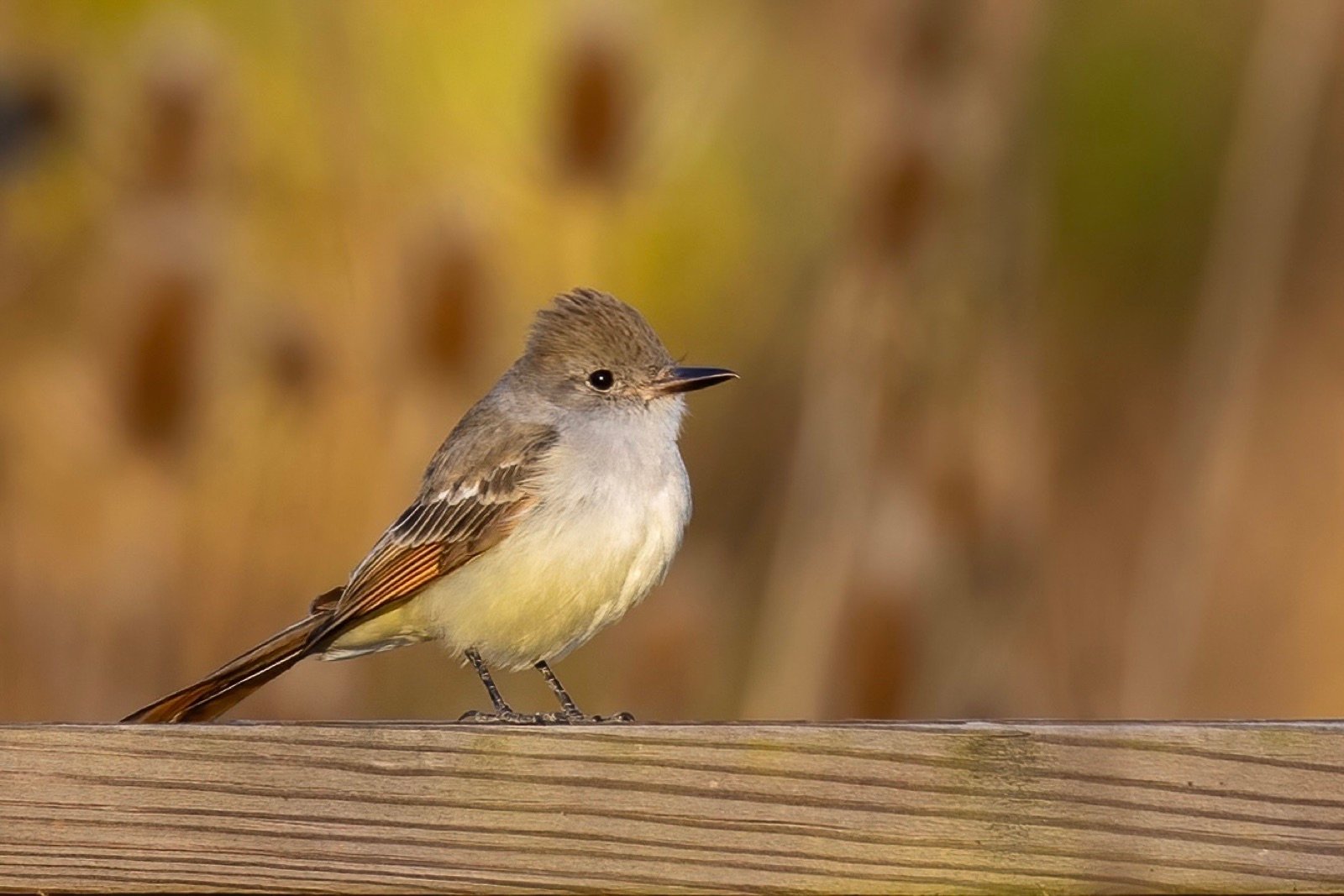
This is a plain, pale flycatcher, and the details are small.
Upperparts: olive brown.
Head: darker, with a short crest.
Breast: gray.
Belly: very pale yellow.
Wings and tail: rufous edges.
Wing bars: two, and dull.
These marks describe the species in general, not Costa Rican birds in particular. It looks extremely like other Myiarchus flycatchers, so plumage alone rarely settles the identification. The pale look, the whitish throat and the very pale yellow belly are the clues that help most.
What it sounds like
Recording: Jonathan Layman, CC BY 4.0, source, read 4 Nov 2026.
Behaviour and diet
It mostly eats insects, taking them from the ground or from foliage in the undergrowth after flying out from a perch. It also eats some fruit, especially in winter when insects are scarce. While perched in low trees it tips its head from side to side as if curious, and its notes sputter out through the morning, which often gives away where it is.
Where it lives
On its breeding grounds this is a bird of arid and semiarid scrub, open woodland and streamside woods in dry regions, from sea level up to about 2000 m. That describes the breeding range, not Costa Rica.
The nominate subspecies breeds in the semiarid western USA and western Mexico, and winters south to northern Costa Rica. In winter the species uses more varied places than when breeding, including parks, woodland patches, hedgerows in farmland, desert streamside oases, secondary scrub and forest edges.
When to see it
The nominate subspecies winters south to northern Costa Rica, so any Ash-throated here would be a winter bird.
Similar birds
Costa Rica's Myiarchus flycatchers include Dusky-capped, Panama, Nutting's, Great Crested and Brown-crested. Compare Nutting's Flycatcher and the bigger-billed Brown-crested Flycatcher, and rely on voice, the safest way to separate them. The Ash-throated is the rarest of them here.
Names and lore in Costa Rica
Costa Rica's Spanish name is Copetón Garganticeniza, and the official list adds the nickname Tontillo, which is shared by the Myiarchus flycatchers. Other countries use different names, such as copetón gorjicenizo in Mexico, chilero cuelligrís in Honduras and güis gorgipálido in Nicaragua. Its look-alikes carry their own names here: Copetón Crestioscuro for Dusky-capped, Copetón Colipardo for Panama and Copetón de Nutting for Nutting's.
Status and conservation
The official Costa Rican list (AOCR) marks it A, accidental, while the IUCN rates the species Least Concern because its range is huge, its population very large and numbers generally rising.
Photography tips
Look for it perched low in trees, where it tilts its head from side to side. Its sputtering morning notes often give away where it is. Check size and tail pattern carefully, as a birder photographing a Myiarchus in Guanacaste in January found when ruling out Ash-throated and Nutting's.
How we know this 15 sources, each read on the date shown
- Lista Oficial de las Aves de Costa Rica (AOCR) read 2026-11-04
https://listaoficialavesdecostarica.wordpress.com/lista-oficial/lista-oficial-online/ - Featherbase (IUCN 2025 data) read 2026-11-04
https://www.featherbase.info/es/species/myiarchus/cinerascens - NaturaLista Colombia (Wikipedia text) read 2026-11-04
https://colombia.inaturalist.org/taxa/16010-Myiarchus-cinerascens - Avibase read 2026-11-04
https://avibase.bsc-eoc.org/species.jsp?avibaseid=E0A049851AD70991 - Wikipedia read 2026-11-04
https://en.wikipedia.org/wiki/Ash-throated_flycatcher - BirdLens (Wikipedia and Cornell-style summary) read 2026-11-04
https://birdlens.secondwindltd.xyz/en/birds/c5b853c8fb - Wikipedia (Spanish) read 2026-11-04
https://es.wikipedia.org/wiki/Myiarchus_cinerascens - Avibase Guanacaste checklist read 2026-11-04
https://avibase.bsc-eoc.org/checklist.jsp?region=CRgu&list=howardmoore - Avibase read 2026-11-04
https://avibase.bsc-eoc.org/species.jsp?avibaseid=40AF6E176D0E5F9C - Wikipedia: List of birds of Costa Rica read 2026-11-04
https://en.wikipedia.org/wiki/List_of_birds_of_Costa_Rica - All About Birds (Cornell) read 2026-11-04
https://www.allaboutbirds.org/guide/Ash-throated_Flycatcher/overview - ResearchGate (Murphy 1982 overview) read 2026-11-05
https://www.researchgate.net/publication/242415689_The_Ash-throated_Flycatcher_in_the_East_An_overview - Bird Watching Costa Rica read 2026-11-05
http://www.birdwatchingcostarica.com/familia/tyrannidae/ - BirdForum read 2026-11-05
https://www.birdforum.net/threads/costa-rica-guanacaste-flycatcher-vireo.389325/ - Birding Depot read 2026-11-05
https://birdingdepot.com/ash-throated-flycatcher/