Family Thraupidae
Bananaquit
Coereba flaveola
In Spanish: Reinita Mielera (Pincha Flor, Santa Marta)
- Resident
Tiny nectar thief with a white eyebrow, common in gardens and forest edges.
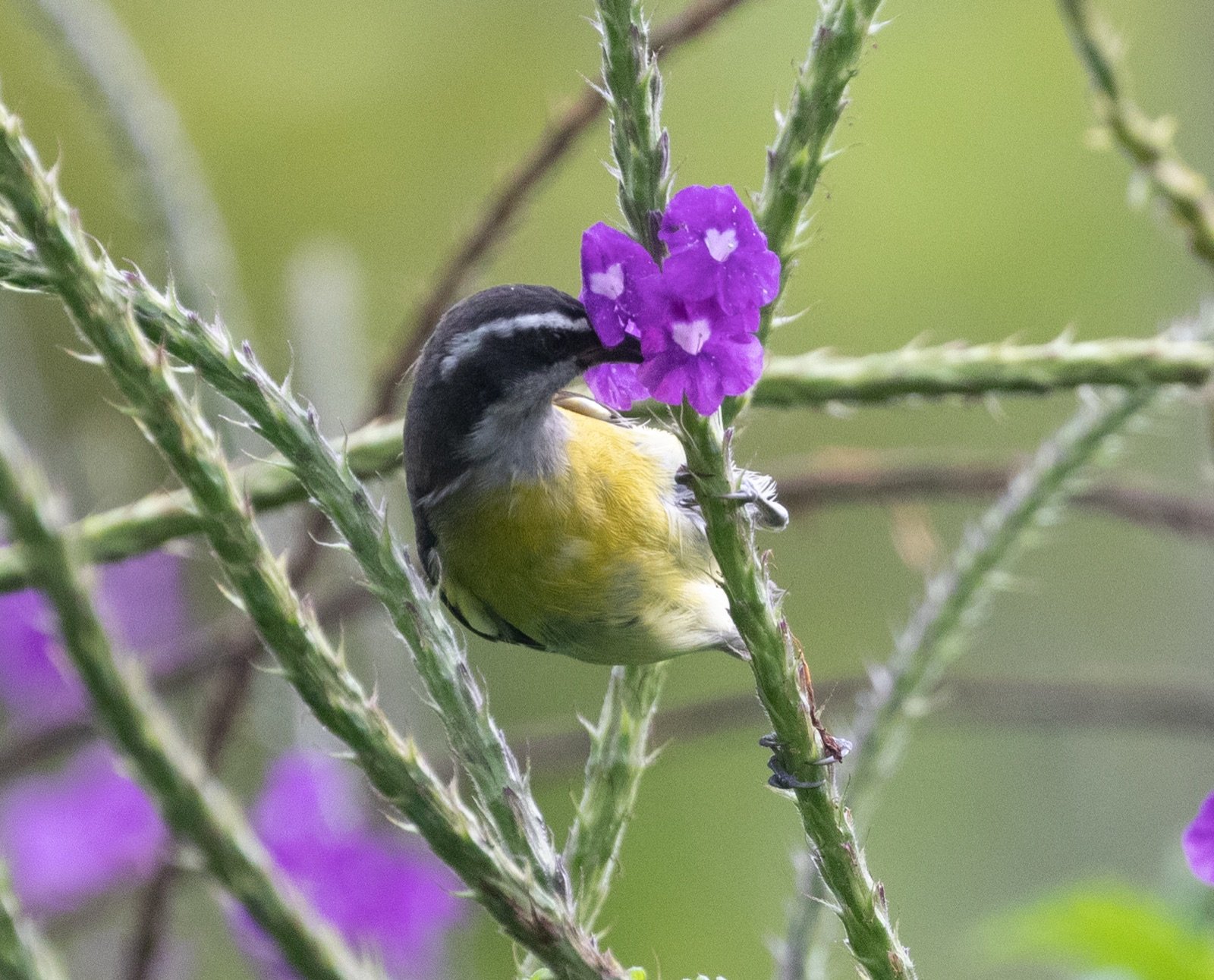
The Bananaquit is described as one of the most common and widespread birds in Costa Rica. It is a tiny, chubby bird with a curved bill, a black back and head, yellow underparts and a bold white eyebrow.
It lives in the wet lowlands on both slopes, from sea level up to about 1,600 m, and it is not a migrant, so it is here all year. It is a familiar sight in gardens and at forest edges, especially where many plants are flowering.
It often comes to feeders for bananas and oranges, which makes it a friendly first bird for a beginner.
How to find it
Start in open country: forest edges, fields, secondary forest and gardens. It turns up wherever many flowers are in bloom. Listen for the raspy, shrill song, then look for a small bird clinging to the blossoms. It moves quickly and calls often, so it is easy to detect even when partly hidden. It may also join mixed flocks passing through the canopy. Feeders are the easiest option: it takes bananas and oranges and also drinks from hummingbird sugar-water feeders.
How to recognise it
Look for a tiny, chubby bird with a curved bill.
Adults are black above, on the back, head and tail. Below, they are bright yellow, and the rump is yellow too. The throat is gray.
The two marks to check first are the broad white eyebrow stripe and the white wing spot, which shows as a patch on the wing.
Males and females look alike, so there are no sexes to sort out. Young birds are paler, grayish-green above and yellowish below, with only a faint eyebrow.
It cannot hover like a hummingbird, so it perches to feed, which gives you a good look at those marks.
What it sounds like
Recording: Daniel Linzbauer, CC BY 4.0, source, read 4 Nov 2026.
Behaviour and diet
Bananaquits are usually found in pairs or small family groups. They are bold, active feeders that cling to flowers on flowering trees and shrubs, and they often hang head down to probe small blooms. They pierce the base of flowers to steal nectar, pick small insects and spiders from leaves and trunks, and puncture berries to drink the juice.
The nest is a loose, rounded ball hanging from a branch tip, with a side entrance. A quick, smaller nest is built for roosting only. Nests go up all year, and the breeding season is so long that several broods are possible. At Monteverde the display is bowing and bobbing while showing the yellow tail feathers, and pairs lay two pale eggs.
Where it lives
In Costa Rica the Bananaquit lives in the wet lowlands on both slopes, from sea level up to about 1,600 m. In the lowlands it is most common in semi-open and shrubby areas. At middle elevations it looks for flowers in the canopy and at the edges of moist to wet forest.
It also feeds in clearings, plantations, gardens and parks. A regional guide says it is found throughout Costa Rica and Panama except the highlands. Across its whole range it is rare or absent in dense forest and above about 2,000 m.
When to see it
It lives in Costa Rica all year. Breeding goes on nearly all year, except March to May on the south Pacific slope and July to September in the Caribbean lowlands, and local flowering changes the timing.
Similar birds
It looks a bit like a warbler, but the bill is thin and clearly downcurved. The bold white eyebrow and curved bill together set it apart from warblers and euphonias, which are also yellow below. Its round, domed nests, used year-round for raising young and for sleeping, are another difference. One guide compares the pattern to a miniature Great Kiskadee, but the tiny size and white wing spot set it apart.
Names and lore in Costa Rica
Costa Ricans call it Reinita Mielera, which means honey warbler. Other Spanish names are Pincha Flor, Santa Marta, Cazadorcita and Picaflor. Elsewhere it goes by names such as platanero, azucarero or cigüita. Its German and French names both mean 'sugar bird', from its habit of competing with hummingbirds for nectar.
Status and conservation
The AOCR lists the Bananaquit as a resident (R), and the IUCN classes it as Least Concern.
Photography tips
It perches to feed, so flowering shrubs and feeders give the best chances of a still bird. Watch for it hanging head down at small flowers. Because it calls often, listen first and then scan the blooms.
How we know this 16 sources, each read on the date shown
- Costa Rica Birding Trips read 2026-11-04
https://www.costaricabirdingtrips.com/incertae-sedis/bananaquit-coereba-flaveola - Monteverde Cloud Forest Reserve page (Anywhere.com), citing Henderson's field guide read 2026-11-04
https://www.anywhere.com/flora-fauna/bird/bananaquit - Wikipedia read 2026-11-04
https://en.wikipedia.org/wiki/Bananaquit - Migration Research Foundation, Costa Rican Birds ID Library read 2026-11-04
https://migrationresearch.org/CRbirds/bana.html - Birds for Beer read 2026-11-04
https://birdsforbeer.com/2020/10/05/in-my-costa-rican-garden-bananaquit/ - Birds of the World (Cornell Lab) read 2026-11-04
https://birdsoftheworld.org/bow/species/banana/cur/introduction - All About Birds, Cornell Lab read 2026-11-04
https://www.allaboutbirds.org/guide/Bananaquit/sounds - Animales En Via De Extincion (Spanish field guide text) read 2026-11-04
http://animalesenviadeestinxion.blogspot.com/2011/11/reinita-mielera-coereba-flaveola.html - Birds & Breakfast Costa Rica read 2026-11-04
https://birdsandbreakfast.com/en/bananaquit/ - BirdIdentifier.com read 2026-11-04
https://birdidentifier.com/encyclopedia/bananaquit/bananaquit-identification-guide - Wikipedia (es) read 2026-11-04
https://es.wikipedia.org/wiki/Coereba_flaveola - Birds of the World read 2026-11-04
https://birdsoftheworld.org/bow/species/banana/cur/introduction?lang=es - North American Birds read 2026-11-04
https://namericanbirds.wordpress.com/explore-species/passeriforms/coerebidae/bananaquit-coereba-flaveola/ - Costa Rica Monkey Tours read 2026-11-04
https://costaricamonkeytours.com/costarica-travelguide/wildlife/birds/the-bananaquit-of-costa-rica/ - Ecos del Bosque read 2026-11-04
https://ecosdelbosque.com/fauna/coereba-flaveola - Animalia.bio read 2026-11-04
https://animalia.bio/bananaquit