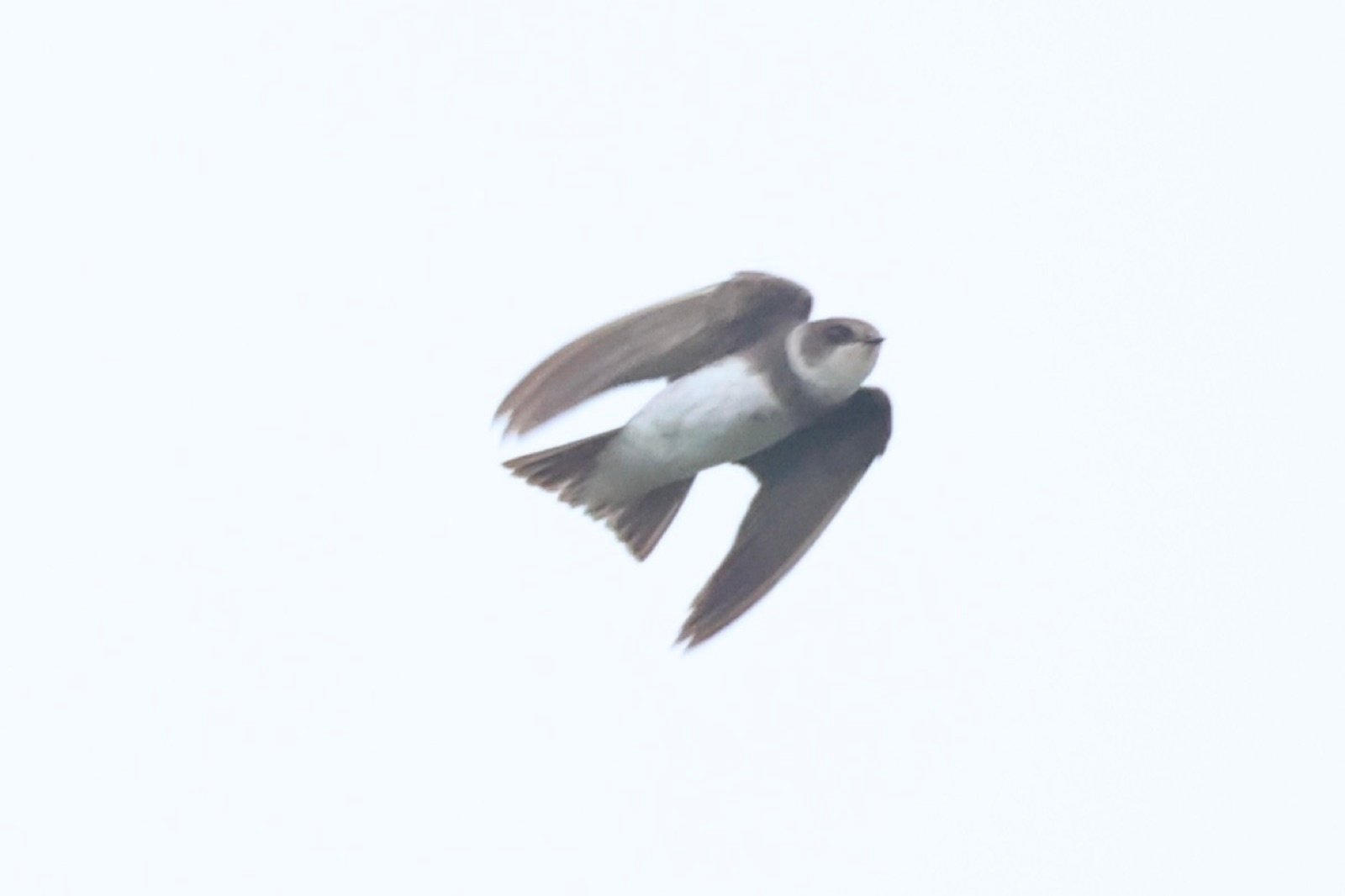
Family Hirundinidae
Bank Swallow
Riparia riparia
In Spanish: Golondrina Ribereña
- Migrant
Small migrant swallow with a dark chest band, passing along both coasts.
The Bank Swallow, Golondrina Ribereña in Spanish, is a small swallow that passes through Costa Rica on migration. In fall it is abundant through the lowlands of both slopes, especially along both coasts.
It breeds far to the north, so here you meet it on the move. Migrants may stay a few minutes or several days where food is plentiful.
On a trip we build, the coast is the place to look: large numbers fly over Cahuita National Park on the Caribbean side during migration periods, often alongside Barn Swallows.
How to find it
Scan the coast during migration, because big numbers pass over coastal areas such as Cahuita. Look for it feeding in flight over or near water, even on migration. It often mixes with other swallows, so go through each flock slowly and check for the dark chest band. Watch the lower layer of a flock, since it often flies lower than Barn and Cliff Swallows. Fresh-cut grass, harvested fields, ponds and marshes can hold birds that have stopped to feed.
How to recognise it
Look for these marks:
- Size: small, about 11.5 cm long.
- Throat: white.
- Chest: a distinct dark band across it.
- Upperparts: grayer than the rough-winged swallows of the genus Stelgidopteryx.
The chest band is the mark that sets it apart. Add the small size and the quick, jerky flight, and you have the combination that separates it from the Tree Swallow, Cliff Swallow and House Martin. Faster wingbeats than a rough-winged swallow are another clue when a mixed flock sweeps past.
What it sounds like
Recording: Susan Marley, CC BY 4.0, source, read 4 Nov 2026.
Behaviour and diet
It eats almost only insects caught in flight, so you will nearly always see it on the wing. It is sociable and often travels in flocks with other swallows. In Costa Rica it migrates with Barn and Cliff Swallows and often flies lower than they do.
The flight is fluttery and fast with short glides, and the bird changes course often while chasing insects.
Where it lives
In Costa Rica it is an abundant fall migrant through the lowlands of both slopes, especially along both coasts. It reaches up to about 1500 m in the Central Valley and is rare inland.
Migrants stop where food is plentiful: freshly harvested fields, newly cut grass, pastures, ponds and marshes. In winter it is mainly near marshes and flooded pastures.
When to see it
The fall passage runs from late August or early September until early November. A second passage in spring is abundant along both coasts from early March to mid May.
Similar birds
The Northern Rough-winged Swallow is warmer brown with a dusky throat and no brown breast band, and the Bank Swallow is smaller with faster wingbeats. A female Purple Martin, another migrant through Costa Rica, lacks the crisp dark bar across the upper chest that the smaller Bank Swallow shows. The Brown-chested Martin, a South American species, has a dark chest band too but is larger, and it has had no verified reports in Costa Rica in about 30 years.
Names and lore in Costa Rica
Costa Ricans use Golondrina Ribereña, and the plain name Golondrina also appears in the Costa Rican field guide entry. Another Spanish name is avión zapador. The Latin genus name Riparia refers to river banks, where it digs its nest burrows.
Status and conservation
The AOCR list marks it as a migrant (M), and globally it is Least Concern with a large and widespread population.
Photography tips
On migration, flocks of several hundred mixed with other swallows can gather at roost sites such as tall grasses, bushes, trees and wires near places rich in insects. Perched birds are far easier to study than fast fliers.
How we know this 14 sources, each read on the date shown
- Flickr (Costa Rica natural history text) read 2026-11-04
https://www.flickr.com/photos/jobando/44276852194 - Audubon Field Guide read 2026-11-04
https://www.audubon.org/field-guide/bird/bank-swallow - Wikipedia read 2026-11-04
https://en.wikipedia.org/wiki/Sand_martin - Cornell Lab of Ornithology read 2026-11-04
https://www.birds.cornell.edu/landtrust/bank-swallow-bans/ - Animal Diversity Web read 2026-11-04
https://animaldiversity.org/accounts/Riparia_riparia/ - Museo Nacional de Costa Rica read 2026-11-04
https://www.museocostarica.go.cr/nuestro-trabajo/investigaciones/historia-natural/cahuita/ - Gramaticalia read 2026-11-04
https://gramaticalia.com/definicion/riparia-riparia - COSEWIC status report read 2026-11-04
https://www.registrelep-sararegistry.gc.ca/virtual_sara/files/cosewic/sr_hirondelle_rivage_bank_swallow_1213_e.pdf - Garrison species account (SITES project) read 2026-11-04
https://sitesproject.org/wp-content/uploads/2023/11/Garrison_1998_Bank-Swallow-Riparia-riparia-Species-Account.pdf - Government of Canada recovery strategy read 2026-11-04
https://www.canada.ca/en/environment-climate-change/services/species-risk-public-registry/recovery-strategies/bank-swallow-proposed-2021.html - Birds for Beer (John Beer) read 2026-11-04
https://birdsforbeer.com/2022/09/29/costa-ricas-official-bird-species-list-now-confirmed-at-923/ - Cornell Birds of the World read 2026-11-04
https://birdsoftheworld.org/bow/species/brcmar1/cur/multimedia?media=photos - Cornell All About Birds read 2026-11-04
https://www.allaboutbirds.org/guide/Purple_Martin/species-compare/ - Cornell All About Birds read 2026-11-04
https://www.allaboutbirds.org/guide/Bank_Swallow/id