Family Thamnophilidae
Barred Antshrike
Thamnophilus doliatus
In Spanish: Batará Barreteado
- Resident
A zebra-striped lowland antbird, easier to hear than to see.
The Barred Antshrike (Batará Barreteado) is a small lowland antbird, about 16 cm long and 28 g, with a shaggy crest and pale yellow eyes. A resident birder called it perhaps the easiest antbird for a visitor to find and identify, which is a real gift in a country where all 22 antbirds tend to hide in thick undergrowth.
The male is striped like a zebra and the female is plain brown, yet their voices are alike. A Costa Rica bird guide says the male is always fun to see, even though the species is widespread.
On a trip we build, this is a bird to listen for first: follow the chuckling duet, then look into the nearby tangles.
How to find it
Listen first. This antbird skulks in thick undergrowth, so birders trace the pair by its chuckling duet and growled calls, then look into the nearby tangles. It prefers dense growth and avoids the interior of mature forest, so try second growth scrub, riparian thickets, edges of dry woodland and secondary forest, and even gardens. Around La Fortuna and Arenal it turns up where vegetation has been left to grow back, so overgrown edges and regrowth are good places to look. Early morning, when song peaks, gives the best chance. One birding tour saw a few at the forest edge at Caño Negro in the far north.
How to recognise it
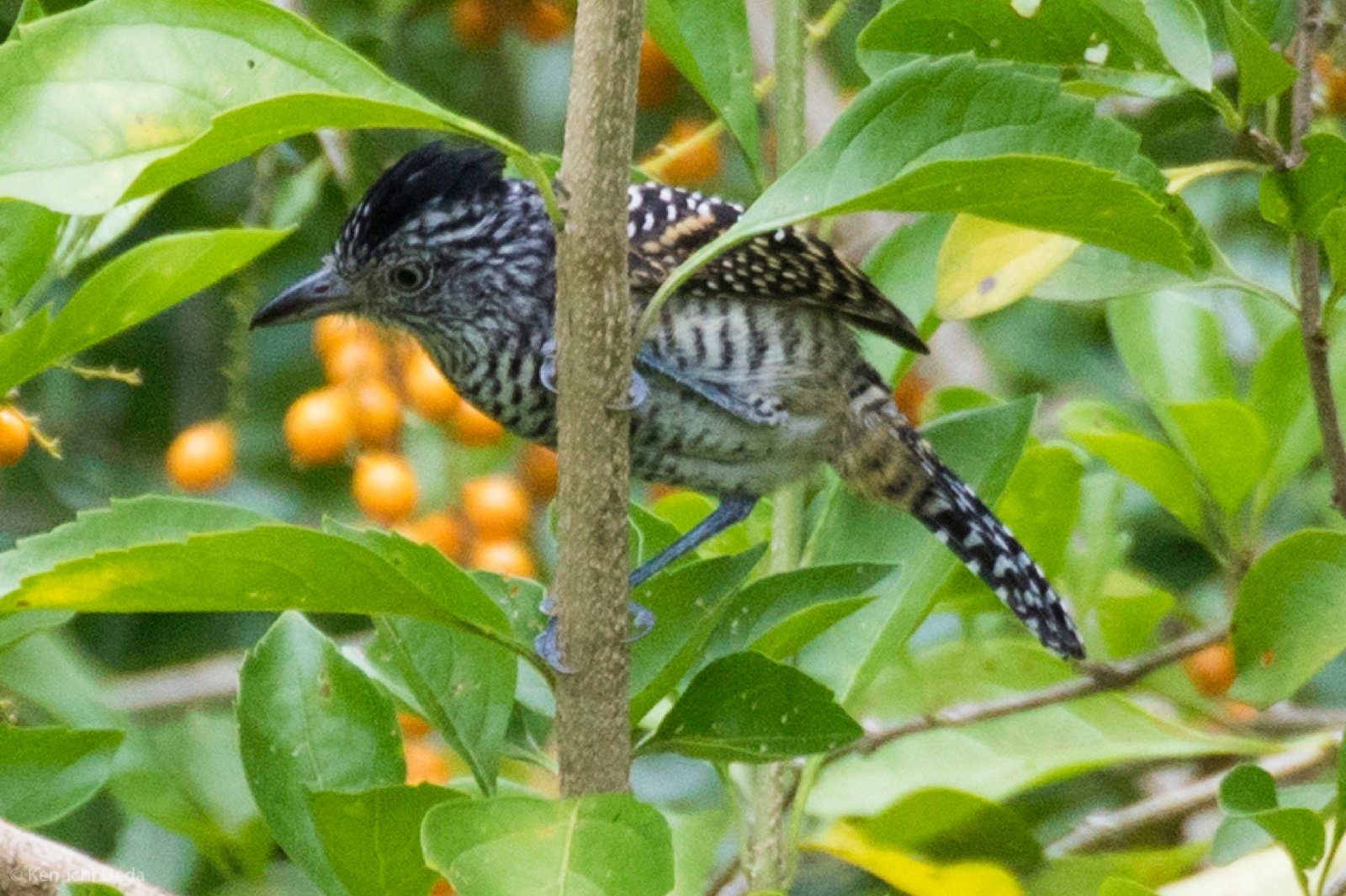
This is a small bird, about 16 cm long and 28 g, with a shaggy crest and pale yellow eyes. The hooked bill is slimmer than the Fasciated Antshrike's. The sexes look very different.
The adult male has a black crown with a hidden white base. His back is black with coarse white bars, and his underparts are evenly barred black and white. The result is the zebra look that makes him easy to name.
The female has a rusty chestnut crown and rusty upperparts. Her head sides and nape collar are streaked black and white, and her underparts are pale buff, lighter on the throat and belly.
What it sounds like
Behaviour and diet
Barred Antshrikes are usually seen as territorial pairs. Male and female perch very near each other when they duet, and they often fan the tail and bob the head as they sing. Pairs stretch the neck, bow forward and pump the tail while singing. The bird often bends over to show a bright white patch on the back of its crown, which is the hidden white base of the male's black cap.
It eats ants and other arthropods at or near the ground. It sometimes follows army ant columns and occasionally takes small lizards and berries.
Where it lives
In Costa Rica this is a bird of forest edges and secondary growth, and it is also found in gallery forest. It is less often inside forest. It is resident in the lowlands of both the Caribbean and Pacific slopes and reaches up to about 1,400 m.
It is uncommon and local in the wet regions, but common in the dry northwest and in the lowlands south of Lake Nicaragua.
When to see it
It is a year round resident. In Costa Rica it breeds from January to June, when pairs are most vocal, and singing in a Costa Rican study peaked at dawn.
Similar birds
The Fasciated Antshrike (Cymbilaimus lineatus) is larger, with a heavier hooked bill, and has dark eyes rather than the pale yellow eyes of this species. The Barred Antshrike's slimmer, thinner bill and smaller size help separate them.
Names and lore in Costa Rica
In Costa Rica the bird is called Batará Barreteado. Other Spanish speaking countries use different names, such as batará barrado in Colombia, Mexico and Peru, and hormiguero rayado in Honduras.
Status and conservation
It is a resident on the AOCR list, and its range runs from Mexico through Central America to northern Argentina.
Photography tips
Because the birds sing as close pairs, finding one usually means finding both, so you can often frame the striped male and the rusty female together. Track the duet, then watch the tangles at the edge of the thicket for a bird perched to sing, head bobbing and tail fanned.
How we know this 23 sources, each read on the date shown
- Aves de Costa Rica read 2026-11-04
https://www.avesdecostarica.com/Thamnophilus-doliatus.html - JungleDragon (Wikipedia text) read 2026-11-04
https://www.jungledragon.com/specie/6632/barred_antshrike.html - Birds of the World (Cornell) read 2026-11-04
https://birdsoftheworld.org/bow/species/barant1/cur/introduction - World Bird Photos read 2026-11-04
https://www.worldbirdphotos.com/photo/antshrike-barred-thamnophilus-doliatus-costa-rica/ - Flickr photo tags read 2026-11-04
https://www.flickr.com/photos/tags/bataras/ - Kiddle (Spanish Wikipedia text) read 2026-11-04
https://ninos.kiddle.co/Batar%C3%A1_barrado - Wikipedia (Spanish) read 2026-11-04
https://es.wikipedia.org/wiki/Thamnophilus_doliatus - Birds Colombia (quoting Wikipedia) read 2026-11-04
https://birdscolombia.com/2019/01/02/batara-barrado-barred-antshrike-thamnophilus-doliatus/ - Crónica (citing Birds of the World) read 2026-11-04
https://www.cronica.com.mx/academia/2026/04/23/el-canto-del-batara-barrado-una-conversacion-en-la-espesura/ - Wikipedia read 2026-11-04
https://en.wikipedia.org/wiki/Barred_antshrike - Wikiwand (Wikipedia) read 2026-11-04
https://www.wikiwand.com/en/Barred_antshrike - Field Guides trip list read 2026-11-04
https://fieldguides.com/triplists/cr217.html - Birds for Beer (Turrialba) read 2026-11-04
https://birdsforbeer.com/2019/05/24/new-species-in-my-garden/ - Cornell Birds of the World read 2026-11-04
https://neotropical.birds.cornell.edu/Species-Account/nb/species/barant1/overview - Wikipedia (ast) read 2026-11-04
https://ast.wikipedia.org/wiki/Thamnophilus_doliatus - Birding Craft read 2026-11-04
https://birdingcraft.com/wordpress/category/biodiversity/page/11/ - Dan Mennill's Bird Songs of Costa Rica (Univ. of Windsor) read 2026-11-04
https://web2.uwindsor.ca/courses/biology/dmennill/CostaRica/CRSongs.html - Birding Craft read 2026-11-04
https://birdingcraft.com/wordpress/tag/barred-antshrike/ - Birding Craft read 2026-11-04
https://birdingcraft.com/wordpress/category/costa-rica-bird-finding-guide/ - Costa Rica Focus read 2026-11-04
https://www.costaricafocus.com/top-ten-birding-destinations-in-costa-rica/ - Exotic Birding read 2026-11-04
http://www.exoticbirding.com/costarica/tapanti-national-park/checklist.html - Journal of Ornithology (Koloff and Mennill) read 2026-11-04
https://link.springer.com/article/10.1007/s10336-012-0867-6 - Birding Craft read 2026-11-04
https://birdingcraft.com/wordpress/2011/05/23/recent-birding-at-tapanti-national-park/