Family Thamnophilidae
Great Antshrike
Taraba major
In Spanish: Batará Grande
- Resident
Red-eyed, heavy-billed antbird of tangles, best found by its song
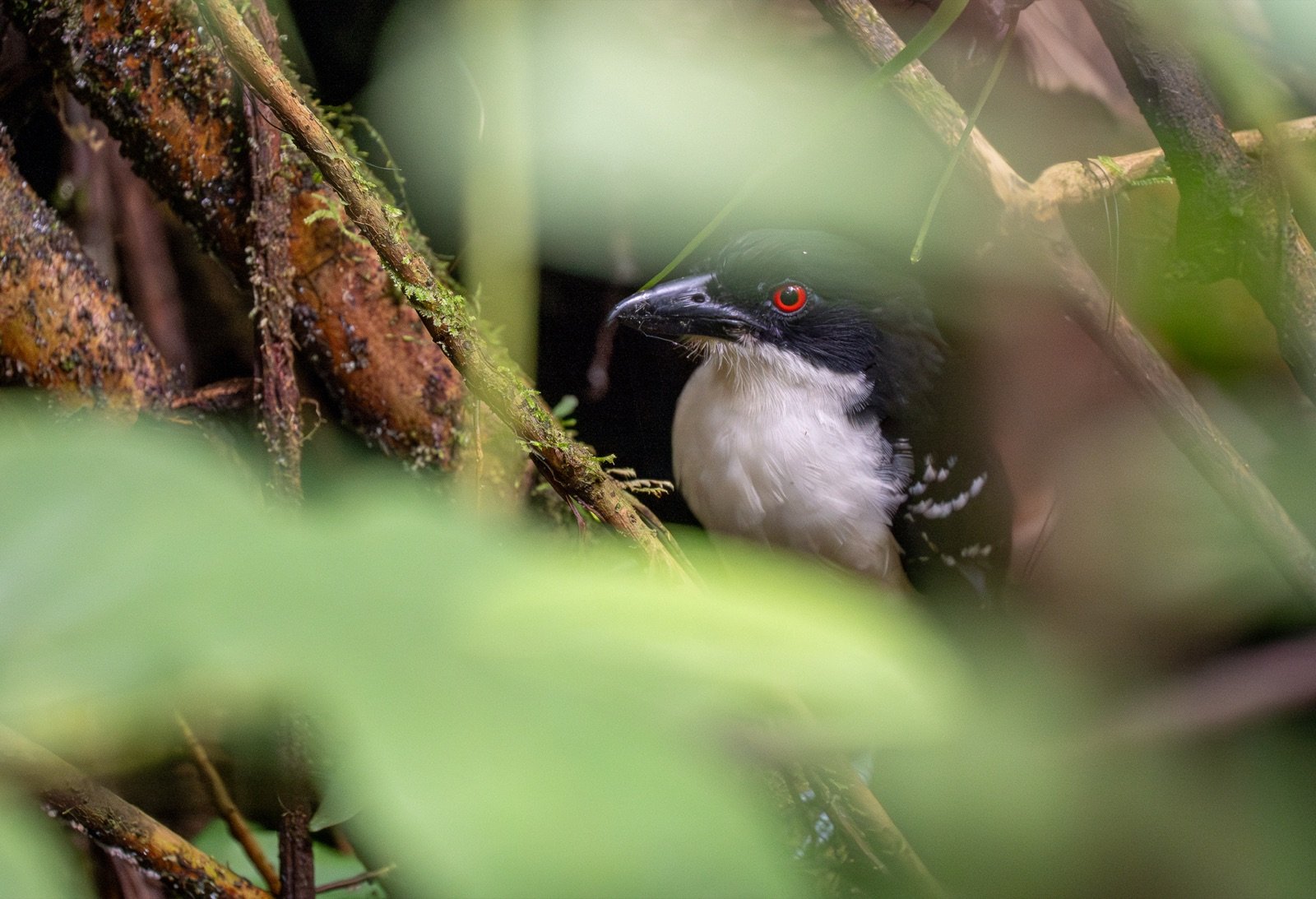
The Great Antshrike, Batará Grande in Costa Rica, is a large antbird of about 20 cm with a bright red eye and a heavy hooked bill. The male is black above and white below, while the female wears rich rufous brown.
It skulks in dense vegetation and usually lives in territorial pairs, so most birders meet its voice well before the bird itself. Its song, a run of 30 to 40 musical notes, is the easiest way to locate it.
On trips we build around the Caribbean lowlands and the north, it is a bird guests can listen for on boat outings and forest trails.
How to find it
Listen first: the song is the easiest way to locate this skulking bird. Pairs call back and forth, so an answering voice can help you pinpoint where to look. Then scan low tangles, scrub and forest edge near the sound. Watch for a bird dropping to the ground to grab prey, as that can bring it into view. At Carara a Costa Rican guide finds it in second growth, where it is less common than at wetter sites. Birds are described as fairly trusting, so patience may be rewarded with a fairly close look.
How to recognise it
Start with the eye: both sexes have a bright red eye. This is a large antbird, about 20 cm long, with a short shaggy crest and a heavy hooked bill. The legs are pale blue-gray.
The male is black above and white below, with two thin white wingbars.
The female has the black replaced by rich rufous brown, and she lacks the white bars on wings and tail.
The male also has a hidden white patch in the middle of the back. It shows during threat displays, so only an agitated bird will reveal it.
What it sounds like
Recording: Chrissy Kondrat, CC BY 4.0, source, read 4 Nov 2026.
Behaviour and diet
This is a skulker of dense vegetation, usually found in territorial pairs, which is why it is so often heard before it is seen. It stays low, about 1 to 5 m above the ground, and forages on the ground and in foliage up to about 2 m.
It moves slowly, hopping from branch to branch in heavy cover. The nest is a deep cup hung from its rim, 1.5 to 2.5 m up in a thicket, often near the edge. Both parents incubate the two to three eggs for about 14 days, and the young fledge about 12 days after hatching.
Where it lives
It lives in dense tangles, clearings, secondary forest, scrub and forest edge, both humid and deciduous. It also turns up in thickets, cocoa and citrus plantations, and sometimes gardens, wherever undergrowth is dense.
In Costa Rica it is a resident on both slopes. One natural history entry says it reaches about 1,400 m in the Central Valley, including the Cartago area, while another gives an upper limit of about 1,100 m. Across most of its range it is found mainly below 1,500 m.
When to see it
Breeding in Costa Rica runs from April to July, so birds should be most active and vocal then.
Names and lore in Costa Rica
In Costa Rica the common Spanish name is batará grande. Other Spanish names include batará mayor and batará blanco y negro, while hormiguero grande is used in Honduras, hormiguero mayor in Nicaragua, and chororó in Argentina and Paraguay.
Status and conservation
The AOCR list marks it as a resident (R), and the IUCN lists it as Least Concern, so it is not at immediate risk of decline.
Photography tips
It moves slowly, hopping from branch to branch in heavy cover and picking prey off leaves and stems. It often drops to the ground to grab prey, which can bring it into view, so watch the base of a tangle as well as the branches.
How we know this 14 sources, each read on the date shown
- Cornell Birds of the World read 2026-11-04
https://birdsoftheworld.org/bow/species/greant1/cur/introduction - Birda read 2026-11-04
https://app.birda.org/species-guide/15938/Great_Antshrike - Naturesongs (Animal Diversity Web) read 2026-11-04
https://www.animaldiversity.org/collections/contributors/naturesongs/gran3/ - Wikipedia (es) read 2026-11-04
https://es.wikipedia.org/wiki/Taraba_major - Observation.org read 2026-11-04
https://observation.org/species/74277/ - Birds Colombia (Spanish) read 2026-11-04
https://birdscolombia.com/2018/03/11/batara-grande-great-antshrike-taraba-major/ - Birding Craft (Costa Rica guide blog) read 2026-11-04
https://birdingcraft.com/wordpress/2013/05/03/carara-can-be-great-for-antbirds/ - Wikipedia-based Spanish text read 2026-11-04
https://www.dailymotion.com/video/x6fdh29 - KimKim read 2026-11-04
https://www.kimkim.com/c/birding-guide-to-costa-rica - Costa Rica Focus read 2026-11-04
https://www.costaricafocus.com/top-ten-birding-destinations-in-costa-rica/ - Wikipedia read 2026-11-04
https://en.wikipedia.org/wiki/Great_antshrike - Wikipedia read 2026-11-05
https://en.wikipedia.org/wiki/Taraba_(bird) - Flickr (Costa Rica natural history text) read 2026-11-05
https://www.flickr.com/photos/jobando/27645473306 - Ornitología Neotropical read 2026-11-05
https://digitalcommons.usf.edu/cgi/viewcontent.cgi?article=1764&context=ornitologia_neotropical